


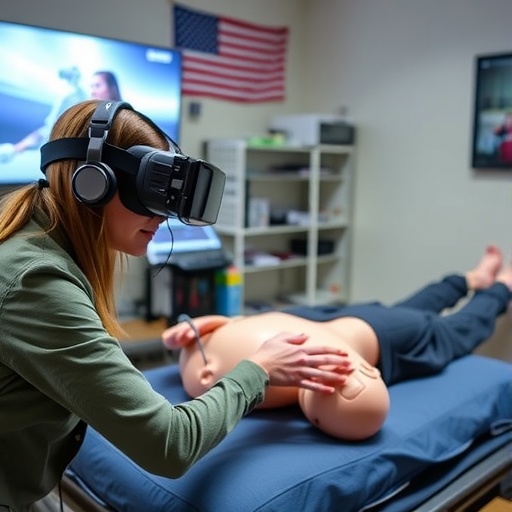
In a groundbreaking exploration of emergency medical training methodologies, researchers led by Al Turki, S., along with collaborators Skaff, D. and Mujlli, G., have conducted a comprehensive summative evaluation comparing the efficacy of Virtual Reality (VR) training against traditional manikin-based training for emergency life-saving skills. Their study, titled “Virtual reality vs. Manikin based training on emergency life saving basic rescue skills: a summative evaluation,” published in BMC Medical Education, promises to ignite discussions among educators and healthcare professionals alike regarding the future of medical training.
The study emerges from an increasingly urgent need to enhance the proficiency of healthcare providers in emergency scenarios. Traditional manikin training has been a staple in teaching critical rescue skills such as CPR and airway management for decades. However, as technology advances, the integration of innovative tools such as virtual reality into training curricula has gained attention for its potentially transformative impact on learning outcomes. The research aims to shed light on whether VR can outperform traditional methods in cultivating essential emergency response skills.
Virtual reality technology has evolved significantly over the years, becoming more accessible and user-friendly. It allows learners to engage in immersive simulations that mimic real-life medical emergencies, providing a unique experiential learning environment. The researchers sought to compare this immersive experience against the more conventional hands-on approach with manikins, assessing not just the immediate skill acquisition but also the retention of these critical competencies over time.
To conduct the study, participants were divided into two groups—one group trained using conventional manikin methods and another employing advanced VR simulations. Each participant underwent rigorous training designed to impart fundamental rescue skills necessary for emergency medical response. Following the training sessions, they were evaluated on their performance through a series of standardized assessments to gauge proficiency and preparedness in real emergency situations.
One of the notable aspects of this research is the consideration of not just the training outcomes but also the participants’ experiences with each modality. While traditional training methods can sometimes be perceived as monotonous or less engaging, VR training offers an interactive platform that fosters a higher level of engagement and motivation. By evaluating the subjective experiences of participants alongside objective skill assessments, the study aims to provide a well-rounded analysis of the effectiveness of VR against manikin-based training.
Initial findings from the summative evaluation revealed promising results for VR training. Participants engaged in virtual scenarios demonstrated higher levels of confidence when performing skills compared to their counterparts trained with manikins. This confidence is crucial in emergency settings, where decision-making and rapid responses can significantly impact patient outcomes.
Moreover, the retention of skills learned through VR training appeared to surpass that of the manikin group over time. The immersive nature of VR not only strengthened immediate recall but also created a mental framework for participants, helping them to transfer learned skills into real-world scenarios with greater ease. The researchers concluded that such an advantage could be indispensable in high-stakes medical environments.
Another critical factor underlined in the study is the cost-effectiveness and scalability of VR training programs. As healthcare systems worldwide grapple with the challenges of training large numbers of professionals within constrained budgets, VR presents a solution that could optimize resource allocation while enhancing training quality. The ability to conduct training remotely in a controlled, standardized environment streamlines the process, potentially leading to widespread adoption in medical education.
In comparing the two methodologies, ethical considerations emerged as a significant aspect of the discussion. With VR training simulating real-life emergencies, the emotional and psychological impacts on trainees must be taken into account. The researchers recommend further exploration into whether VR-induced stress responses could potentially prepare trainees better than traditional methods, fostering resilience in high-pressure situations.
Future implications of this study could extend beyond emergency response training alone. If validated through additional research, the use of VR in educational contexts may revolutionize how medical professionals are trained across various specializations. The potential for VR to address training gaps in critical areas such as surgery, pediatrics, and critical care cannot be overlooked as the technology continues to evolve.
In conclusion, the research conducted by Al Turki, S. and colleagues is poised to influence the trajectory of medical training. As institutions consider integrating technology into their curricula, this study provides empirical evidence supporting the efficacy of VR as a formidable training tool for emergency life-saving skills. The findings not only advocate for innovation in training methods but challenge the status quo of traditional educational frameworks in healthcare.
The discourse surrounding advancements in medical training methodologies is crucial in an era where technology and healthcare increasingly intersect. Stakeholders across the medical community must take heed of such research to remain relevant and effective in equipping future healthcare providers. The transition toward incorporating cutting-edge technologies like VR showcases a promising avenue to enhance training quality while preparing healthcare professionals for the complexities of real-world medical emergencies.
The full ramifications of this research will evolve as further studies are conducted and teaching institutions begin integrating such technologies into their programs. For educators, trainers, and policy-makers, the implications are clear: the time to embrace innovation in medical training is now, as the stakes have never been higher in saving lives.
As we advance into this new era, the unfolding narrative of VR in medical training continues to gather momentum, signaling a powerful shift toward a future where training is not only more effective but also more engaging and adaptable to the demands of an ever-changing healthcare landscape. The commitment to improving emergency medical training through innovative methods stands as a testament to the resilience of the healthcare community, ready to face the challenges of the present and future.
Al Turki, S., Skaff, D., Mujlli, G. et al. Virtual reality vs. Manikin based training on emergency life saving basic rescue skills: a summative evaluation.
BMC Med Educ 25, 1375 (2025). https://doi.org/10.1186/s12909-025-07971-5
Cite Scienmag News
Courtney Benton. (October 8, 2025). Virtual Reality vs. Manikin Training in Life-Saving Skills. Scienmag. https://scienmag.com/virtual-reality-vs-manikin-training-in-life-saving-skills/
Courtney Benton. "Virtual Reality vs. Manikin Training in Life-Saving Skills." Scienmag, 8 October 2025, https://scienmag.com/virtual-reality-vs-manikin-training-in-life-saving-skills/. Accessed 5 September 2026.
Courtney Benton. "Virtual Reality vs. Manikin Training in Life-Saving Skills." Scienmag. October 8, 2025. https://scienmag.com/virtual-reality-vs-manikin-training-in-life-saving-skills/


