


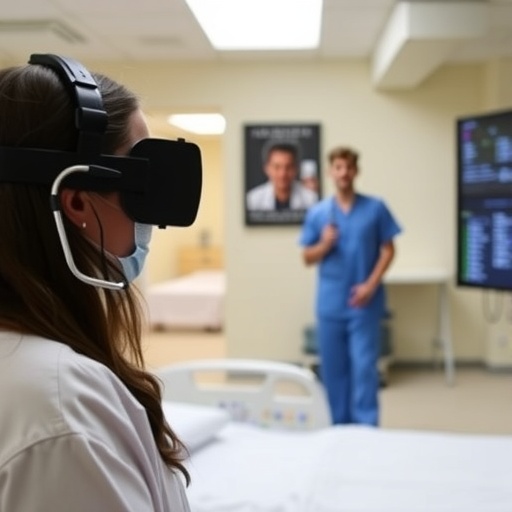
Virtual reality has won its most persuasive round yet against the hospital mannequin. In a head-to-head comparison of 272 undergraduate nursing students in South Korea, students who trained with immersive virtual reality scored significantly higher than classmates trained through conventional simulation-based learning on clinical decision-making ability — and on every other educational outcome the researchers measured, from learning engagement and self-efficacy to nursing performance and professional self-concept. The study, published as an open-access research article in the journal BMC Nursing, delivers some of the clearest quantitative evidence to date that learner-centered digital environments can outperform the high-fidelity mannequin laboratories that have anchored nursing education for decades. Just as striking, the analysis reveals that the two technologies appear to build clinical reasoning through different psychological routes, with self-directed learning emerging as the dominant engine of virtual reality training while traditional simulation leans far more heavily on how well students grasp their classroom material. The findings arrive at a pivotal moment for health professions education worldwide.
Clinical decision-making — the capacity to gather patient data, weigh competing explanations, prioritize interventions and act under pressure — is regarded as a core competency of safe nursing practice. Yet the traditional pipeline for developing it is narrowing. Hospitals are discharging patients faster, remaining beds are filled with higher-acuity cases, and supervisors are justifiably reluctant to let novices rehearse invasive procedures on real people. Direct patient-care opportunities during clinical placements have become so constrained that many students graduate having performed key procedures rarely, if ever, on living patients. Nursing schools have responded by moving more training into simulated environments, and two formats now dominate. Simulation-based learning typically revolves around lifelike mannequins that can be intubated, defibrillated and monitored by teams of students under an instructor’s supervision. Virtual reality, by contrast, places a single headset-wearing learner inside a computer-generated clinical world where scenarios can be repeated endlessly at no risk to anyone. Which format better teaches students to think like nurses, however, has been remarkably under-tested, with comparative evidence on both outcomes and the factors that drive them remaining scarce.
To close that evidence gap, a research team led by Minkyung Gu of Daejin University, together with Sue Young Hahm and Sohyune Sok of Kyung Hee University, conducted a comparative cross-sectional study involving 272 undergraduate nursing students drawn from nursing colleges in South Korea. Of these, 126 had completed virtual reality training and 146 had completed simulation-based training. Rather than staging a single classroom experiment, the researchers compared the educational outcomes of students who had already experienced each modality, assessing five constructs with validated self-report questionnaires: clinical decision-making ability, learning engagement, self-efficacy, nursing performance and nursing professional self-concept. The team first used chi-square tests to confirm that the two groups were statistically comparable in their baseline characteristics, then applied independent t-tests to detect differences in outcomes between the modalities. Finally, they ran simple linear regression analyses separately within each group to identify which individual factors predicted clinical decision-making ability under each training regime — a design that effectively treats each technology as its own learning ecosystem with its own rules.
The results were unambiguous. The virtual reality group outscored the simulation-based group on all five measures, and every difference reached conventional statistical significance. Clinical decision-making ability showed the largest gap, with a t-statistic of 3.47 and a p-value of 0.001 — meaning that, if the two formats were truly equivalent, a difference this large would be expected by chance only about one time in a thousand. Learning engagement (p = 0.005), self-efficacy (p = 0.004), nursing performance (p = 0.020) and nursing professional self-concept (p = 0.003) followed the same pattern. In practical terms, students immersed in virtual scenarios reported thinking more like clinicians, feeling more capable, performing more skillfully and identifying more strongly with the nursing profession than peers who had trained on mannequins. For a field in which mannequin simulation has served as the gold-standard safeguard for patient safety — and in which VR hardware is often dismissed as an expensive novelty — the sweep of the result is difficult to ignore.
Why would a headset outperform the traditional mannequin? The researchers point to the distinctive architecture of immersive virtual environments. Virtual reality generates a sense of presence — the subjective feeling of genuinely standing inside a clinical situation — creating psychological fidelity even where physical fidelity is rendered in software. Learners wearing a headset can control their own pace, repeat difficult scenarios without embarrassment or scheduling constraints, fail privately and safely, and receive feedback embedded directly in the environment. That autonomy stands in sharp contrast to conventional simulation laboratories, where a cohort typically rotates through scenarios in groups, an instructor choreographs each session, and every student’s hands-on time is rationed by the clock and the number of available mannequins. In the virtual format the individual learner becomes the center of the experience; in the mannequin lab the learner shares that center with the group, the faculty member and the equipment. The study’s regression results suggest that this shift in the center of gravity changes not only how much students learn, but which students flourish.
That difference is most visible in the predictors of clinical decision-making ability. In the virtual reality group, self-directed learning — a student’s capacity to set goals, locate resources and evaluate progress independently — was the strongest single predictor, with an unstandardized coefficient of B = 8.40 (p < 0.001) and an R² of 0.144. In plain language, each one-point rise on the self-directed learning measure was associated with an 8.40-point rise in decision-making score, and self-directed learning alone accounted for roughly 14.4 percent of the variation among VR-trained students — a substantial share for a single variable in behavioral research. Seven additional factors showed significant positive associations in the VR group at the p < 0.05 threshold: class comprehension ability, living arrangement, learning engagement, self-efficacy, male gender, nursing performance and being 23 years of age or younger. Together they sketch a portrait of the student who gains most from immersive training: someone who comprehends lecture material, drives their own study habits, engages deeply with the task and believes in their own capability — characteristics the technology amplifies rather than replaces.
The simulation-based group told a different story. There, class comprehension ability was the leading predictor of clinical decision-making, with B = 2.40 (p = 0.004), though the model explained far less variance — an R² of just 0.032, or about 3.2 percent. Self-directed learning, learning engagement and nursing professional self-concept also emerged as significant predictors in the mannequin-based cohort. The contrast is instructive. In traditional simulation, the strongest lever on clinical reasoning is how thoroughly a student absorbed classroom instruction, consistent with a model in which an instructor transmits knowledge and the simulation stage rehearses it. In virtual reality, the student’s own motivational machinery takes over as the dominant predictor, and the substantially larger R² suggests that outcomes become more explainable — and arguably more designable — in the immersive format. The two modalities, the data imply, do not simply differ in magnitude; they appear to operate on different cognitive and motivational foundations, rewarding different kinds of learners along the way.
The authors conclude that learner-centered virtual reality education provides an immersive learning environment that effectively fosters clinical reasoning skills in undergraduate nursing education, and their data carry concrete implications for curriculum designers. If self-directed learning is the strongest amplifier of VR-based decision-making, programs adopting the technology may want to measure and cultivate self-directedness before and during deployment — pairing headset sessions with explicit training in goal-setting and self-evaluation, for example. The demographic signals, including the advantages observed among male students, students aged 23 or younger and those in particular living arrangements, hint that subgroups may need tailored scaffolding to extract equal value from immersive training. Educators running conventional simulation laboratories can take a different lesson: because class comprehension dominates outcomes there, strengthening pre-simulation preparation and tighter integration of theory with practice may yield the biggest returns. One technology, one size, one pedagogy — the results argue — no longer describes the landscape of nursing simulation.
The study’s design imposes important limits on interpretation. As a comparative cross-sectional analysis, it captures associations rather than proving that virtual reality causes superior decision-making; students were not randomized to formats, and although baseline homogeneity was verified statistically, unmeasured differences between groups could contribute to the gap. All five outcomes were self-reported, so the findings reflect students’ perceptions of their competence and engagement rather than objectively scored clinical performance. The regression models, moreover, leave most of the variance in decision-making unexplained, and the sample was drawn from a single country. The article was released open access under a Creative Commons license as a peer-reviewed, citable accepted manuscript carrying a permanent DOI and subject to further editorial refinement. The research was approved by the Daejin University Institutional Review Board, conducted in accordance with the Declaration of Helsinki, and all participants provided written informed consent; the authors disclose no funding and no competing interests.
None of this dims the significance of the result for a profession confronting a global shortage of clinical training opportunities. The study reframes the debate from whether virtual reality belongs in nursing education to how to engineer it so that every student — not only the naturally self-directed — reaps its benefits. The design points toward the needed next steps: longitudinal follow-up of the same students over time, objective performance measures alongside self-reports, and trials of hybrid curricula in which mannequin rehearsals build teamwork and psychomotor precision while immersive virtual reality sharpens solitary clinical reasoning. The near-term message, though, is already legible. For a generation raised on interactive screens, virtual reality appears to function not as a gimmick but as a genuine rehearsal space for clinical judgment — one that engages students more deeply, convinces them of their own capability and, according to the numbers, leaves them measurably better at the defining skill of nursing: deciding what to do for a patient when it matters. The mannequin is not retiring from the classroom. It is, however, no longer unquestionably the teacher in the room.
Cite Scienmag News
Ophelia Keating. (August 29, 2026). Virtual Reality Versus Simulation Training: Comparing Nursing Students’ Clinical Decision-Making. Scienmag. https://scienmag.com/virtual-reality-versus-simulation-training-comparing-nursing-students-clinical-decision-making/
Ophelia Keating. "Virtual Reality Versus Simulation Training: Comparing Nursing Students’ Clinical Decision-Making." Scienmag, 29 August 2026, https://scienmag.com/virtual-reality-versus-simulation-training-comparing-nursing-students-clinical-decision-making/. Accessed 3 September 2026.
Ophelia Keating. "Virtual Reality Versus Simulation Training: Comparing Nursing Students’ Clinical Decision-Making." Scienmag. August 29, 2026. https://scienmag.com/virtual-reality-versus-simulation-training-comparing-nursing-students-clinical-decision-making/


