


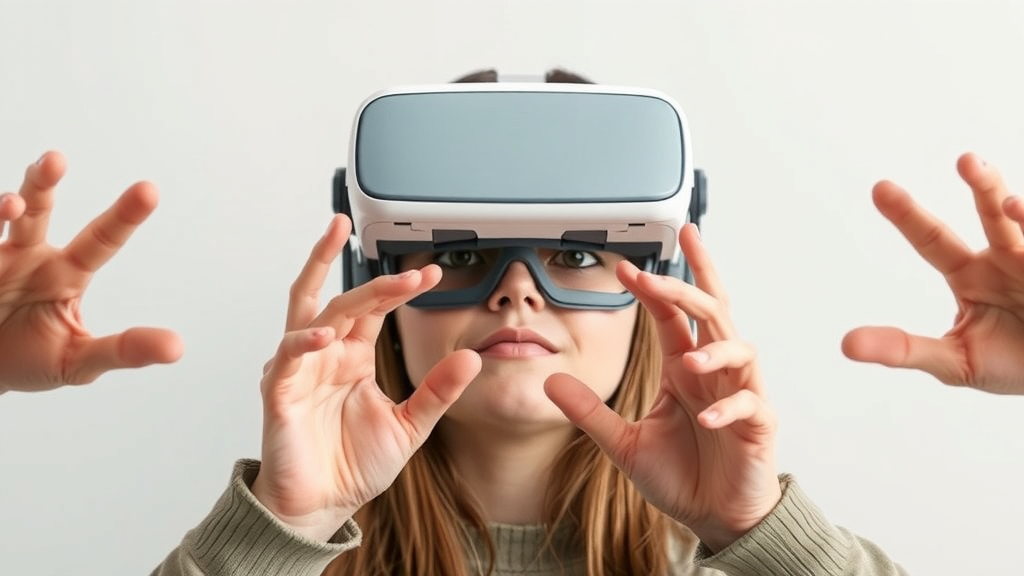
For decades, scientists studying attention have asked volunteers to stare at flat screens and press buttons. The results have been enormously influential, but they raise an uncomfortable question: how much do we really learn about distraction in the real world when our experiments take place in a two-dimensional rectangle? A new study published in Behavior Research Methods by Max D. Gurr, Christopher D. Erb, and colleagues at the University of Auckland and Connecticut College tackles that question head-on by moving the classic laboratory test of distraction into immersive virtual reality, where participants reach for virtual objects with their hands while a headset simultaneously records every flick of their eyes.
The task the researchers chose is the additional singleton paradigm, one of the most widely used tools in attention research. Participants search for a uniquely shaped target, such as a pear among apples, while a salient distractor, here a red object among green ones, appears on half of the trials. In traditional versions, people respond more slowly and make more errors when the distractor is present, a phenomenon known as attentional capture. The salient stimulus grabs attention automatically, even though it is irrelevant to the task. What has been missing is a way to watch that capture unfold in three dimensions, in movements that resemble the reaching and looking we do every day.
Fifty-four participants aged 18 to 26 wore an HTC Vive Pro Eye headset fitted with integrated eye tracking and held a motion-tracked controller in their dominant hand. The system recorded hand positions at roughly 90 hertz and gaze direction from the headset’s infrared eye tracker, allowing the team to capture reaching and looking behavior at the same time in the same trial. Participants completed the task in two contrasting virtual environments: a sparsely detailed, untextured room designed to mimic a bare laboratory, and a richly detailed virtual greenhouse filled with visual clutter. The order of the environments was counterbalanced across participants.
On each trial, four fruit-shaped stimuli appeared on a virtual tree at the top, left, right, and bottom locations. The target was always the unique shape, and its color and identity were randomized from trial to trial, encouraging participants to search for any singleton rather than a specific feature. When a distractor appeared, it was always the uniquely colored object. Participants initiated each reach by holding the controller inside a central starting sphere for two seconds, then had three seconds to move to the target. Correct responses earned a pleasant 600-hertz tone; errors or timeouts produced a low 300-hertz buzz.
The results were striking in their consistency. When a distractor was present, participants were slower to initiate their movements, slower to complete them, and slower overall. Their reach trajectories curved more, their hands spent a greater proportion of each movement being pulled toward the distractor location, their eyes traveled greater angular distances, and they took longer to fixate the target for the first time. Effect sizes were substantial, with distractor presence explaining between roughly a quarter and nearly two-thirds of the variance in individual measures. In short, the attentional capture effects documented over thirty years of button-press experiments generalize robustly to three-dimensional immersive environments.
But the study’s real methodological contribution lies in how the movements were analyzed. Traditional reach-tracking studies collapse three-dimensional trajectories into two-dimensional summary statistics such as maximum perpendicular deviation from a straight path. The problem is that a large deviation does not necessarily mean the hand was drawn toward the distractor; it could also reflect a delayed decision, with the hand drifting toward the center of the display before committing. Gurr and colleagues instead computed continuous target attraction and distractor attraction scores: for every time point in a movement, they determined which object the hand was moving closest toward, and calculated the proportion of the trajectory devoted to each. These measures revealed capture effects that the curvature measure missed entirely, particularly on trials where the distractor appeared far from the target.
Those attraction scores also allowed the team to reconstruct the time course of capture using cluster-based permutation analyses. When the distractor was adjacent to the target, the hand was pulled toward the distractor from the very first moments of movement, with the effect persisting for up to 78 percent of the trajectory before the movement was corrected. Even when the target and distractor sat on opposite sides of the display, the hand still showed significant early attraction to the distractor, though the effect was briefer and weaker. This graded pattern mirrors earlier findings that capture costs shrink as the distance between target and distractor grows, and it extends them into a fully three-dimensional movement space.
The comparison between the sparse room and the rich greenhouse produced a subtler story. Participants were generally slower and moved their eyes more in the detailed greenhouse, consistent with prior work showing that cluttered environments impair visual search. Yet the size of the attentional capture effect itself did not differ between environments. Bayesian analyses provided moderate evidence for this null result on several measures, though the evidence was mixed on others. One complication emerged: participants who started in the sparse room performed nearly identically in both environments, while those who started in the rich greenhouse were markedly faster in the sparse room afterward, hinting at practice or adaptation effects that future studies will need to disentangle.
The authors are candid about the limitations. Many participants adopted a rigid strategy of looking first at the top location, which complicated the analysis of initial eye movements. The task’s fixed layout may have allowed participants to learn that the bottom object revealed the target’s color, potentially shrinking the distractor effect. And VR hardware brings its own caveats: the headset’s eye tracker is less precise than professional laboratory systems, and the motion-to-photon lag between a real hand movement and its virtual rendering, estimated at a few tens of milliseconds, means VR-derived timing should be compared cautiously with data from electromagnetic or optical trackers.
Even so, the study makes a compelling case that a commercially available VR headset, costing a fraction of traditional tracking rigs, can deliver laboratory-grade measurements of how distraction plays out simultaneously in the hand and the eye. Because the equipment is portable and the software tools are increasingly accessible, the approach could spread quickly through labs studying attention, perception, and motor control. The data and analysis scripts have been released openly, and the team plans to publish user-friendly processing software. The gap between the psychology laboratory and the cluttered, three-dimensional world we actually inhabit may finally be starting to close.
Subject of Research: Measuring attentional capture dynamics in hand and eye movements using virtual reality
Article Title: Measuring the dynamics of attentional capture in hand and eye movements with virtual reality
Article References: Gurr, M. D., Moher, J., Egbert, M. D., & Erb, C. D. (2026). Measuring the dynamics of attentional capture in hand and eye movements with virtual reality. Behavior Research Methods, 58(11), Article 302. https://doi.org/10.3758/s13428-026-03177-9
Image Credits: AI Generated
DOI: 10.3758/s13428-026-03177-9
Keywords: attentional capture, virtual reality, eye tracking, hand tracking, additional singleton task, visual attention, reaching movements, distractors, Behavior Research Methods, sensorimotor processing, visual search, immersive environments
Cite Scienmag News
Glenn Wilkins. (September 25, 2026). Virtual Reality Headset Tracks How Distractors Hijack Hands and Eyes in 3D. Scienmag. https://scienmag.com/virtual-reality-headset-tracks-how-distractors-hijack-hands-and-eyes-in-3d/
Glenn Wilkins. "Virtual Reality Headset Tracks How Distractors Hijack Hands and Eyes in 3D." Scienmag, 25 September 2026, https://scienmag.com/virtual-reality-headset-tracks-how-distractors-hijack-hands-and-eyes-in-3d/. Accessed 4 October 2026.
Glenn Wilkins. "Virtual Reality Headset Tracks How Distractors Hijack Hands and Eyes in 3D." Scienmag. September 25, 2026. https://scienmag.com/virtual-reality-headset-tracks-how-distractors-hijack-hands-and-eyes-in-3d/


