


Social media. The climate crisis. Political polarization. The tumult of a pandemic and online learning. Teens today are dealing with unprecedented stressors, and over the past decade their mental health has been in sustained decline. Levels of anxiety and depression rose after the onset of the COVID-19 pandemic. Compounding the problem is a shortage of mental health providers — for every 100,000 children in the U.S., there are only 14 child and adolescent psychiatrists.

Credit: Björling et al./JMXR 2024
Social media. The climate crisis. Political polarization. The tumult of a pandemic and online learning. Teens today are dealing with unprecedented stressors, and over the past decade their mental health has been in sustained decline. Levels of anxiety and depression rose after the onset of the COVID-19 pandemic. Compounding the problem is a shortage of mental health providers — for every 100,000 children in the U.S., there are only 14 child and adolescent psychiatrists.
In response to this crisis, University of Washington researchers studied whether virtual reality might help reduce stress for teens and boost mental health. Working with adolescents, the team designed a snowy virtual world with six activities — such as stacking rocks and painting — based on practices shown to improve mental health.
In a 3-week study of 44 Seattle teens, researchers found that teens used the technology an average of twice a week without being prompted and reported lower stress levels and improved mood while using it, though their levels of anxiety and depression didn’t decline overall.
The researchers published their findings April 22 in the journal JMIR XR and Spatial Computing. The system is not publicly available.
“We know what works to help support teens, but a lot of these techniques are inaccessible because they’re locked into counseling, which can be expensive, or the counselors just aren’t available,” said lead author Elin Björling, a UW senior research scientist in the human centered design and engineering department. “So we tried to take some of these evidence-based practices, but put them in a much more engaging environment, like VR, so the teens might want to do them on their own.”
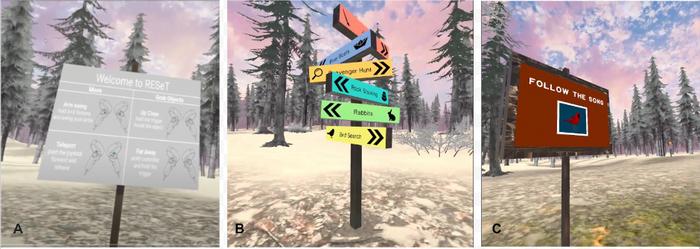
The world of Relaxation Environment for Stress in Teens, or RESeT, came from conversations the researchers had with groups of teens over two years at Seattle Public Library sites. From these discussions, the team built RESeT as an open winter world with a forest that users could explore by swinging their arms (a behavior known to boost mood) to move their avatar. A signpost with six arrows on it sent users to different activities, each based on methods shown to improve mental health, such as dialectical behavior therapy and mindfulness-based stress reduction.
In one exercise, “Riverboat,” users put negative words in paper boats and send them down a river. Another, “Rabbit Hole,” has players stand by a stump; the longer they’re still, the more rabbits appear.
“In the co-design process, we learned some teens were really afraid of squirrels, which I wouldn’t have thought of,” Björling said. “So we removed all the squirrels. I still have a Post-It in my office that says ‘delete squirrels.’ But all ages and genders loved rabbits, so we designed Rabbit Hole, where the reward for being calm and paying attention is a lot of rabbits surrounding you.”
To test the potential effects of RESeT on teens’ mental health, the team enrolled 44 teens between ages 14 and 18 in the study. Each teen was given a Meta Quest 2 headset and asked to use RESeT three to five times a week. Because the researchers were trying to see if teens would use RESeT regularly on their own, they did not give prompts or incentives to use the headsets after the start of the study. Teens were asked to complete surveys gauging their stress and mood before and after each session.
On average, the teens used RESeT twice a week for 11.5 minutes at a time. Overall, they reported feeling significantly less stressed while using RESeT, and also reported smaller improvements in mood. They said they liked using the headset in general. However, the study found no significant effects on anxiety and depression.
“Reduced stress and improved mood are our key findings and exactly what we hoped for,” said co-author Jennifer Sonney, an associate professor in the UW School of Nursing who works with children and families. “We didn’t have a big enough participant group or a design to study long-term health impacts, but we have promising signals that teens liked using RESeT and could administer it themselves, so we absolutely want to move the project forward.”
The researchers aim to conduct a larger, longer-term study with a control group to see if a VR system could impart lasting effects on mood and stress. They’re also interested in incorporating artificial intelligence to personalize the VR experience and in exploring offering VR headsets in schools or libraries to improve community access.
Additional co-authors were Himanshu Zade, a UW lecturer and researcher at Microsoft; Sofia Rodriguez, a senior manager at Electronic Arts who completed this research as a UW master’s student in human centered design and engineering; Michael D. Pullmann, a research professor in psychiatry and behavioral sciences at the UW School of Medicine; and Soo Hyun Moon, a senior product designer at Statsig who completed this research as a UW master’s student in human centered design and engineering. This research was funded by the National Institute of Mental Health through the UW ALACRITY Center, which supports UW research on mental health.
For more information, contact Björling at bjorling@uw.edu and Sonney at jsonney@uw.edu.
DOI
Article Title
Using Virtual Reality to Reduce Stress in Adolescents: Mixed Methods Usability Study
Article Publication Date
22-Apr-2024
Cite Scienmag News
Denise Maddox. (May 1, 2024). Virtual reality environment for teens may offer an accessible, affordable way to reduce stress. Scienmag. https://scienmag.com/virtual-reality-environment-for-teens-may-offer-an-accessible-affordable-way-to-reduce-stress/
Denise Maddox. "Virtual reality environment for teens may offer an accessible, affordable way to reduce stress." Scienmag, 1 May 2024, https://scienmag.com/virtual-reality-environment-for-teens-may-offer-an-accessible-affordable-way-to-reduce-stress/. Accessed 4 September 2026.
Denise Maddox. "Virtual reality environment for teens may offer an accessible, affordable way to reduce stress." Scienmag. May 1, 2024. https://scienmag.com/virtual-reality-environment-for-teens-may-offer-an-accessible-affordable-way-to-reduce-stress/

