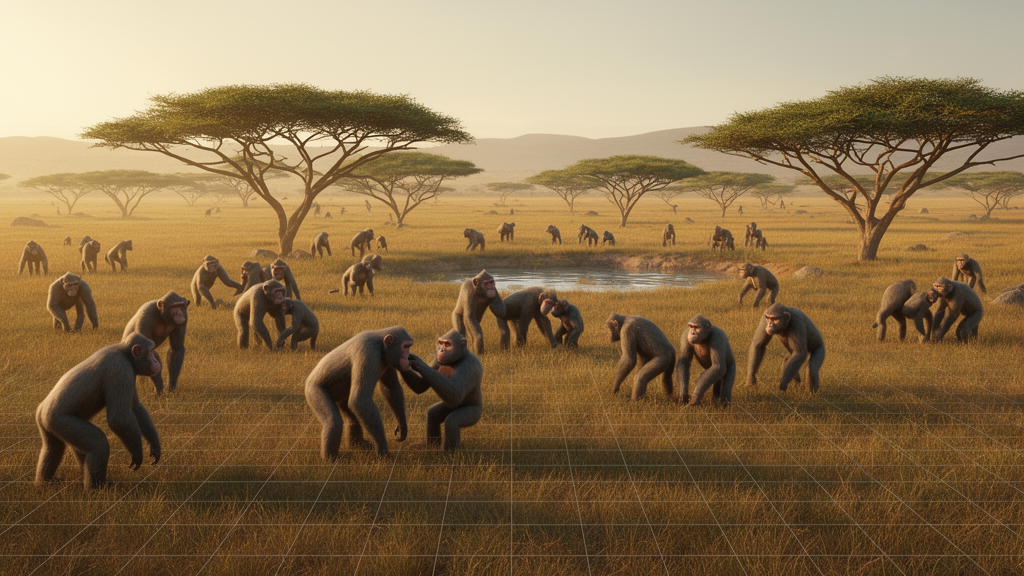
A virtual ecosystem populated by simulated chimpanzees, geladas, and baboons has produced societies so lifelike that males disperse, females stay put, home ranges collide, and follower males evolve from scratch—without a single top-down rule enforcing any of it. The engine behind this digital primate laboratory is B3GET, pronounced “bee’get” and standing for Behavior, Ecology, Genetics, Evolution, and Tradeoffs, a generalized agent-based modeling framework introduced in the journal Individual-based Ecology. Across 288 simulations totaling 370,199 virtual individuals, the framework emulated four real primate species and reproduced their signature dispersal patterns, mating strategies, and ranging behaviors, offering ecologists a reusable “Petri dish” for experiments that would be impractical or unethical to run on living animals.
The central challenge B3GET tackles is one of scale: how do individual behaviors—what an animal eats, whom it mates with, whether it fights or flees—add up to the population and ecosystem patterns we observe in nature? Individual-based models, also called agent-based models, are theoretically ideal for bridging this gap because they explicitly represent every individual rather than averaging across a population. In practice, however, the field has struggled to realize that promise. Classical demographic models operate at the population level and ignore individual variation, while mechanistic individual-level models become too complex to scale. The result has been a proliferation of narrowly scoped, single-species models built ad hoc for specific systems—so many, and so redundant, that critics coined the YAAWN syndrome: “Yet Another Agent-Based Model… Whatever… Nevermind.”
B3GET was designed at the University of Minnesota, initially as a virtual laboratory for a course on primate ecology and social behavior, and refined through multiple semesters of classroom use beginning in fall 2014. Implemented in NetLogo 6.2.2, a freely available agent-based modeling program, it balances generality with mechanistic depth by drawing on behavioral ecology, evolutionary game theory, optimal foraging theory, life-history theory, resource competition, and artificial life. The environment is a toroidal grid of 10,000 PLANTS—simulated entities are written in ALL CAPS to distinguish them from real organisms—on which a population of ANIMAL agents lives, forages, breeds, and dies. User-defined controls set PLANT resource quality, spatial distribution, and seasonal cycles, driving the ecological pressures that shape everything downstream.
Each ANIMAL carries a genotype composed of heritable stimulus–response rules called genes. These rules determine which actions an individual performs—moving, eating, mating, fighting, helping, carrying offspring—and how much energy it allocates to each, based on the observable traits of nearby individuals and plants relative to its own internal state. Every action incurs a nonzero energetic cost, enforcing realistic tradeoffs: energy spent on growth cannot be spent on survival maintenance, movement, or reproduction. Survival itself is a probability that continuously declines with age and must be maintained through energetic investment, so individuals that fail to acquire sufficient food can die at any life stage. During sexual reproduction, genes mutate and recombine, allowing adaptive strategies and counterstrategies to emerge over generations without any explicit global fitness function.
The virtual plants themselves are dynamic, inspired by Conway’s Game of Life. PLANTS grow best within a preferred neighborhood size, controlled by user-set minimum and maximum neighbor parameters, and at specific times of the year. Higher neighbor settings generate discrete energy patches, while lower settings produce homogeneous distributions—and unexpectedly maze-like patterns emerged when the maximum-neighbor parameter was set low. The research team ran a full factorial experiment crossing four virtual primate species with 36 combinations of PLANT settings, each simulated twice, for 288 baseline runs executed at the Minnesota Supercomputing Institute over roughly six days in July 2021. Every run lasted 100,000 timesteps—approximately five adult lifespans—and all reached the end without crashing.
Persistence was tightly linked to resource stability. Across the 288 simulations, 204 populations—83.6 percent—survived the full duration, with olive baboon populations showing the highest extinction rate at 29.2 percent, followed by chimpanzees at 12.5 percent, geladas at 8.3 percent, and hamadryas baboons at just 5.6 percent. Populations declined or collapsed when mean PLANT abundance fell below roughly 1.5 energy units per cell and patchiness exceeded about 20, while abundance above 2.0 with patchiness under 10 supported populations of 150 to 250 individuals or more. Consistent increases in mean generation number over time confirmed that persistence reflected genuine generational turnover rather than survival of unusually long-lived individuals.
Evolutionary change was commonly observed. In one CHIMPANZEE simulation, the gene controlling bite.capacity—the energy-intake capacity of adults—rose gradually from an initial value of 0.001 to 0.014 by the end of the run, and adult bite.capacity increased significantly between ancestral and descendant generations, from 0.2384 to 0.3752 on average. Most conceptions were achieved by individuals with moderate to high bite capacity, demonstrating directional selection for greater energy-intake capacity. In contrast, a GELADA simulation showed evolutionary stasis in gestation duration: while the maternal gene evolved toward zero investment in triggering birth—consistent with the expectation that mothers conserve energy for future offspring—the overall distribution of gestation durations did not differ significantly between ancestral and descendant populations, suggesting stabilizing selection.
The behavioral results are the most striking. CHIMPANZEE males were strictly philopatric while nearly all females dispersed from their natal communities, and only about half of dispersing females successfully joined a new group—mirroring patterns documented at Gombe and Ngogo. Dispersal was costly: 56.7 percent of juvenile females that died did so after leaving their natal group but before joining another. CHIMPANZEE communities were the largest among the four virtual species, averaging 43.2 individuals, and exhibited high range fidelity at 91.3 percent, with home-range boundaries that closely followed the spatial distribution of PLANT energy. GELADA females were largely philopatric while 84.3 percent of males dispersed and transferred a mean of roughly 25 times over their lifetimes, forming the loose, shifting clusters characteristic of gelada multilevel societies. HAMADRYAS females dispersed to join recruiting males, residing in a median of 12 groups over their lifetimes, and in 67 of 72 simulations a gene enabling males to recruit follower males—initially set to zero—mutated to positive values, causing follower males to emerge on their own. OLIVE females never dispersed while all males did, though 69.2 percent of dispersing males died before successfully joining a new group, contributing to their species’ relatively low persistence.
What makes B3GET notable is its bottom-up architecture: species-typical societies emerged from genotype-encoded rules without any top-down enforcement. Small genotype edits produced large societal differences—the four PRIMATE genotypes shared 112 core genes governing general mammalian functions, with only about 10 species-specific genes each, and the genotype development process accelerated as genes were reused across species, taking several months for geladas but just one week for olive baboons. Because B3GET can emulate a broad range of animal species, it provides a promising approach for investigating questions in animal behavior and primate socioecology, both for research and education. Users with no coding background have successfully edited, saved, and reloaded population and genotype files to conduct new experiments in classroom laboratories, student projects, and conference workshops.
The framework is not without limitations. PLANT growth is governed by internal rule-based dynamics and does not use phenology, climate inputs, or externally derived resource maps, and timesteps and energy units are non-dimensional, reducing realism for system-specific forecasting. B3GET can identify combinations of mechanisms capable of reproducing empirical patterns, but successful reproduction does not demonstrate that the underlying mechanisms are uniquely correct—multiple processes may generate similar outcomes given the vast parameter space, on the order of more than 300 trillion possible ANIMAL behaviors when all potential genotype mutations are considered. The team plans longer simulations to examine oscillatory resource–consumer dynamics reminiscent of classical predator–prey interactions, multiple PLANT species within the same landscape, neural-network architectures that permit learning and plasticity, and calibration procedures that use empirical data to construct genotype rules more efficiently. For now, B3GET stands as a reusable foundation for multiscale ecological modeling—a digital sandbox where virtual primates live, evolve, and organize themselves into societies that look remarkably like our own living world.
Subject of Research: Simulating the socioecology of virtual primates using B3GET: a generalized behavioral modeling tool
Article Title: Simulating the socioecology of virtual primates using B3GET: a generalized behavioral modeling tool
Article References: Crouse, K. N., Lehman, C. L., & Wilson, M. L. (2026). Simulating the socioecology of virtual primates using B3GET: a generalized behavioral modeling tool. Individual-based Ecology, 2, Article e174844. https://doi.org/10.3897/ibe.2.174844
Image Credits: AI Generated
DOI: 10.3897/ibe.2.174844
Keywords: Simulating, socioecology, virtual, primates, B3GET, generalized, behavioral, modeling, tool, scientific research
Cite Scienmag News
Gavin Prescott. (October 16, 2026). Virtual Primates Evolve Real Societies in a New Agent-Based Modeling Tool. Scienmag. https://scienmag.com/virtual-primates-evolve-real-societies-in-a-new-agent-based-modeling-tool/
Gavin Prescott. "Virtual Primates Evolve Real Societies in a New Agent-Based Modeling Tool." Scienmag, 16 October 2026, https://scienmag.com/virtual-primates-evolve-real-societies-in-a-new-agent-based-modeling-tool/. Accessed 16 October 2026.
Gavin Prescott. "Virtual Primates Evolve Real Societies in a New Agent-Based Modeling Tool." Scienmag. October 16, 2026. https://scienmag.com/virtual-primates-evolve-real-societies-in-a-new-agent-based-modeling-tool/