


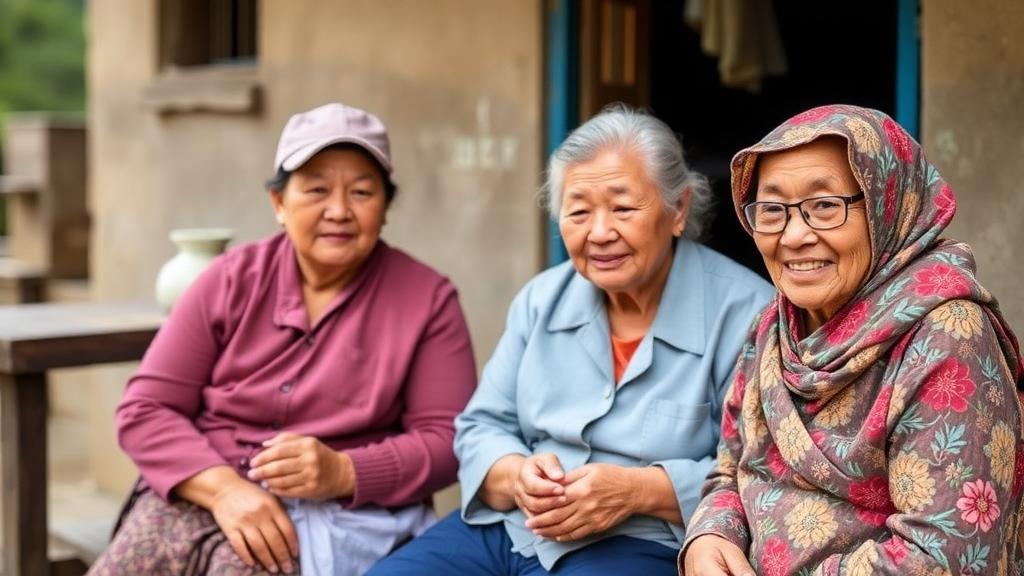
In the agricultural prefecture of Ya’an in southwestern China’s Sichuan Province, researchers have spent years listening to mothers and grandmothers describe the quiet emotional weight of raising small children in villages where no psychiatrist has ever practiced. The result of that listening is the Thinking Healthy Extended Program, or THEP, a mental health intervention designed to be delivered entirely by trained nonspecialists to female caregivers of children aged six to thirty-six months. A new study published in SSM – Mental Health documents, step by step, how the curriculum was built, tested, and refined, offering one of the most transparent accounts to date of how a mental health intervention for an underserved population actually comes into existence.
The need is staggering. In low- and middle-income countries, roughly one in four women experiences depressive symptoms during pregnancy or the first year after childbirth, yet more than ninety percent of them have no access to any mental health service or social support. Treatment coverage for common mental disorders in these settings ranges from just seven to twenty-eight percent, leaving a treatment gap of up to ninety-three percent. In rural China the picture is equally bleak: a meta-analysis of ninety-five studies found that 16.3 percent of Chinese mothers experience perinatal depression, and among rural caregivers of children aged six to thirty-six months, twenty-five percent report depressive symptoms while thirty-nine percent report symptoms of depression, anxiety, or stress. Meanwhile, among rural Chinese children under three, forty-five percent are at risk of cognitive delay, forty-six percent of language delay, and thirty-six percent of social-emotional delay.
The stakes extend far beyond the caregivers themselves. Maternal mental health shapes the quality of nurturing care a child receives, and caregivers struggling with psychological symptoms tend to engage less in stimulating activities such as storytelling, reading, and singing. Insufficient nurturing care prevents an estimated 250 million children under five in low- and middle-income countries from reaching their developmental potential. Because the first three years of life mark the most rapid phase of brain development, delays during this window can ripple into adulthood, compromising health and human capital and perpetuating an intergenerational cycle of poverty. The economics are as compelling as the neuroscience: landmark studies of early childhood stimulation interventions have shown lasting returns in labor market outcomes decades later.
To close the treatment gap, global health researchers have increasingly turned to task-sharing, the strategy of training community members without formal psychological training to deliver structured care. The evidence base is solid. A review of twenty-seven trials of nonspecialist-delivered interventions for common mental disorders in low- and middle-income countries found a moderate to strong effect size of 0.49 standard deviations, and a meta-analysis of thirteen perinatal trials showed a significant reduction in depressive symptoms with an effect size of 0.38 standard deviations. The flagship of this movement is the World Health Organization’s Thinking Healthy Programme, which simplifies core cognitive behavioral therapy techniques, combining cognitive reframing, in which mothers learn to identify and restructure destructive thought patterns, with behavioral activation, which builds relaxation and problem-solving into daily routines.
The original Thinking Healthy Programme, however, ends ten months after childbirth, leaving a void precisely where rural China’s burden is heaviest. A peer-delivered adaptation tested in Pakistan and India simplified the content and shifted delivery to peer facilitators, but produced weaker effects than the original, suggesting that stripping out core cognitive behavioral components may have blunted its power. A subsequent lower-intensity booster phase extending to thirty-six months postpartum showed no significant effects on maternal depression outcomes. The Ya’an team set out to build something new: a standalone program that preserves simplified cognitive reframing, extends support through toddlerhood, and deliberately includes both mothers and grandmothers regardless of mental health status to minimize the risk of stigmatization.
Guided by Fixsen’s Stages of Implementation Science framework, the researchers moved through four formative phases. In the exploration stage, twenty-three in-depth interviews with caregivers revealed an unaddressed emotional toll. Caregivers described self-blame and frustration when caregiving expectations went unmet, limited support from husbands and in-laws, and profound social isolation. One mother confessed, I can’t control myself. I feel like I’m falling short in terms of educating him, so I compensate by buying him things. I’m either spoiling him or yelling at him, and I don’t understand why. Another described her coping strategy bluntly: when she is angry, she simply lets it out on her own, because her family would not understand anyway. The interviews also exposed a striking child-centered identity, with caregivers defining themselves almost entirely through their duties to their children, and frequent intergenerational tension between mothers-in-law and daughters-in-law over childcare practices.
These insights shaped every design decision. Caregivers preferred small groups of three to five participants, community-based venues such as village committees rather than private homes, and afternoon timing that avoided meals and naps. In the installation phase, the team developed four signature activities and tested them through nine cognitive walkthrough sessions. Story-based discussions embed caregiving challenges in narratives that guide participants through a structured reframing process linking thoughts to emotions and outcomes. Card games feature healthy practices that participants draw and discuss. Parenting activity demonstrations give caregivers hands-on rehearsal of stimulating interactions to practice later at home, adapted from an evidence-based Chinese parenting intervention. A health calendar translates selected practices into daily home routines with a check-in mechanism to encourage adherence.
The walkthroughs surfaced practical lessons that reshaped the curriculum. Grandmothers with limited literacy struggled with small text and unfamiliar terminology, prompting larger fonts and more intuitive language. Group sessions generated far stronger engagement and emotional resonance than individual sessions, but were occasionally disrupted by emotional reactions or dominant participants, so the team retained group delivery while adding ice-breaking activities and training facilitators to manage distress. Sessions without children present flowed more smoothly, though the researchers acknowledge that integrating childcare services might make the program more accessible for sole caregivers. Perhaps most tellingly, caregivers found cognitive reframing concepts difficult to grasp, a challenge consistent with prior Thinking Healthy Programme evaluations, so the team standardized the storylines so that each narrative explicitly walks participants from an unhealthy thought through its consequences to a healthier alternative and its application in their own lives.
Topic development proved equally revealing. Experts proposed twenty-four candidate topics across three pillars borrowed from the original program: the caregiver’s personal health, the caregiver-child relationship, and the caregiver’s relationships with family and friends. Six focus groups with twenty-six caregivers, organized separately for mothers and grandmothers, winnowed the list to twenty topics, twelve of them entirely new. The additions reflect distinctly Chinese realities: postpartum health concerns, self-confidence after body changes, fatalistic beliefs that a child’s poor health is innate and unchangeable, balancing parenthood with personal goals, sibling relationships, intergenerational childcare conflicts, and trust in public support services. The final curriculum comprises twenty-four fortnightly sessions with step-by-step scripts for facilitators, and, in a deliberate anti-stigma move, avoids the terms mental health and depression entirely, framing everything instead around self-care and the well-being of caregivers and children.
The study’s theory of change weaves these elements together: cognitive reframing replaces unhelpful beliefs, behavioral activation embeds healthy routines, group formats build mutual emotional support, and parenting demonstrations improve caregiver-child interactions that feed back into better mental health. Whether it works at scale will be answered by a large randomized controlled trial whose results are reported elsewhere. But the development process itself carries a lesson for global mental health. By involving seventy-three caregivers across four stages, iterating on every activity, and documenting each decision, the researchers have shown that interventions for the world’s most neglected populations need not be imported wholesale from manuals written for other contexts. They can be built from the ground up, one honest conversation at a time, with the women who carry the burden.
Subject of Research: Development of a nonspecialist-led mental health intervention for female caregivers of young children in rural China
Article Title: Developing a nonspecialist-led mental health intervention for female caregivers of young children in rural China
Article References: Jiang, Q., Yang, L., Qian, Y., Chung, E. O., Zhang, H., Rozelle, S., & Fernald, L. (2026). Developing a nonspecialist-led mental health intervention for female caregivers of young children in rural China. SSM – Mental Health, 10, Article 100707. https://doi.org/10.1016/j.ssmmh.2026.100707
Image Credits: AI Generated
DOI: 10.1016/j.ssmmh.2026.100707
Keywords: maternal mental health, rural China, task-sharing, cognitive behavioral therapy, Thinking Healthy Programme, early childhood development, caregivers, implementation science, perinatal depression, nonspecialist delivery, stigma, global mental health
Cite Scienmag News
Glenn Wilkins. (October 6, 2026). Village Grandmothers and Mothers Test a New Mental Health Program for Rural China. Scienmag. https://scienmag.com/village-grandmothers-and-mothers-test-a-new-mental-health-program-for-rural-china/
Glenn Wilkins. "Village Grandmothers and Mothers Test a New Mental Health Program for Rural China." Scienmag, 6 October 2026, https://scienmag.com/village-grandmothers-and-mothers-test-a-new-mental-health-program-for-rural-china/. Accessed 17 October 2026.
Glenn Wilkins. "Village Grandmothers and Mothers Test a New Mental Health Program for Rural China." Scienmag. October 6, 2026. https://scienmag.com/village-grandmothers-and-mothers-test-a-new-mental-health-program-for-rural-china/


