


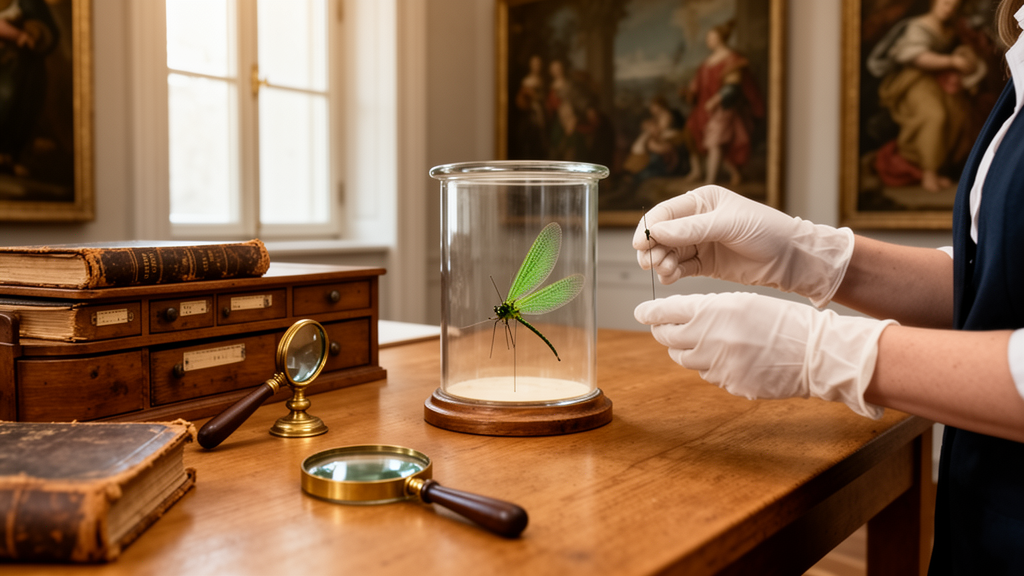
Deep inside the Natural History Museum Vienna, thousands of pinned insects carry the weight of scientific history. A new catalogue published in the Annals of the Natural History Museum Vienna documents the type specimens of two insect orders, Megaloptera and Neuroptera, held in the museum’s Neuropterida collection, and the results read like a detective story spanning five centuries. The work records six type specimens of three Megaloptera species and 202 type specimens of 63 Neuroptera species, but it also confirms something more troubling: types of 14 species are missing, and the type specimens of eight more lacewing species described in 1852 are apparently lost forever.
Type specimens are the single most important objects in taxonomy. When a scientist describes a new species, one particular specimen becomes the name-bearer, the physical anchor to which the scientific name is permanently attached. If that specimen disappears, the species itself becomes harder to define, and in the worst cases the name turns into a nomen dubium, a doubtful name that can no longer be reliably assigned to any animal. That is why catalogues like this one, compiled by researchers at the Vienna museum, matter far beyond the walls of a single institution.
The Vienna collection itself is one of the most important in the world, comprising around 24,350 specimens, including 350 Megaloptera and 2,000 Neuroptera. Its foundations were laid by Friedrich Moritz Brauer, a schoolboy obsessed with lacewings who grew up to become Director of the Zoological Department at the institutions preceding the museum. His private collection, handed over posthumously in 1905, contained numerous type specimens by Brauer, Selys, Hagen and others, and is still evidenced today by the labels reading Coll. Brauer. A second golden era began in the early 1960s, when Ulrike Aspöck and Horst Aspöck launched an intensive neuropterological research program that continues unabated, with countless expeditions to the Mediterranean, southern Africa, India, Kyrgyzstan, the Far East, Australia and the Americas.
The catalogue’s historical introduction reaches back even further, to the sixteenth century, when the Flemish miniature painter Joris Hoefnagel created the first reliable depictions of neuropterid specimens in his manuscript Four Elements. Among his illustrations are an alderfly, probably a specimen of Sialis, and a green lacewing, likely Chrysoperla in its pale yellowish-brown winter coloration. Hoefnagel’s images, arranged like still-life paintings and headed with proverbs from the Bible and Erasmus’ Adagia, belong partly to artwork and partly to epistemic image, a singular manuscript accessible only to a small courtly audience. In the pre-Linnaean era, naturalists called these insects flies, butterflies, water insects, or even grouped them close to the dragonflies, and it took centuries of entomological work to untangle Linnaeus’ original order Neuroptera into the modern orders Raphidioptera, Megaloptera and Neuroptera that today form the superorder Neuropterida.
Among the documented treasures are specimens with remarkable stories. The holotype of Sialis vanderweelei, described from Egypt in 1983, carries a label noting that more precise collection data are unfortunately not available. The lectotype of Chauliodes punctatoguttatus from Java was once mislabeled as belonging to a different species, Chauliodes dispar, until later researchers recognized that the two female syntypes were not conspecific with the male and designated them as the type series of the new species. The holotype of Chloronia plaumanni from Brazil was originally labeled as a different species entirely, hieroglyphicus, before Penny and Flint recognized it as new in 1982.
Some entries reveal errors that persisted for over a century. The holotype of the osmylid lacewing Gumilla adspersus, described by the Spanish Jesuit priest Longinos Navás in 1912, carries the locality Blumenau in Brazil, but Navás transcribed the collector’s name as Hetschka and the town as Blumenan. The catalogue corrects both: the collector was Ing. Lothar Hetschko, who lived and collected in the former German colony Blumenau for three years until his sudden death in 1885. Even more puzzling, Navás recorded the type locality of Spilosmylus aureus as Siberia, although the specimen was collected on the Indonesian island of Obi; the catalogue suggests Navás may have confused the island Obi with the river Ob in Siberia, noting that the collector Hans Fruhstorfer never collected in western Siberia but mainly in southeast Asia.
Not every labeled type is what it claims to be. The catalogue lists two specimens whose type status could not be confirmed, including one labeled as a type of Osmylus naevius from Sikkim, India. The term Type on its label, the researchers found, refers not to the species but to the genus Mesosmylus, which Krüger established based on this specimen in 1913. The actual syntype of the species is deposited in the British Museum in London. Similarly, a specimen labeled as a paratype of Dilar zimmermannae from Myanmar is not listed in the original description at all.
The most sobering section concerns types reported to be stored in Vienna but apparently lost. Types of 14 species are missing, including the holotype of the mantisfly Mantispa aphavexelte from the Greek island of Samothraki, which the original description explicitly stated had been transferred to the Vienna museum. The wet collections yielded no trace of alcohol-preserved types of several Dilar species from France, Laos and China, nor of the beaded lacewing Speleoberotha palomae from Brazil, whose original description listed two male and two female paratypes in Vienna.
An even deeper historical mystery surrounds eight Hemerobiidae species described by Gustav von Gözsy in 1852, all supposedly from Austria. The catalogue’s authors traced the otherwise unknown author through church registers, discovering that his surname was spelled Göszy at his baptism in Schwechat and in his marriage register at St. Augustin, but handwritten corrections dated March 1900 changed the name to Gözsy. A childhood friend of Brauer, Gözsy studied medicine at the University of Vienna before a life-threatening illness and the voluntary death of his father derailed his studies. He later obtained a doctorate in philosophy, trained as an archivist, and worked in the cipher department of the Ministry of Foreign Affairs until his death in 1885. Virtually nothing is known about the fate of his type specimens, and the only remnant today is a single label with the handwritten inscription Kollari Gözsy Type, its handwriting matching Gözsy’s letter of application. The specimen it once belonged to is gone, and with it the physical evidence for eight species names, several of which must now stand as nomina dubia.
The catalogue documents each entry with meticulous detail: the page number of the original description, the type locality, the current taxonomic status, and verbatim label texts marked with square brackets, with handwritten text in italics and authors’ remarks in curly brackets. Most material is dried and pinned, with a few specimens preserved in 75 percent ethanol or glycerine, and macerated genital segments stored in small glass vials pinned to their specimens. The work forms the second part of a series documenting the Vienna type collections, following a catalogue of the snakefly order Raphidioptera, and brings the taxonomic status of all treated taxa up to date using the latest nomenclatural references. For taxonomists worldwide, it transforms a collection of pinned insects into a verified, searchable record of scientific history, preserving what remains and honestly documenting what has been lost.
Subject of Research: Type specimens of Neuropterida ( Insecta ) in the Natural History Museum Vienna. II. Megaloptera and Neuroptera partim
Article Title: Type specimens of Neuropterida ( Insecta ) in the Natural History Museum Vienna. II. Megaloptera and Neuroptera partim
Article References: Randolf, S., Kleewein, A., Bruckner, H., & Aspöck, U. (2026). Type specimens of Neuropterida (Insecta) in the Natural History Museum Vienna. II. Megaloptera and Neuroptera partim. Annals of the Natural History Museum Vienna, 127, 155-186. https://doi.org/10.3897/anhmw.179298
Image Credits: AI Generated
DOI: 10.3897/anhmw.179298
Keywords: Type, specimens, Neuropterida, Insecta, Natural, History, Museum, Vienna, Megaloptera, Neuroptera, partim, scientific research
Cite Scienmag News
Gavin Prescott. (October 17, 2026). Vienna museum catalogue traces lacewing type specimens from Renaissance art to lost treasures. Scienmag. https://scienmag.com/vienna-museum-catalogue-traces-lacewing-type-specimens-from-renaissance-art-to-lost-treasures/
Gavin Prescott. "Vienna museum catalogue traces lacewing type specimens from Renaissance art to lost treasures." Scienmag, 17 October 2026, https://scienmag.com/vienna-museum-catalogue-traces-lacewing-type-specimens-from-renaissance-art-to-lost-treasures/. Accessed 17 October 2026.
Gavin Prescott. "Vienna museum catalogue traces lacewing type specimens from Renaissance art to lost treasures." Scienmag. October 17, 2026. https://scienmag.com/vienna-museum-catalogue-traces-lacewing-type-specimens-from-renaissance-art-to-lost-treasures/


