

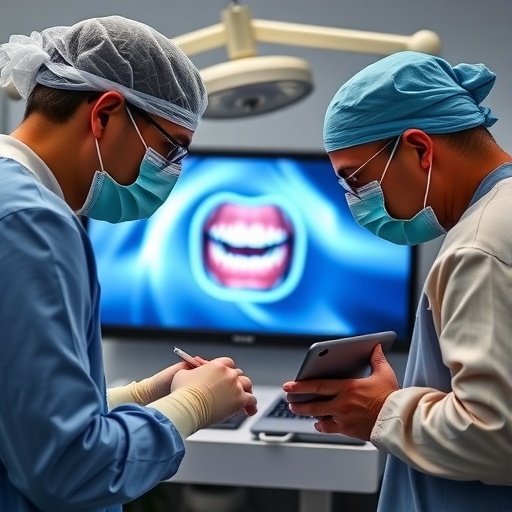
In an innovative leap within the field of medical education, recent research has illuminated the efficacy of video-enhanced training for mastering entrustable professional activities (EPAs) in preclinical oral surgery. This ground-breaking randomized controlled trial, conducted by Lin et al., seeks to establish a robust pedagogical framework that aligns with the evolving demands of professional competency in healthcare. As the landscape of medical training continues to undergo rapid transformation, the findings of this study hold immense promise for both educators and medical students alike.
The cornerstone of this research lies in the implementation of video as a primary instructional tool. Traditionally, medical education has relied heavily on lectures and textbook learning. However, in recent years, the integration of technology into educational environments has paved the way for innovative instructional strategies. The use of video not only caters to diverse learning styles but also enhances the process of skill acquisition, particularly in complex domains such as oral surgery, where precision is paramount.
Within the realm of preclinical oral surgery training, the ability to learn and practice skills in a controlled environment before working with real patients is critical. The study conducted by Lin and colleagues underscores the significance of EPAs, which are essentially units of professional practice that can be trusted to be performed unsupervised once a learner has demonstrated adequate competence. By focusing on EPAs, this research addresses a pivotal aspect of medical education—the transition from knowledge to actionable skills.
Video-enhanced training serves multiple purposes. Firstly, it provides students with visual demonstrations of surgical techniques, enabling them to observe and analyze expert practices from the comfort of their learning environments. This is particularly crucial in disciplines like oral surgery, where anatomical subtleties play a vital role in successful outcomes. Secondly, video resources can be revisited multiple times, allowing learners to absorb and understand complex procedures at their own pace, which is often not feasible during live demonstrations or lectures.
Moreover, the research methodology employed by Lin et al. lends itself to the credibility of their findings. By utilizing a well-structured randomized controlled trial framework, the researchers compared traditional training methods with video-enhanced approaches among medical students. This robust design not only strengthens the validity of the results but also provides valuable insight into the comparative effectiveness of these educational modalities in fostering skill acquisition and confidence among trainees.
One of the notable outcomes of this study is the direct correlation between video-enhanced training and student confidence levels. Participants who engaged with video resources reported feeling more assured in their abilities to perform specific surgical tasks. This enhancement of confidence is a vital component of medical training; without it, even the most knowledgeable students may hesitate when faced with real-life clinical challenges.
In addition to bolstering confidence, the study’s findings indicate that video-enhanced training significantly improves skill retention. Long-term retention of surgical techniques is imperative in medical practice, as the field continually evolves with emerging technologies and methodologies. By equipping students with the ability to revisit and refine their skills through video, this research provides a sustainable framework for lifelong learning in healthcare.
Another critical aspect highlighted in the research is the importance of feedback mechanisms in the training process. The study suggests that video not only serves as a passive learning tool but also encourages active engagement through self-analysis. Trainees who self-review their performances alongside instructional videos exhibit greater awareness of their proficiency levels, which translates to targeted efforts for improvement. This self-directed learning approach is essential in nurturing independent clinicians who can adapt to the dynamic nature of medical practice.
As the study opens up discussions on educational reform within medical training, it is evident that traditional methods are no longer sufficient to meet the challenges of modern healthcare education. The integration of video into curricula, as advocated by Lin et al., supports a shift toward more interactive and student-centered approaches. This paradigm shift is not merely a trend; it reflects an urgent need for educational institutions to adapt to the digital age and harness the potential of technology to enhance learning outcomes.
The application of video-enhanced training is not limited to oral surgery alone. The implications of this research extend across various medical disciplines, suggesting that the principles of the study can be adopted in other fields that require hands-on practice and critical skill development. Whether it’s surgical techniques, diagnostic procedures, or patient interaction scenarios, the benefits of video-enhanced learning can revolutionize how competencies are taught in medical education.
In conclusion, the research conducted by Lin et al. sets a vital precedent for the future of medical training, emphasizing the role of innovative educational strategies in foster clinical competencies. The integration of video resources into preclinical oral surgery represents a significant shift toward more effective training paradigms, ensuring that future healthcare providers are not only knowledgeable but also confident and skilled practitioners. As the medical field continues to evolve, embracing such innovative approaches will undoubtedly play a crucial role in shaping the next generation of healthcare professionals, ultimately benefiting patient care and safety in an increasingly complex healthcare landscape.
By focusing on the vital importance of EPAs and the role technology plays in education, this research underlines the necessity of continuous adaptation and improvement within medical curricula. In a world where competency-based training is becoming the norm, the findings from this study provide a clear roadmap for educational reforms that can enhance the readiness of medical students and, consequently, the quality of care provided to patients.
In essence, Lin et al.’s findings illuminate a pathway that not only aids in the training of future clinicians but also drives the ongoing evolution of medical education as it responds to the ever-changing technological landscape. The implications are significant, and the future of medical training looks brighter as we increasingly embrace innovative approaches that prioritize competence, confidence, and comprehensive learning methodologies.
As we look toward the horizon, it is clear that education in the medical field must embrace the tools of the future. The incorporation of video training is one step in a larger movement geared toward equipping healthcare practitioners with the skills they need to succeed in an unpredictable and demanding environment. Comprehensive, well-rounded medical training is not just a goal; it is a necessity in ensuring the highest standards of care for patients around the world.
Subject of Research: Video-enhanced training for entrustable professional activities in preclinical oral surgery.
Article Title: Video-enhanced training for entrustable professional activities in preclinical oral surgery: a randomized controlled trial.
Article References:
Lin, Y., Wen, Z., Li, Y. et al. Video-enhanced training for entrustable professional activities in preclinical oral surgery: a randomized controlled trial. BMC Med Educ (2025). https://doi.org/10.1186/s12909-025-08368-0
Image Credits: AI Generated
DOI: 10.1186/s12909-025-08368-0
Keywords: video-enhanced training, entrustable professional activities, preclinical oral surgery, medical education, randomized controlled trial.


