

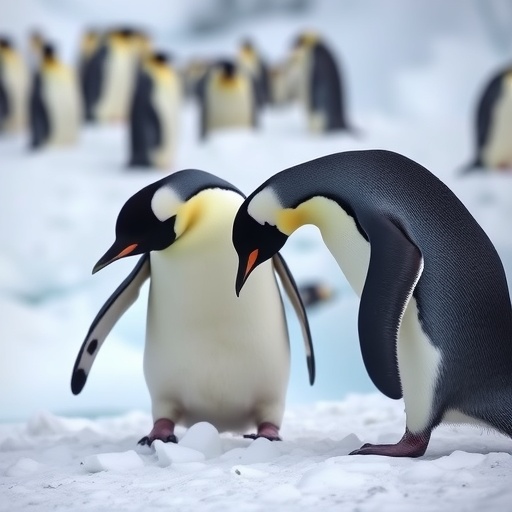
In the remote and pristine realms of East Antarctica, the intricate web of life continues to reveal surprising and underappreciated connections that are critical to understanding ecosystem dynamics in a rapidly changing climate. A recent groundbreaking study has illuminated a previously elusive trophic interaction: the consumption of shelled pteropods by Adélie penguins. This discovery was made possible through the innovative use of animal-borne video loggers, a technological advance that offers unprecedented glimpses into the feeding behavior of these iconic Antarctic seabirds.
Pteropods, often referred to as “sea butterflies,” are free-swimming marine gastropods belonging to the suborder Thecosomata. These tiny, delicate creatures form an essential link in the Southern Ocean food web, serving as a pivotal prey item for various marine predators. However, direct evidence of higher trophic predators actively preying upon Thecosomata has been remarkably sparse, leaving significant gaps in our understanding of Antarctic ecosystem interactions. This new research fills a crucial void by confirming that Adélie penguins opportunistically hunt and ingest these shelled mollusks during foraging episodes.
The study utilized a sample of eight chick-rearing Adélie penguins, evenly split between females and males, outfitted with cutting-edge time-delay cameras activated by saltwater immersion and complemented by GPS sensors that recorded spatial data every 10 seconds. The cameras, equipped to record up to 12 hours of underwater footage, provided a detailed and unfiltered record of foraging activity as these penguins pursued sustenance beneath the icy waters.
Analyzing over 86 hours of meticulously reviewed video footage, researchers found that seven out of the eight monitored penguins captured and consumed shelled pteropods. Specifically, prey species such as Clio pyramidata and Limacina rangii were identified with reasonable confidence. Remarkably, in two individuals, pteropods comprised more than 60% of the observed diet during the monitored dives, underscoring the substantial role these mollusks can play in the penguins’ nutritional intake under certain conditions.
The study posits that this dietary pattern may reflect a blend of factors including individual penguin foraging preferences, energetic demands, environmental prey availability, and perhaps the learned experience of exploiting dense aggregations of pteropods. When encountering swarms or patches with high pteropod density, the penguins appeared to capitalize on this readily accessible food resource, potentially as an adaptive strategy in the face of fluctuating krill populations or other more traditional prey shortages.
Despite these findings, the authors caution against interpreting pteropods as the primary target in the Adélie penguins’ diet. Krill still emerged as the dominant food source during the recorded foraging trips, followed by pteropods, with other prey items comprising the remainder of the diet. Krill and fish remain the most energetically profitable prey, yet the opportunistic and sometimes substantial consumption of pteropods suggests a nuanced dietary flexibility that may be crucial for survival as oceanic conditions evolve.
This trophic flexibility gains further significance in light of ongoing climate change and ocean acidification, particularly considering the known sensitivity of shelled pteropods to shifts in carbonate chemistry caused by rising CO2 concentrations. The vulnerability of pteropods to acidification not only threatens their populations but also potentially disrupts the complex food webs that depend on them, including top predators such as Adélie penguins. Recognizing pteropods as a viable and sometimes important food source introduces fresh considerations for ecological forecasting and conservation strategies in Southern Ocean ecosystems.
One of the study’s pioneering achievements lies in the direct visual evidence captured of Adélie penguins consuming shelled pteropods—a feat not accomplished prior to this research. This approach provides an invaluable methodological contribution by validating assumptions about dietary breadth and foraging adaptability through empirical observation rather than inference from indirect dietary markers.
Still, the researchers acknowledge key limitations in the scope of their study. The findings derive from data collected from a single penguin colony during just one season, with video recordings representing only the initial half of some foraging trips, which in reality can last up to 34 hours. These constraints emphasize the necessity of expanding research to multiple colonies and across multiple years to ascertain the consistency and ecological significance of this trophic link.
Looking forward, the research team aims to broaden their investigative lens to determine whether opportunistic pteropod predation is a persistent feature throughout time and across broader geographic ranges or if it emerges only under certain environmental or biological conditions. Such longitudinal and spatial studies are critical to delineate the potential role of pteropods in the penguins’ diet amidst shifting ecological baselines driven by climate change.
The implications of this research extend beyond descriptive natural history, offering crucial insights into ecosystem resilience and trophic connectivity in polar marine environments. By unveiling an underrepresented pathway within the Antarctic food web, scientists can better predict how energy flows may shift and how species might adapt or struggle to survive as their habitats face unprecedented stressors.
This work was spearheaded by researchers from the National Institute of Polar Research (NIPR) in Japan in collaboration with French colleagues from the Centre d’Etudes Biologiques de Chizé at La Rochelle Université and the Université de Strasbourg. The study was supported financially by institutions including the World Wide Fund for Nature UK, the Japan Society for the Promotion of Science (JSPS KAKENHI), and the Institut Polaire Française Paul-Émile Victor.
The National Institute of Polar Research, a pivotal institution in polar science, excels in interdisciplinary investigations that span atmospheric sciences, ice dynamics, geomagnetism, and biosciences. By leveraging advanced observational infrastructure and fostering international scientific cooperation, NIPR continues to illuminate the complexities of Arctic and Antarctic environments against the backdrop of global change.
Ultimately, the revelation that Adélie penguins include shelled pteropods in their diet not only broadens the understanding of Antarctic trophic interactions but also spotlights how flexible foraging strategies may underpin survival in ecosystems subjected to rapid environmental transformations. As the polar regions warm and the chemistry of the Southern Ocean changes, deciphering such ecological nuances will be paramount for conserving the resilience and biodiversity of this fragile frontier.
Subject of Research: Antarctic marine ecology, trophic relationships, Adélie penguin foraging behavior, pteropod consumption, Southern Ocean ecosystem dynamics.
Article Title: First Direct Evidence of Shelled Pteropod Consumption by Adélie Penguins Reveals Novel Trophic Link in the Southern Ocean.
News Publication Date: March 16, 2026.
Web References: https://www.nipr.ac.jp/english/, https://www.rois.ac.jp/en/, http://dx.doi.org/10.1007/s00227-026-04827-4
References: Watanabe, H.T., Takahashi, A., Kato, A., Marcouillier, L., Angelier, F., Ropert-Coudert, Y., Raclot, T. (2026). Marine Biology, DOI: 10.1007/s00227-026-04827-4
Image Credits: National Institute of Polar Research (NIPR).
Keywords: Adélie penguins, pteropods, Thecosomata, Southern Ocean, trophic interactions, marine ecology, climate change, ocean acidification, animal-borne video loggers, Antarctic ecosystem.


