


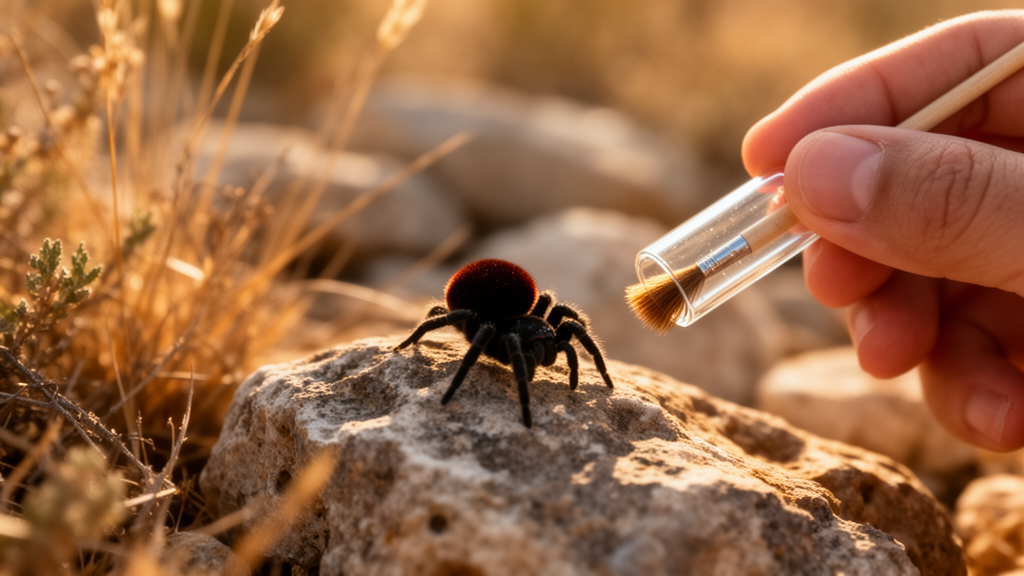
For nearly three decades, one of the Caucasus’s most striking spiders has kept its best-kept secret underground. Eresus lavrosii, a velvet spider with an unmistakable white-and-black male, was described in 1997 from just three specimens collected near Udzo Monastery in Georgia. Since then, every record of the species — from Türkiye, Iran, and Armenia — has been based solely on males. Now, a team working under the Caucasus Barcode of Life project has finally described the female for the first time, ending a 28-year wait and opening a window into the hidden life of a spider that spends most of its existence beneath the soil.
The discovery, published in the journal Caucasiana, is more than a taxonomic formality. In the genus Eresus, commonly known as ladybird spiders, the two sexes lead radically different lives. Adult females and juveniles are strictly subterranean and sedentary, rarely leaving their silk-lined burrows, while adult males wander above ground in search of mates during a short spring copulation period. This split lifestyle explains why, of the 25 known species and five subspecies in the genus, both sexes have been formally described for only six. The female of E. lavrosii had remained undiscovered for over two decades despite the species’ growing fame among arachnologists.
The breakthrough came in May 2021, when a male and a copulated female — complete with a secretion mating plug — were collected from the same burrow at Kiketi, on the edge of a deciduous forest meadow at 1,088 meters above sea level. The pair was preserved in 96 percent ethanol and stored at the scientific collections of Ilia State University in Tbilisi. To confirm the female’s identity beyond morphological comparison, the researchers sequenced a 658-base-pair fragment of the COI mitochondrial gene from both specimens. The sequences were identical to each other, with a p-distance of zero percent, and perfectly matched reference sequences of E. lavrosii from Türkiye in the BOLD Systems database, assigned to the same Barcode Index Number, BOLD:AEE3321.
Morphologically, the new female diagnosis is a masterclass in fine detail. Females of E. lavrosii resemble those of the related E. moravicus in having a cephalic region covered with dense short yellow hair and a uniformly black abdomen. But they can be distinguished by a suite of characters: yellow and off-white macrosetae on the underside of the first four leg segments and on the sternum, which are completely black in E. moravicus; a shorter and wider epigyne with a significantly more extensive median lobe; more globular anterior sections of the copulatory ducts; longer epigynal fissures with almost straight anterior tips; and yellow setae that stop short of the midline of the head region. The adult female measures 14.21 millimeters in total length, with a carapace 7.25 millimeters long and 5.38 wide, dark red-brown in alcohol but black in life.
The species’ own history is as colorful as its males. Mcheidze described the first three males in 1997 and originally named the species E. lavrosiae — a lapsus calami, or slip of the pen, corrected under the International Code of Zoological Nomenclature — in honor of her husband, Lavrosi Kutubidze. In striking contrast to the bright red abdomens typical of male ladybird spiders, males of E. lavrosii bear white abdomens marked with a broad, continuous, oval-shaped black patch with irregular ridges. For more than two decades the species was considered a local endemic of Georgia, known only from its type locality, before records from Türkiye in 2020, Iran in 2022, and Armenia in 2023 pushed its known range southward. The new study adds Azerbaijan, marking the first record from that country.
To understand the species’ ecology, the researchers combined traditional fieldwork with citizen science. They mined publicly available data from iNaturalist, the Georgian Biodiversity Database, and the Facebook group Wildlife in Georgia, aggregating GPS records to produce a distribution map. The species turns out to inhabit altitudes from roughly 800 to 2,300 meters, favoring woodland edges, forest clearings, and temperate grasslands. Phenological data show that copulation generally takes place in the second half of spring, when the mean weekly maximum air temperature hovers around 16 degrees Celsius, with the earliest males appearing in late February and the latest in early June.
At the type locality near Udzo Monastery in Kojori, the team delimited a 50-square-meter plot and counted every occupied burrow on 27 May 2024, marking each with colored flags to prevent double counting. They found 80 inhabited burrows, yielding a population density of 1.6 burrows per square meter. Spiders were extracted from 15 burrows, revealing a single subadult, six juveniles, and eight adults. Because subadults are nearly the same size as adults, the researchers used burrow entrance diameter as a proxy for age: juveniles occupy burrows with a mean diameter of 9.3 millimeters, significantly smaller than the 15.4-millimeter burrows of adults. Extrapolating across the remaining 75 burrows, they estimated 32 were occupied by juveniles, giving a juvenile-to-adult ratio of roughly one to 1.5. The variation in age structure, combined with the population’s density and proximity to a neighboring population about 500 meters away, points to high viability.
The natural diet of E. lavrosii proved equally revealing. Members of the genus Eresus construct sheet-like tents above their burrow entrances, which serve both as camouflage and as storage for prey remains attached to the inner side. The researchers collected 110 webs — 70 from adult burrows and 40 from juvenile burrows — a month after measuring the burrows, and identified 888 prey remains under a stereo microscope. The remains represented at least 87 taxa from 10 orders of arthropods, ranging from large prey such as the ground beetle Carabus adamsi and the European field cricket Gryllus campestris to tiny ants of the genus Tetramorium and the weevil beetle Ceratapion onopordi. Adults fed mainly on beetles, ants, pill bugs, and millipedes, which together made up 78 percent of the remains in their webs.
Juveniles, by contrast, showed a diet dominated by ants, which accounted for more than 62 percent of prey in their webs compared with roughly 20 percent in adults. Beetles were the second-most abundant prey in the juvenile diet at about 18 percent. The researchers suggest that ants found in adult webs were likely consumed during the spiders’ juvenile stage, given the shift in diet with age. The broad prey spectrum, spanning ground-dwelling beetles, ants, isopods, and millipedes, confirms that E. lavrosii is a generalist predator whose diet reflects the dominant ground arthropod fauna of its habitat. Notably, at the time of web collection, all adult females carried cocoons, hinting at synchronized reproduction within the population.
Beyond completing the species’ description, the study underscores how much remains to be learned about even seemingly well-studied spiders. Velvet spiders are unusual among araneomorph spiders for their longevity, subsocial lifestyle, and low dispersal ability, traits that create a gradient of age structure within populations and make them valuable subjects for conservation research. The combination of morphological diagnosis, DNA barcoding, ecological survey, and citizen science data demonstrates a modern template for documenting poorly known species. With the female finally in the spotlight, E. lavrosii — once a burrow-dwelling enigma known from three males — now stands as one of the better-understood velvet spiders of the Caucasus, even as its full story continues to unfold across Georgia, Türkiye, Armenia, Iran, and Azerbaijan.
Subject of Research: First description of the female of the velvet spider Eresus lavrosii with notes on its natural history
Article Title: From burrows to spotlight: first description of the female of Eresus lavrosii Mcheidze, 1997 ( Araneae , Eresidae ), with notes on the natural history
Article References: Seropian, A., Bulbulashvili, N., Makharadze, G., & Kovács, G. (2025). From burrows to spotlight: first description of the female of Eresus lavrosii Mcheidze, 1997 (Araneae, Eresidae), with notes on the natural history. Caucasiana, 4, 1-14. https://doi.org/10.3897/caucasiana.4.e151922
Image Credits: AI Generated
DOI: 10.3897/caucasiana.4.e151922
Keywords: Eresus lavrosii, Eresidae, velvet spiders, ladybird spiders, Georgia, Caucasus, taxonomy, spider ecology, COI barcoding, citizen science, population density, spider diet
Cite Scienmag News
Gavin Prescott. (October 17, 2026). Velvet Spider Mystery Solved as Scientists Finally Describe Elusive Female After 28 Years. Scienmag. https://scienmag.com/velvet-spider-mystery-solved-as-scientists-finally-describe-elusive-female-after-28-years/
Gavin Prescott. "Velvet Spider Mystery Solved as Scientists Finally Describe Elusive Female After 28 Years." Scienmag, 17 October 2026, https://scienmag.com/velvet-spider-mystery-solved-as-scientists-finally-describe-elusive-female-after-28-years/. Accessed 17 October 2026.
Gavin Prescott. "Velvet Spider Mystery Solved as Scientists Finally Describe Elusive Female After 28 Years." Scienmag. October 17, 2026. https://scienmag.com/velvet-spider-mystery-solved-as-scientists-finally-describe-elusive-female-after-28-years/


