

Tuesday, July 28, 2026
Science
No Result
View All Result
  • Login
  • HOME
  • SCIENCE NEWS
  • CONTACT US
  • HOME
  • SCIENCE NEWS
  • CONTACT US
No Result
View All Result
Scienmag
No Result
View All Result
Home Science News Medicine

Vector-Based Olfactory Navigation Strategy Revealed in Drosophila Flies

July 28, 2026
in Medicine, Technology and Engineering
Reading Time: 2 mins read
0
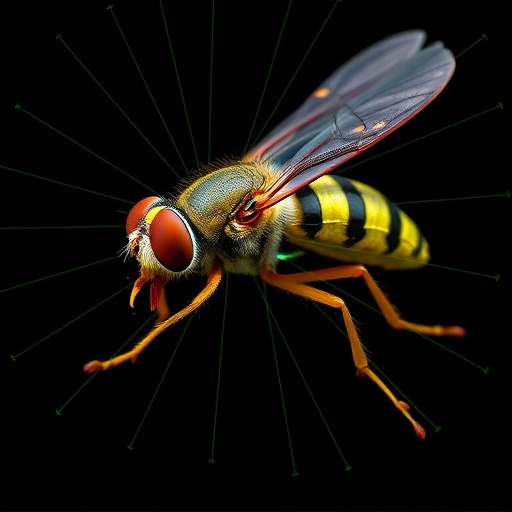
Vector-Based Olfactory Navigation Strategy Revealed in Drosophila Flies

Vector-Based Olfactory Navigation Strategy Revealed in Drosophila Flies

65
SHARES
587
VIEWS
Share on FacebookShare on Twitter
ADVERTISEMENT

Flies hunting airborne odor plumes do more than follow scent—they “edge track,” repeatedly steering along the moving boundary between odor and no-odor. In a new Nature study, researchers probe how small insects build and refine a memory of plume direction while crossing that boundary, focusing on the angular information flies likely extract from each exit and re-entry.

Although odor corridors can span a 180° range, the team finds that flies adopt a narrow set of angles that depends on plume geometry. This consistency suggests a simple yet powerful mechanism: whenever a fly crosses the plume’s boundary, it stores its heading relative to wind as an angular memory. Subsequent boundary encounters then use these memories to bias trajectories toward efficient re-tracking.

To formalize the idea, the authors build a switching state-space model in which simulated flies alternate between two functional regimes: “leaving” and “returning.” These states are not merely inside-versus-outside plume epochs; instead, transition rates depend on odor presence. Crucially, the model’s velocity is generated by an autoregressive process whose correlation timescale and noise depend on the current regime.

The model also incorporates memory: in the leaving state, motion is biased by an exit-angle memory updated each time the simulated fly exits the plume, whereas in the returning state, motion is biased by an entry-angle memory updated each time it re-enters. Each update blends the prior memory with the current heading, making the remembered direction gradually adapt with experience.

Using variational inference, the researchers infer latent leaving and returning states and latent goal directions from individual trajectories across plume geometries. The resulting parameter sets vary across simulated individuals, matching behavioral heterogeneity observed in real flies—some adhere tightly to the boundary, while others take longer, more circuitous excursions before returning.

When the authors simulate trajectories with average learned parameters, the model reproduces key experimental outcomes: path efficiency relative to perpendicular distance from the plume boundary, and similar behavioral statistics across plume orientations. The first outside bout is excluded, reflecting the model’s need for an entry-angle memory before a meaningful return goal can form.

Testing memory necessity reveals a striking asymmetry. Removing entry-angle memory severely disrupts edge tracking across all plume orientations, indicating that dynamic entry angles actively instruct an angular goal for returns to the plume boundary. By contrast, continuous updating of exit-angle memory is less critical—while a purely upwind or resampled exit memory degrades performance in some geometries, it does not abolish edge tracking outright.

Finally, operant-style training experiments connect directly to the model: a single session enhances the ability to track a later plume segment oriented oppositely, consistent with rapid strengthening of crosswind components in the inferred entry-angle goal. Together, the work supports a vector-based navigational strategy in which stable exit bias helps steering, but fast, experience-driven entry memories provide the decisive instruction for progression along odor boundaries.

Subject of Research:
Drosophila olfactory navigation and edge tracking under wind-driven odor plumes

Article Title:
A vector-based strategy for olfactory navigation in Drosophila

Article References:
Siliciano, A.F., Minni, S., Morton, C. et al. A vector-based strategy for olfactory navigation in Drosophila. Nature (2026). https://doi.org/10.1038/s41586-026-10827-7

Image Credits:
AI Generated

DOI:
https://doi.org/10.1038/s41586-026-10827-7

Keywords:
Drosophila, olfactory navigation, plume tracking, edge tracking, wind direction memory, state-space model, vector-based strategy, variational inference, behavioral modeling

Tags: adaptive flight strategies in fliesangular memory in olfactory navigationboundary edge tracking in insectscomputational models of insect olfactionDrosophila odor-guided behaviorodor memory formation in insectsodor plume tracking mechanismsolfactory navigation in fliesstate-space modeling of insect movementswitching regimes in insect movementvector-based navigation strategieswind direction and odor source localization
Share26Tweet16
Previous Post

Long COVID and ME/CFS Alter Skeletal Muscle Properties Differently Than Bed Rest

Next Post

Nagoya Institute Scientists Identify Molecular Basis of Red-Green Color Vision

Related Posts

Researchers Create Sustainable Material From Plants to Help Body Rebuild
Technology and Engineering

Researchers Create Sustainable Material From Plants to Help Body Rebuild

July 28, 2026
Blood Tests Detect Alzheimer’s in People With Down Syndrome, Study Finds
Medicine

Blood Tests Detect Alzheimer’s in People With Down Syndrome, Study Finds

July 28, 2026
Long COVID and ME/CFS Alter Skeletal Muscle Properties Differently Than Bed Rest
Medicine

Long COVID and ME/CFS Alter Skeletal Muscle Properties Differently Than Bed Rest

July 28, 2026
Chemical distance model may predict which trace elements plants absorb
Technology and Engineering

Chemical distance model may predict which trace elements plants absorb

July 28, 2026
Primary Care Doctors Compare Tradeoffs Between Salaried Employment and Private Practice
Medicine

Primary Care Doctors Compare Tradeoffs Between Salaried Employment and Private Practice

July 28, 2026
Columbia’s PROGRESS Study Lays Out Methods for Genetic Risk in Autism
Technology and Engineering

Columbia’s PROGRESS Study Lays Out Methods for Genetic Risk in Autism

July 28, 2026
Next Post
Nagoya Institute Scientists Identify Molecular Basis of Red-Green Color Vision

Nagoya Institute Scientists Identify Molecular Basis of Red-Green Color Vision

  • Mothers who receive childcare support from maternal grandparents show more

    Mothers who receive childcare support from maternal grandparents show more parental warmth, finds NTU Singapore study

    27656 shares
    Share 11059 Tweet 6912
  • University of Seville Breaks 120-Year-Old Mystery, Revises a Key Einstein Concept

    1061 shares
    Share 424 Tweet 265
  • Bee body mass, pathogens and local climate influence heat tolerance

    682 shares
    Share 273 Tweet 171
  • Researchers record first-ever images and data of a shark experiencing a boat strike

    546 shares
    Share 218 Tweet 137
  • Groundbreaking Clinical Trial Reveals Lubiprostone Enhances Kidney Function

    531 shares
    Share 212 Tweet 133
Science

Embark on a thrilling journey of discovery with Scienmag.com—your ultimate source for cutting-edge breakthroughs. Immerse yourself in a world where curiosity knows no limits and tomorrow’s possibilities become today’s reality!

RECENT NEWS

  • Toward a theory for stable Earth albedo and 21st-century hemispheric symmetry
  • Researchers Create Sustainable Material From Plants to Help Body Rebuild
  • New Insights Into the Microbiome and Its Metabolites Illuminate Health
  • Thermodynamics Explained for Spinning Particles

Categories

  • Agriculture
  • Anthropology
  • Archaeology
  • Athmospheric
  • Biology
  • Biotechnology
  • Blog
  • Bussines
  • Cancer
  • Chemistry
  • Climate
  • Earth Science
  • Editorial Policy
  • Marine
  • Mathematics
  • Medicine
  • Pediatry
  • Policy
  • Psychology & Psychiatry
  • Science Education
  • Social Science
  • Space
  • Technology and Engineering

Subscribe to Blog via Email

Enter your email address to subscribe to this blog and receive notifications of new posts by email.

Join 5,146 other subscribers

© 2025 Scienmag - Science Magazine

Welcome Back!

Login to your account below

Forgotten Password?

Retrieve your password

Please enter your username or email address to reset your password.

Log In
No Result
View All Result
  • HOME
  • SCIENCE NEWS
  • CONTACT US

© 2025 Scienmag - Science Magazine

Discover more from Science

Subscribe now to keep reading and get access to the full archive.

Continue reading
