


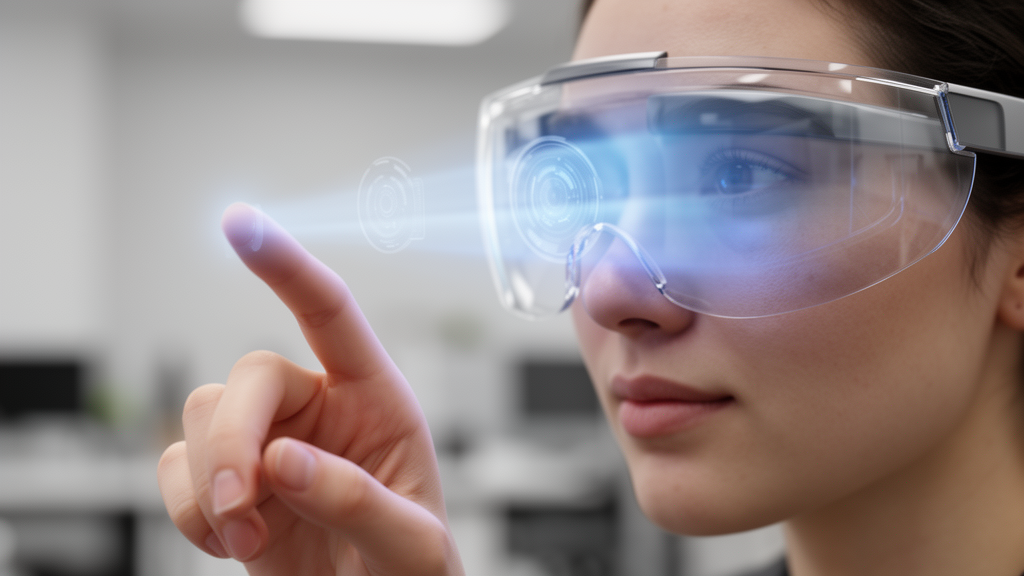
Most virtual reality and augmented reality displays present virtual objects at a fixed focal distance, creating a fundamental mismatch between where the eyes converge and where they focus. This optical discrepancy, known as the vergence-accommodation conflict, can hinder user comfort and interaction efficiency. To address this challenge, researchers from the Shibaura Institute of Technology and international partners developed a custom varifocal augmented reality display that dynamically adjusts its focal plane to match the depth of virtual objects. The system combines real-scene light with virtual images reflected by a spherical mirror and beamsplitter, allowing the display to reproduce natural focusing cues. By testing this hardware in a controlled experimental setting, the team investigated whether reducing this conflict could enhance 3D pointing performance without compromising accuracy.
The research team, led by Assistant Professor Xiaodan Hu from the Shibaura Institute of Technology in Japan, included experts from Japan, China, and Canada. Collaborators included Dr. Monica Perusquía-Hernández and Dr. Kiyoshi Kiyokawa from the Nara Institute of Science and Technology, Dr. Yan Zhang from Shanghai Jiaotong University, and researchers from the University of Calgary, Concordia University, and Simon Fraser University. The collaboration integrated hardware development and user studies from the Asian team with interaction experiment design from the Canadian team. Their findings were published online on August 28, 2026, in the journal Virtual Reality, offering a peer-reviewed examination of how adaptive focus mechanisms influence human-computer interaction in immersive environments.
The experimental design involved testing whether a varifocal display could improve 3D pointing tasks compared to fixed-focal viewing. Participants used a tracked wand to select virtual targets of varying sizes and distances within a stereoscopic augmented reality prototype. The researchers measured movement time, error rates, and throughput, which serves as a measure of task efficiency. The study consisted of two phases: the first involved 24 participants, followed by a second study with 12 additional participants to verify the hardware’s performance and consistency. The second study was conducted to verify the hardware’s performance.
In the first study, varifocal viewing significantly reduced movement time and increased information throughput compared to fixed-focal conditions. Error rates did not change significantly, indicating that the faster performance did not come at the cost of accuracy. The benefits appeared more pronounced for movements in depth, although the difference by direction was only borderline significant for throughput. These results suggest that adjusting focal distance can improve how people interact with virtual objects, extending beyond mere visual perception to tangible gains in motor performance. The findings highlight the potential for varifocal displays to make augmented reality interactions more effective and efficient.
Despite the overall improvements, the benefits varied among individual users, highlighting the importance of individual differences in human-computer interaction. Dr. Hu noted that users do not all benefit equally, making individual differences a critical question for future research. Variations in binocular vision or depth perception may contribute to these differences, although these specific factors were not measured in the current study. The prototype also had a limited field of view and did not use eye tracking to adjust focus, which limits its resemblance to everyday augmented reality use. These limitations underscore the need for further investigation into how displays might adapt to individual needs and how user characteristics predict greater benefits.
The study did not test long-term eye health or establish that the technology prevents eyestrain, focusing instead on immediate performance metrics. Participants’ ratings showed no clear preference between display modes, and reported discomfort was mild.
The technical implementation of the varifocal display involved a sophisticated optical setup that allows for dynamic adjustment of the focal plane. The system uses a spherical mirror and beamsplitter to combine real-scene light with virtual images, enabling the display to match the focus to the depth of the virtual object. This hardware approach addresses the vergence-accommodation conflict by providing natural focusing cues, which are often missing in traditional augmented reality headsets. The prototype’s design offers a basis for evaluating personalized augmented reality systems that can adapt to individual visual characteristics.
The findings indicate that reducing the vergence-accommodation conflict with varifocal technology can improve 3D pointing performance, while highlighting the need to understand why responses vary among users.
Future studies can examine which user characteristics predict greater benefits and how displays might adapt to individual needs, as suggested by Dr. Hu. This work offers a basis for evaluating personalized augmented reality systems that can tailor their focus adjustments to the user’s visual profile.
Subject of Research: Varifocal augmented reality displays and their impact on 3D pointing performance
Article Title: Adaptive-focus displays could make virtual and augmented reality interactions more effective
Article References: Adaptive-focus displays could make virtual and augmented reality interactions more effective. Original publication (Bibliographic details unavailable.)
Image Credits: AI Generated
DOI: Not provided
Keywords: augmented reality, varifocal display, vergence-accommodation conflict, 3D pointing, human-computer interaction, optical see-through, Shibaura Institute of Technology, Virtual Reality journal, eye tracking, display technology, Adaptive-focus, displays
Cite Scienmag News
Bethany Barker. (November 11, 2026). Varifocal Displays Improve AR Pointing Speed and Efficiency. Scienmag. https://scienmag.com/varifocal-displays-improve-ar-pointing-speed-and-efficiency/
Bethany Barker. "Varifocal Displays Improve AR Pointing Speed and Efficiency." Scienmag, 11 November 2026, https://scienmag.com/varifocal-displays-improve-ar-pointing-speed-and-efficiency/. Accessed 22 November 2026.
Bethany Barker. "Varifocal Displays Improve AR Pointing Speed and Efficiency." Scienmag. November 11, 2026. https://scienmag.com/varifocal-displays-improve-ar-pointing-speed-and-efficiency/




