

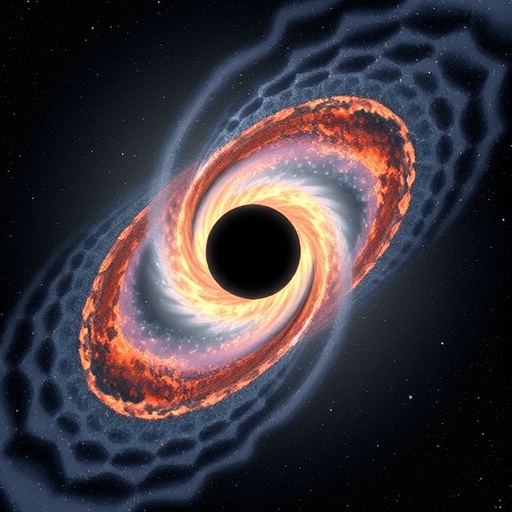
The enigmatic realm of black holes has long captured the imagination of astronomers and physicists alike, evolving dramatically with the advancement of observational technologies. Recent years have witnessed groundbreaking detections of stellar-mass black holes through gravitational wave observatories such as LIGO, Virgo, and KAGRA. Complementing this progress, the James Webb Space Telescope (JWST) has unveiled a surprisingly large population of supermassive black holes in the early Universe, challenging our conventional paradigms about black hole growth and assembly. Yet, amid these monumental discoveries, a critical mass scale remains conspicuously elusive—the intermediate-mass black holes (IMBHs). Their existence is hypothesized to bridge the gap between the well-confirmed stellar-mass black holes and their gargantuan supermassive counterparts, but definitive evidence for IMBHs remains tantalizingly out of reach.
The intermediate-mass black holes are hypothesized to range between hundreds to hundreds of thousands of solar masses, a crucial range that encapsulates the hierarchical growth epochs leading to the formation of supermassive black holes. Understanding this missing link is not just a matter of filling in a cosmic census; it offers profound insights into the very mechanisms that govern black hole formation and evolution across cosmic time. The search for IMBHs has proven exceptionally challenging because traditional detection techniques, which primarily rely on either accretion signatures in active galactic nuclei (AGN) or dynamical effects on surrounding stars, have failed to deliver conclusive detections. This absence is partly due to their expected quiescent nature and the observational biases inherent in current surveys.
In addressing this vexing puzzle, a novel paradigm is emerging that leverages the temporal domain of astrophysical observations. Time-domain astronomy—the study of how celestial objects vary over timescales from milliseconds to decades—holds the key to uncovering the hidden population of IMBHs. Unlike static imaging or single-epoch spectroscopy, time-domain observations capture the dynamic processes that may reveal IMBH signatures through characteristic variability patterns in AGN light curves or in tidal disruption events (TDEs) when stars are shredded as they stray too close to the black hole. Variability offers a unique diagnostic because it encodes information about the mass, accretion physics, and environment of black holes, and can distinguish IMBHs from supermassive black holes and other astrophysical sources.
Active galactic nuclei powered by accreting black holes have long been studied for their variability, but previous monitoring efforts lacked the duration, cadence, or sensitivity required to isolate signals indicative of intermediate masses. Recent advancements in time-domain observatories have transformed this landscape. High-cadence monitoring over wide fields enables the detection of low-luminosity AGN variability and facilitates the identification of rapid changes associated with less massive black holes. This shift towards comprehensive time-domain surveys represents a new frontier in black hole astrophysics, turning the dynamic sky into a treasure trove of hidden IMBH candidates ripe for investigation.
Tidal disruption events present another compelling probe for IMBH discovery. When a star ventures within the tidal radius of a black hole, intense gravitational forces can rip it apart, generating a luminous flare whose temporal and spectral profile reflects the mass of the devouring black hole. IMBH-induced TDEs are predicted to manifest with unique signatures that differ in timescale and energy output from TDEs powered by supermassive black holes. Continuous time-domain observations are critical to capturing these rare and fleeting events, and analyzing their variability profiles allows astrophysicists to infer the underlying black hole mass with unprecedented accuracy.
The forthcoming Vera C. Rubin Observatory, with its ambitious Legacy Survey of Space and Time (LSST), stands poised to revolutionize the hunt for IMBHs. Its unparalleled ability to survey the dynamic sky repeatedly over the entire southern hemisphere every few nights will provide extensive, high-precision light curves for vast numbers of variable sources. This dataset will enable researchers to identify subtle variability indicative of IMBH accretion activity or tidal disruption phenomena across cosmological distances. The Rubin Observatory’s combination of depth, cadence, and sky coverage is perfectly suited to untangle the complex variability signatures that have so far concealed intermediate-mass black holes.
Moreover, the Rubin Observatory’s data will synergize with multi-wavelength and multi-messenger astronomy programs. Coordinated observations with X-ray telescopes and gravitational wave detectors will enhance the discriminating power of time-domain variability studies, enabling cross-validation of IMBH candidates. For example, a transient X-ray flare contemporaneous with an optical variability signature could solidify the presence of an IMBH. Additionally, potential gravitational wave signals from merging IMBH binaries captured by next-generation detectors will complement electromagnetic data, painting a holistic picture of black hole demographics and formation channels.
The successful identification of intermediate-mass black holes will fill a critical gap in our understanding of black hole mass distribution, fundamentally refining models of black hole seed formation in the early Universe. Competing theories propose diverse formation mechanisms ranging from direct collapse of pristine gas clouds to runaway stellar mergers in dense star clusters; robust IMBH detections will constrain these scenarios by anchoring the mass function at intermediate scales. Furthermore, IMBHs serve as potential progenitors for supermassive black holes observed in massive galaxies, providing empirical footing for hierarchical growth frameworks that unfold over billions of years.
This breakthrough is also pivotal for understanding galaxy evolution, as black holes exert profound feedback effects on their host galaxies through accretion-driven outflows and jets. Intermediate-mass black holes residing in dwarf galaxies or globular clusters could fundamentally influence star formation and gas dynamics in these environments, with cascading effects on their larger-scale cosmic neighborhoods. The detection and detailed study of IMBHs will thus illuminate the symbiotic relationship between black holes and galactic ecosystems across epochs, offering new perspectives on the co-evolutionary dance of matter and gravity.
In this era of rapid astronomical innovation, the fusion of time-domain variability with emerging observatories heralds an exciting frontier. The elusive IMBHs are no longer just theoretical placeholders; they are within reach of empirical discovery through targeted variability analyses. Such investigations demand sophisticated data processing algorithms, machine learning classification of variable phenomena, and robust statistical modeling to differentiate genuine IMBH signals from other astrophysical variability sources. The development of these analytical tools is accelerating in tandem with observational capabilities, fostering a golden age of discovery.
As we stand on the cusp of unveiling this long-hidden population, the broader implications ripple across fundamental physics. IMBHs provide natural laboratories to test strong gravity in regimes inaccessible to stellar-mass or supermassive black holes. Their intermediate gravitational potentials offer unique opportunities to investigate accretion physics, black hole spin, and relativistic effects in novel settings. Precision timing of variability offers prospects for constraining alternative theories of gravity and probing the nature of dark matter through its interaction with black holes.
Ultimately, the quest for intermediate-mass black holes epitomizes the synergy between technological progress and scientific ambition. It exemplifies how expanding the temporal dimension of astrophysical data enriches our cosmic narratives by revealing dynamic processes previously concealed in static snapshots. Through dedicated observational campaigns and innovative methodologies, the fog of uncertainty surrounding IMBHs is beginning to lift. The imminent deluge of variability data promises to transform these enigmatic objects from hypothetical curiosities into well-characterized cosmic constituents, bridging the mass spectrum of black holes and unlocking new chapters in astrophysics.
The interdisciplinary nature of this research underscores the importance of collaborative efforts across observational astronomy, theoretical modeling, and numerical simulations. The integration of time-domain data with complementary approaches will allow scientists to build comprehensive frameworks for IMBH identification and characterization. In the coming decades, as the Vera C. Rubin Observatory fuels an explosion of time-resolved discoveries, the intermediate-mass black holes will step out from the shadows, reshaping our understanding of black hole populations and the cosmic tapestry at large. This transformative journey promises to capture the imagination and drive the scientific frontier for generations to come.
Subject of Research:
Intermediate-mass black holes (IMBHs) and their identification through time-domain variability studies.
Article Title:
Variability as a new discovery channel for intermediate-mass black holes in the time-domain era.
Article References:
Burke, C.J., Natarajan, P. Variability as a new discovery channel for intermediate-mass black holes in the time-domain era. Nat Astron (2026). https://doi.org/10.1038/s41550-025-02759-5
Image Credits:
AI Generated


