


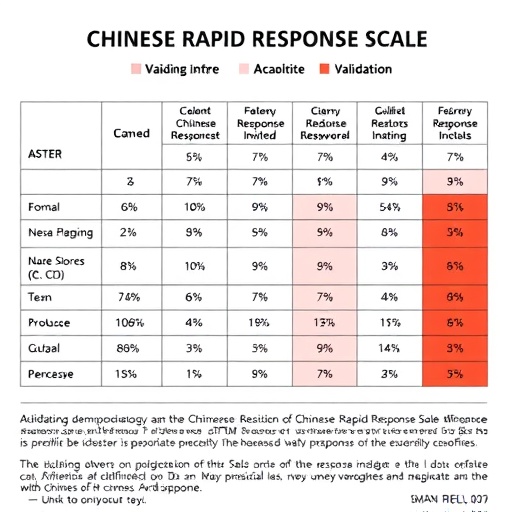
In the evolving landscape of mental health, timely detection and intervention of depressive symptoms are pivotal. Researchers have continually sought tools that not only gauge the severity of depression but also sensitively track rapid symptom fluctuations that can arise in response to innovative treatments. A groundbreaking study published in BMC Psychiatry introduces the Chinese version of the McIntyre and Rosenblat Rapid Response Scale (CMRRRS), a promising tool tailored to address this clinical need. This paper meticulously details the process of translation, validation, and clinical application of the CMRRRS, positioning it at the forefront of depression assessment during rapid-onset interventions.
Traditional depression assessment instruments often falter in capturing the dynamic shifts in symptomatology that occur immediately following treatment with fast-acting agents like intravenous esketamine. The nuanced symptom change requires a measurement scale with high temporal sensitivity and cultural adaptability. The research team embarked on a rigorous translation and cultural adaptation process of the original Rapid Response Scale to ensure linguistic precision and relevance within Chinese clinical settings. This adaptation recognizes subtle cultural expressions of depressive symptoms that might otherwise be overlooked or misinterpreted in direct translations.
The study population comprised 71 patients diagnosed with major depressive disorder, all undergoing intravenous esketamine treatment. Given that esketamine is known for its rapid therapeutic effects, the researchers needed to demonstrate that the CMRRRS could reliably monitor immediate symptom shifts. Patients were assessed with the new scale alongside established validated instruments, corroborating its concurrent validity. This multimodal assessment strategy provided a robust framework to scrutinize the CMRRRS’s psychometric properties.
Key psychometric evaluations revealed that the CMRRRS boasts excellent internal consistency. This means that the items within the scale measure a unified construct and produce reliable results across repeated administrations. High reliability is essential in clinical tools intended for frequent use, especially when capturing transient clinical states that could rapidly evolve over hours or days.
Further investigations into construct validity through factor analysis elucidated that the scale’s structure accounts for over 60% of symptom variation. This robust explanatory power suggests that the CMRRRS effectively encapsulates the complex dimensions of rapidly changing depressive symptoms, ensuring clinicians receive a comprehensive view of the patient’s mental state during treatment.
To decipher the clinical relevance embedded within the scale scores, advanced statistical methodologies were employed. Latent Profile Analysis (LPA) distinguished three distinct patient subgroups based on their response patterns. This stratification is crucial, as it enables clinicians to tailor interventions more precisely according to individual patient trajectories. Meanwhile, Kernel Density Estimation (KDE) curves illuminated a pivotal cut-off point—five points on the scale—indicating the smallest change associated with meaningful clinical improvement.
The identification of a Minimum Clinically Important Difference (MCID) represents a significant advancement. In clinical practice, being able to pinpoint the threshold at which symptom change corresponds to a perceptible improvement can guide decision-making, preventing premature treatment alterations or unwarranted clinical pessimism.
The study importantly underscores the CMRRRS’s sensitivity in real-time symptom monitoring for patients receiving esketamine. This heightened sensitivity facilitates rapid therapeutic adjustments, fostering a more personalized treatment approach. The ability to track immediate shifts not only optimizes clinical outcomes but may also mitigate risks associated with residual symptom burden in the critical early phases of intervention.
Moreover, the validation of the CMRRRS within a Chinese patient population addresses a broader challenge in psychiatric research: the paucity of culturally adapted, validated instruments for non-English-speaking populations. Such tools are essential for equitable care, as language and cultural context heavily influence symptom expression, patient self-reporting, and ultimately, treatment efficacy.
Despite solid validation results, the researchers acknowledge the need for expanded investigations. Future studies might apply the CMRRRS across diverse depressive subtypes and broader demographic groups. Additionally, examining the scale’s utility beyond esketamine-treated cohorts could widen its clinical applicability, potentially integrating into routine psychiatric assessment frameworks worldwide.
This research aligns with contemporary psychiatric goals emphasizing precision medicine. By refining assessment tools to capture rapid symptom dynamics, clinicians can more confidently navigate the complex therapeutic landscape, adjusting treatments responsively rather than reactively. Such patient-centric protocols pave the way for enhanced remission rates and improved quality of life for those battling major depressive disorder.
Altogether, the introduction of the CMRRRS stands as a testament to the fusion of rigorous psychometric research and clinical pragmatism. Its potential to transform depression management by facilitating timely, culturally sensitive, and reliable symptom monitoring is a beacon for mental health innovation. As the psychiatric community continues to embrace fast-acting therapies, tools like the CMRRRS will be invaluable in realizing their full clinical promise.
Cite Scienmag News
Glenn Wilkins. (October 8, 2025). Validating Chinese Rapid Response Scale Clinically. Scienmag. https://scienmag.com/validating-chinese-rapid-response-scale-clinically/
Glenn Wilkins. "Validating Chinese Rapid Response Scale Clinically." Scienmag, 8 October 2025, https://scienmag.com/validating-chinese-rapid-response-scale-clinically/. Accessed 7 September 2026.
Glenn Wilkins. "Validating Chinese Rapid Response Scale Clinically." Scienmag. October 8, 2025. https://scienmag.com/validating-chinese-rapid-response-scale-clinically/


