

Saturday, May 23, 2026
Science
No Result
View All Result
  • Login
  • HOME
  • SCIENCE NEWS
  • CONTACT US
  • HOME
  • SCIENCE NEWS
  • CONTACT US
No Result
View All Result
Scienmag
No Result
View All Result
Home Science News Technology and Engineering

UVA researchers drive safety forward on 3 Toyota collaborative projects

July 18, 2024
in Technology and Engineering
Reading Time: 2 mins read
0
Crash Testing
67
SHARES
606
VIEWS
Share on FacebookShare on Twitter
ADVERTISEMENT

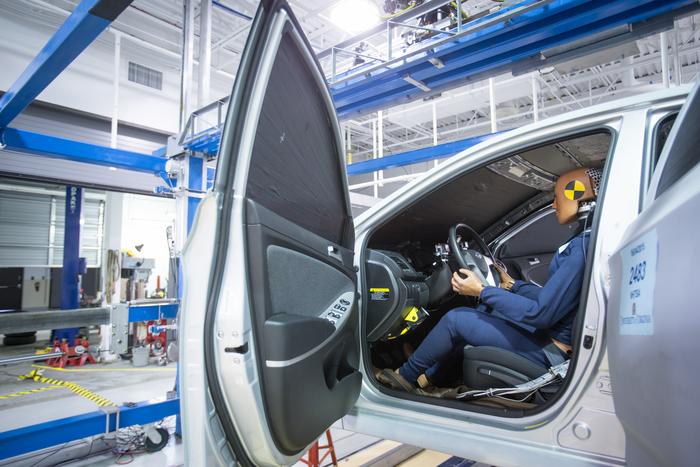
The Center for Applied Biomechanics at the University of Virginia studies the impact of car crashes on the human body, aiming to improve injury prevention. Funded by Toyota’s Collaborative Safety Research Center, CAB’s three newest projects will study rib, lumbar and ankle injuries specifically. 

Crash Testing

Credit: UVA Engineering

The Center for Applied Biomechanics at the University of Virginia studies the impact of car crashes on the human body, aiming to improve injury prevention. Funded by Toyota’s Collaborative Safety Research Center, CAB’s three newest projects will study rib, lumbar and ankle injuries specifically. 

Jason Forman, a UVA Engineering and Applied Science research associate professor in the Department of Mechanical and Aerospace Engineering, is the principal investigator on two of the studies. 

One study will use virtual simulations to measure injuries in human models, with the goal of developing a standardized process for predicting rib fractures in near- and far-side collisions.

The second study, a joint project between the center and University of Michigan Health, will use crash dummies to predict different ankle injury risks among a more diverse driver population. The study will use a tool developed from a previous project to simulate hundreds of combinations of body shape and crash characteristics, then match those conditions to virtual dummies. 

“We’re honored and grateful for our continuing collaboration with Toyota on these important projects,” Forman said. “Together, these projects will advance safety for all people, through continuing to expand our understanding of the fundamental biomechanics of the human body and how person-to-person variability can influence injury risk in an automobile collision.” 

Jason Kerrigan, the center’s director and also an associate professor of mechanical and aerospace engineering, is the principal investigator on the third study, which will look at how to better assess back injuries in crashes by using simulations of humans and crash dummies to inform new lumbar spine injury prediction measures. 


Share27Tweet17
Previous Post

Statewide Biomedical and Clinical Research Collaborative Awards granted

Next Post

Study reveals key gene protecting plants from harmful metals in soil

Related Posts

Lumacaftor/Ivacaftor Safe, Effective in Preschoolers: Study — Technology and Engineering
Technology and Engineering

Lumacaftor/Ivacaftor Safe, Effective in Preschoolers: Study

May 23, 2026
Boosting Crop Yield Accuracy with MHCNN-LSTM-MHA Model — Technology and Engineering
Technology and Engineering

Boosting Crop Yield Accuracy with MHCNN-LSTM-MHA Model

May 23, 2026
Probiotics Boost Gut Immunity in Healthy Infants — Technology and Engineering
Technology and Engineering

Probiotics Boost Gut Immunity in Healthy Infants

May 23, 2026
Postnatal Growth Effects on Preterm Toddlers’ Body Composition — Technology and Engineering
Technology and Engineering

Postnatal Growth Effects on Preterm Toddlers’ Body Composition

May 23, 2026
Vancomycin Dosing Boosts Pediatric Sepsis Treatment Outcomes — Technology and Engineering
Technology and Engineering

Vancomycin Dosing Boosts Pediatric Sepsis Treatment Outcomes

May 23, 2026
Explainable AI Predicts Pediatric Sepsis Early Using Labs — Technology and Engineering
Technology and Engineering

Explainable AI Predicts Pediatric Sepsis Early Using Labs

May 22, 2026
Next Post
Lotus japonicus

Study reveals key gene protecting plants from harmful metals in soil

  • Mothers who receive childcare support from maternal grandparents show more parental warmth, finds NTU Singapore study

    Mothers who receive childcare support from maternal grandparents show more parental warmth, finds NTU Singapore study

    27648 shares
    Share 11056 Tweet 6910
  • University of Seville Breaks 120-Year-Old Mystery, Revises a Key Einstein Concept

    1051 shares
    Share 420 Tweet 263
  • Bee body mass, pathogens and local climate influence heat tolerance

    679 shares
    Share 272 Tweet 170
  • Researchers record first-ever images and data of a shark experiencing a boat strike

    543 shares
    Share 217 Tweet 136
  • Groundbreaking Clinical Trial Reveals Lubiprostone Enhances Kidney Function

    528 shares
    Share 211 Tweet 132
Science

Embark on a thrilling journey of discovery with Scienmag.com—your ultimate source for cutting-edge breakthroughs. Immerse yourself in a world where curiosity knows no limits and tomorrow’s possibilities become today’s reality!

RECENT NEWS

  • Tropical Cyclones Trigger Unprecedented Heat Waves in Japan
  • Lumacaftor/Ivacaftor Safe, Effective in Preschoolers: Study
  • Maternal Brain Changes Linked to Neurotransmitters Postpartum
  • Evaluating Mobility Plan Impact in Swiss Geriatric Clinic

Categories

  • Agriculture
  • Anthropology
  • Archaeology
  • Athmospheric
  • Biology
  • Biotechnology
  • Blog
  • Bussines
  • Cancer
  • Chemistry
  • Climate
  • Earth Science
  • Editorial Policy
  • Marine
  • Mathematics
  • Medicine
  • Pediatry
  • Policy
  • Psychology & Psychiatry
  • Science Education
  • Social Science
  • Space
  • Technology and Engineering

Subscribe to Blog via Email

Enter your email address to subscribe to this blog and receive notifications of new posts by email.

Join 5,146 other subscribers

© 2025 Scienmag - Science Magazine

Welcome Back!

Login to your account below

Forgotten Password?

Retrieve your password

Please enter your username or email address to reset your password.

Log In
No Result
View All Result
  • HOME
  • SCIENCE NEWS
  • CONTACT US

© 2025 Scienmag - Science Magazine

Discover more from Science

Subscribe now to keep reading and get access to the full archive.

Continue reading
