

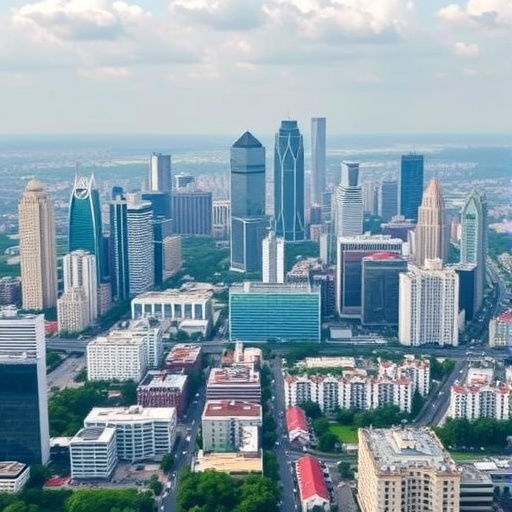
Urbanization is fundamentally altering our planet, not just in terms of landscape but also in its climate dynamics. A recent study published in Commun Earth Environ highlights a pressing concern: by the year 2100, urbanization is projected to significantly increase local surface temperatures. This research, conducted by Liu, Li, and Shi, sheds light on the intricate relationship between urban expansion and climate change, revealing critical insights that could influence how societies approach urban planning and environmental policies moving forward.
Urban areas, characterized by dense populations and extensive infrastructure, often create microclimates that differ substantially from surrounding rural areas. The phenomenon, known as the urban heat island effect, is driven by several factors inherent to city living, including concrete and asphalt surfaces that absorb and retain heat, as well as the heat generated by vehicles, industrial activities, and energy consumption. In their comprehensive study, Liu and colleagues utilized advanced modeling techniques to project how urbanization trends, currently observed in many regions around the globe, might influence localized temperature increases over the coming decades.
The implications of rising temperatures are far-reaching. Increased local surface temperatures can exacerbate existing public health challenges, particularly for vulnerable populations. Heatwaves, which are expected to become more frequent and severe due to climate change, can lead to heat-related illnesses and exacerbate respiratory conditions. The researchers emphasized the need for urban areas to adopt proactive measures to mitigate these health risks, such as enhancing green spaces, improving public transport, and implementing energy-efficient building practices.
Moreover, the study highlights the intersection of urbanization and ecological impacts, particularly in light of biodiversity loss. As cities expand, natural habitats are often fragmented or destroyed, leading to declines in local flora and fauna. Since urban regions are hotbeds of innovation and economic activity, the researchers urge cities to prioritize sustainability to reconcile the pressures of urban growth with ecological preservation. This requires a paradigm shift in how urban environments are developed, where ecological considerations are integrated into city planning processes from the very start.
The findings of Liu et al. serve as a call to action for urban planners and policymakers. With projections indicating that more than 68% of the world’s population will reside in urban areas by 2050, the challenge of managing urban heat while maintaining livable environments is critical. As cities invest in infrastructure and expand their boundaries, the authors recommend employing strategies that increase urban resilience against heat, such as installing reflective roofing materials, enhancing tree canopy coverage, and promoting the use of public green spaces.
In addition to immediate urban planning strategies, the research indicates a need for longitudinal studies that investigate the long-term impacts of urban heat on local climates. By identifying patterns and trends in temperature variation, researchers can better understand the effectiveness of various mitigation strategies. Liu and colleagues point out that while immediate adaptations are essential, long-term planning that considers climate resiliency will ultimately determine the sustainability of urban environments.
The urgency of this issue cannot be overstated. If cities do not implement these findings into their development frameworks, the consequences may include increased energy consumption due to elevated temperatures, a rise in greenhouse gas emissions, and heightened vulnerability to climate-related disasters. The multifactorial approach recommended by the study underscores the interconnectedness of urbanization and climate change, suggesting that effective solutions must address both.
As information circulates on how urbanization will shape our planetary future, the media has a pivotal role in disseminating this knowledge. Scientific findings are crucial, but translating complex data into digestible insights for the general public is equally important. Liu et al.’s study presents a compelling narrative that should resonate with urban inhabitants and leaders alike.
In essence, the researchers have effectively illuminated the critical challenge facing urban areas worldwide. The interplay of urbanization, temperature increases, and public health must be addressed comprehensively. Thus, governments, communities, and individuals need to engage in conversations about sustainable urban living practices. The steps taken today will resonate for generations to come, influencing both climate stability and the health of urban populations.
The research conducted by Liu and his team stands as a crucial contribution to understanding the future of urban environments. Their use of projection models serves as a valuable framework that other cities should adopt. As we face what is shaping up to be a pivotal century for climate action, the findings of this study will echo in the discussions that shape our cities. Urbanization may be an inevitable phenomenon, but how we choose to respond in light of this research will be crucial in defining the future of urban life amidst climate change.
Ultimately, the message from this research is clear: cities must evolve. They must change the way they operate to not only accommodate growing populations but also to protect the health and well-being of their residents in a warming world. The path to a sustainable urban future lies in the integration of innovative solutions, engagement with the public, and a commitment to environmental responsibility. As we advance towards 2100, the challenge is not just to build cities, but to build them wisely, with an eye toward imminent climate realities.
The urgency of mitigating urban heat effects will only intensify, particularly as climate models predict more severe and frequent weather extremes. Liu et al.’s study should not only inform urban policy but also inspire grassroots movements focused on sustainability. Together, these efforts can foster a more resilient and adaptive urban landscape in the face of growing climate challenges.
In conclusion, the projections made in Liu and colleagues’ research are not merely statistical forecasts but serve as a vital warning bell for communities worldwide. As urbanization continues unabated, the responsibility to mitigate its effects on local climates falls on all shoulders—governments, industries, and citizens alike. The shared goal of achieving a sustainable urban future is within reach, provided we recognize the challenges already laid out before us.
Subject of Research: Urbanization and its impact on local surface temperature by 2100.
Article Title: Urbanization is projected to increase local surface temperature by 2100.
Article References:
Liu, S., Li, X., Shi, Z. et al. Urbanization is projected to increase local surface temperature by 2100.
Commun Earth Environ 6, 988 (2025). https://doi.org/10.1038/s43247-025-02947-1
Image Credits: AI Generated
DOI: https://doi.org/10.1038/s43247-025-02947-1
Keywords: Urbanization, Climate Change, Local Temperature, Urban Heat Island Effect, Sustainability, Public Health, Urban Planning, Ecological Preservation.


