

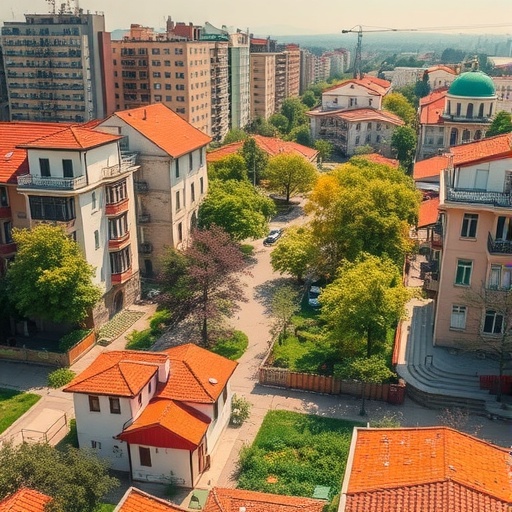
As climate change intensifies, urban areas across the United States face escalating challenges related to heat exposure and vegetation degradation. A pioneering study by Yan, Dong, Liu, and colleagues, published in npj Urban Sustainability, shines a critical spotlight on the uneven impacts of drought on urban greenery and the corresponding heat stress experienced by city dwellers. Their work provides the most detailed analysis to date on how drought conditions disproportionately affect different neighborhoods, exposing stark environmental and social inequalities that demand urgent attention.
Urban vegetation plays a pivotal role as a natural air conditioner, cooling cityscapes through shade and evapotranspiration. Yet, during drought periods, water scarcity stresses or kills trees, lawns, and shrubs, significantly diminishing these cooling benefits. Yan and co-authors harnessed high-resolution satellite imagery, meteorological data, and socioeconomic indicators from over 50 U.S. metropolitan areas to track the durability of urban plant life and temperature fluctuations amid recent drought cycles. Their multidimensional methodology enabled precise mapping of vegetation health decline alongside spikes in surface temperatures, revealing alarming patterns.
One of the study’s groundbreaking revelations is the heterogeneous nature of vegetation degradation within cities. Neighborhoods with lower socioeconomic status experienced more severe declines in green cover compared to wealthier areas. This disparity stems from multiple structural factors: lack of investment in green infrastructure, less frequent irrigation of public and private plants, and more impervious surfaces limiting water infiltration. Consequently, vulnerable communities are disproportionately deprived of the mitigating effects that urban greenery offers during extreme heat events.
This disparity directly translates into uneven exposure to extreme heat, making the urban heat island effect more pronounced in socioeconomically marginalized zones. The authors detail how neighborhoods with degraded vegetation cover experienced not just higher surface temperatures, but also more frequent and prolonged heatwaves at the street level. Such localized temperature spikes amplify risks of heat-related illnesses and mortality, particularly among the elderly, children, and those with pre-existing health conditions— groups already at heightened vulnerability in these communities.
Mechanistically, the study elaborates how drought-induced vegetation stress impairs the physiological functions of plants critical for cooling. Reduced leaf water content limits transpiration, a process through which leaves release water vapor to cool their surroundings. Aging or dead trees lose their canopy function, removing natural shade that lowers urban temperatures. These physiological disruptions underscore the profound environmental feedback loops whereby droughts exacerbate urban heat independently of global warming trends.
Yan et al. also emphasize the interplay between urban design and vegetation resilience. Cities characterized by sprawling development and limited green spaces encountered sharper declines in vegetation health and aggravated heat exposure. Conversely, metropolitan areas prioritizing integrated green infrastructure—such as green roofs, permeable pavements, and community parks—maintained more stable vegetation cover. These proactive urban planning strategies demonstrate the potential to buffer heat spikes during drought periods, underscoring the need for sustainable, climate-adaptive urban design.
The dataset compiled for this research spans multiple drought events from the past decade, combining Normalized Difference Vegetation Index (NDVI) metrics for vegetation health with Land Surface Temperature (LST) readings. The fusion of remote sensing and localized climate measurements allowed the team to construct dynamic temporal and spatial models. These models predict how vegetation vulnerability and urban heat interplay, offering a predictive framework essential for city planners and public health officials aiming to mitigate future risks.
Crucially, the authors discuss implications for environmental justice. They highlight how systemic inequalities translate not only into differential access to green amenities but also into health outcome disparities exacerbated by environmental stressors. Their analysis calls for equitable investment in urban greening, ensuring underserved populations receive adequate irrigation, tree planting, and maintenance services. Without such interventions, the vicious cycle of vegetation loss and heat burden could worsen, amplifying public health inequities.
This research also identifies gaps in current urban drought response mechanisms. Emergency water rationing and conservation policies often fail to prioritize ecological watering needs, inadvertently accelerating the degradation of vital urban vegetation. Yan and colleagues advocate for adaptive water management approaches that balance human consumption with green infrastructure preservation. Such policies could maintain urban vegetation’s cooling functions even under constrained water availability.
From a technical perspective, the study’s integrative use of multi-sensor satellite data with ground-level temperature loggers provides a model framework for future urban environmental studies. The authors demonstrate how advancing remote sensing technology enables continuous monitoring of urban ecosystems at unprecedented granularity. This capability is critical as cities confront increasingly frequent and severe droughts, demanding real-time data to inform adaptive management strategies.
The implications of this study extend beyond the U.S., offering lessons for cities worldwide grappling with climate-induced drought stress. Rapid urbanization and climate change converge globally to threaten urban vegetation and human health. By illustrating the complex socio-environmental dynamics driving vegetation degradation and heat exposure disparities, this research contributes foundational knowledge for sustainable urban planning in the Anthropocene era.
Moreover, the findings inevitably prompt a reimagining of urban resilience. Protecting and revitalizing urban green spaces must become central pillars of climate adaptation strategies. Integrating ecological functions with social equity represents a transformative vision for future cities, where human health and environmental sustainability are co-prioritized. This approach demands cross-sector collaboration between urban planners, public health officials, ecologists, and community advocates.
In conclusion, Yan, Dong, Liu, and their team have provided a critical advance in understanding the interlinked crises of urban drought, vegetation loss, and heat exposure. Their comprehensive analysis exposes deep structural inequalities in environmental health risks while offering scientifically grounded pathways for mitigation. As climate pressures mount, this research underscores the urgent imperative to foster greener, more equitable cities equipped to thrive in the face of drought and extreme heat.
Subject of Research: Disparities in urban vegetation degradation and heat exposure during drought periods in U.S. cities
Article Title: Disparities in urban vegetation degradation and heat exposure during drought periods in U.S. cities
Article References:
Yan, Y., Dong, C., Liu, Z. et al. Disparities in urban vegetation degradation and heat exposure during drought periods in U.S. cities. npj Urban Sustain (2025). https://doi.org/10.1038/s42949-025-00319-4
Image Credits: AI Generated


