

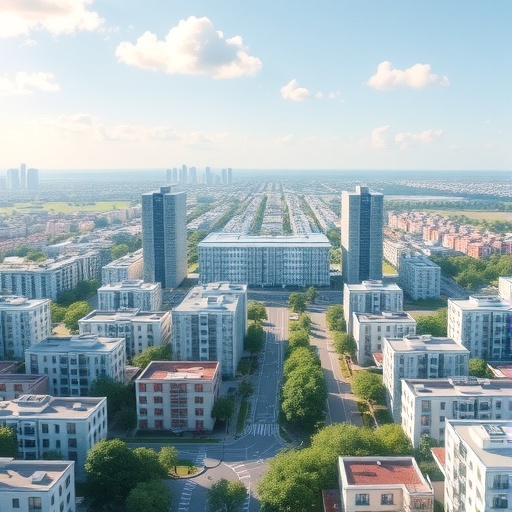
In the rapidly urbanizing world of the 21st century, the pursuit of sustainable development has never been more urgent or complex. Contemporary urban planning grapples with the immense challenge of harmonizing human expansion with the finite capacities of natural ecosystems. A groundbreaking study set to appear in npj Urban Sustainability in 2026 offers an innovative framework, emphasizing the fundamental necessity of respecting nature’s intrinsic limits through the establishment of human–nature partnerships grounded in shared values and principles. This transformative approach promises to redefine how cities are envisioned, constructed, and lived in, ensuring that urban growth enriches rather than depletes the natural world.
The premise underlying this research is that traditional urban development paradigms have largely overlooked or undervalued the role of ecological integrity and resilience in shaping sustainable futures. Conventional planning models often prioritize economic growth and infrastructural expansion without duly accounting for the carrying capacity and regenerative abilities of surrounding environments. This oversight has contributed to a cascade of environmental crises—from habitat loss and biodiversity decline to escalating greenhouse gas emissions and resource shortages—each of which directly undermines human wellbeing and urban viability.
Central to the study by Artmann, Harms, Ives, and colleagues is the articulation of a refined conceptual framework that integrates ecological science, urban theory, and participatory governance. The authors argue for a paradigmatic shift wherein cities are not seen as isolated entities but as dynamic components of broader socio-ecological systems. The recognition that urban spaces are embedded within and dependent upon natural processes underpins a call for planners to adopt a holistic perspective, balancing built infrastructure with green infrastructure to sustain ecosystem functions such as air and water purification, climate regulation, and habitat provision.
The researchers meticulously delineate a suite of core values vital to fostering genuine partnerships between humans and nature in urban contexts. These values include respect for biodiversity, recognition of ecosystem services as essential to human health, and commitment to intergenerational equity. The study posits that embedding these values into municipal policies demands more than rhetorical affirmation; it necessitates systemic integration into planning protocols, investment decisions, and community engagement processes. Only through such institutional embedding can the ethos of sustainability transcend symbolic gestures and manifest as tangible outcomes.
Principles derived from these foundational values translate into practical guidelines that can redirect urban development trajectories towards sustainability. Among these principles are the prioritization of nature-based solutions, the imperative to maintain ecological connectivity within and beyond city boundaries, and the adoption of adaptive management to respond to evolving environmental conditions. By operationalizing these principles, cities can enhance resilience to climate extremes, safeguard critical habitats, and ensure equitable access to natural amenities across diverse urban populations.
The technical implications of these propositions are profound. For instance, the application of green infrastructure—such as urban forests, wetlands, and permeable surfaces—requires sophisticated spatial planning and interdisciplinary collaboration. Ecological modeling tools become indispensable for predicting the outcomes of various planning scenarios on ecosystem health and service provision. Furthermore, the deployment of technologies that monitor environmental indicators in real time enables dynamic stewardship, allowing planners to refine strategies based on observed ecological feedback loops.
A pivotal feature of this research is its emphasis on participatory governance frameworks that empower communities as co-creators of sustainable urban environments. The study underscores that values and principles must be translated through inclusive dialogues that acknowledge cultural diversity, local knowledge, and socio-economic disparities. Empowering marginalized groups in decision-making processes ensures that urban nature partnerships are just and reflect the multiplicity of human relationships with the environment, enhancing legitimacy and fostering stewardship.
The article also critically examines existing policy and regulatory landscapes, identifying gaps that hinder the full realization of human–nature partnerships in urban planning. It advocates for integrated policy frameworks that dissolve sectoral silos and encourage cross-scale coordination—from neighborhood initiatives to national climate adaptation strategies. Policy instruments such as zoning codes, incentives for conservation, and mandates for green building certifications are highlighted as levers to align development with ecological thresholds.
Moreover, the authors delve into the economic dimensions of respecting nature’s limits, challenging the dominance of growth-centric economic models that externalize environmental costs. They propose reconfiguring urban economies to valorize ecosystem services through measures like payments for ecosystem services, green taxation, and investment in circular economy models. Such economic realignments can shift market incentives towards sustainable practices and generate funding streams for ecological restoration and management.
The integration of these multidisciplinary insights culminates in a blueprint for future urban sustainability that is not only visionary but actionable. The researchers present case studies illustrating how cities worldwide have successfully implemented elements of human–nature partnerships, providing empirical validation and practical lessons. These examples demonstrate measurable benefits including improved air quality, enhanced urban biodiversity, climate mitigation, and improved public health outcomes.
Importantly, the study situates its contributions within the broader context of global sustainability agendas, including the United Nations Sustainable Development Goals (SDGs) and the Paris Agreement on climate change. It emphasizes that urban sustainability initiatives anchored in respect for nature’s limits are indispensable to achieving these international commitments. Thus, the urban planning community is called upon to assume a proactive role in addressing global environmental challenges while promoting local well-being.
The methodological rigor of Artmann et al.’s work deserves special mention. The study employs a comprehensive literature review, stakeholder consultations, and systems-thinking analyses to construct its framework. By integrating empirical data with normative considerations, the research transcends disciplinary boundaries, fostering a nuanced understanding of human–nature dynamics in cities. This methodological plurality equips urban planners and policymakers with a robust toolkit for navigating the complexities of sustainable urbanization.
As cities worldwide face increasing pressures from population growth, climate change, and resource depletion, the implications of this study cannot be overstated. By embedding respect for nature’s limits into the core of urban planning, humanity can transition from exploitative interactions with the environment to regenerative coexistence. This shift represents not merely an environmental imperative but a profound reimagining of social, cultural, and economic relationships within the urban milieu.
The study concludes with an urgent call to action, emphasizing that the window for transformative change is narrow. Policymakers, planners, scientists, and citizens must collaboratively embrace values and principles that honor the intrinsic worth of nature and acknowledge human dependence upon its vitality. This collaborative ethos, when institutionalized and operationalized, offers a pathway toward cities that are not only livable and just but resilient and thriving in harmony with the Earth’s ecosystems.
In summary, the forthcoming article by Artmann and colleagues stands as a seminal contribution to urban sustainability scholarship, delineating a visionary yet pragmatic approach to integrating ecological stewardship into the fabric of urban life. Its comprehensive articulation of values and principles for human–nature partnerships invites a paradigm shift that redefines the relationship between urban development and environmental limits. As such, it holds transformative potential for shaping the cities of tomorrow.
Subject of Research: Sustainable urban planning strategies that integrate ecological limits and promote human–nature partnerships for resilient and just city development.
Article Title: Respecting nature’s limits in urban planning: values and principles for human–nature partnerships.
Article References: Artmann, M., Harms, P., Ives, C.D. et al. Respecting nature’s limits in urban planning: values and principles for human–nature partnerships. npj Urban Sustain (2026). https://doi.org/10.1038/s42949-025-00328-3
Image Credits: AI Generated


