


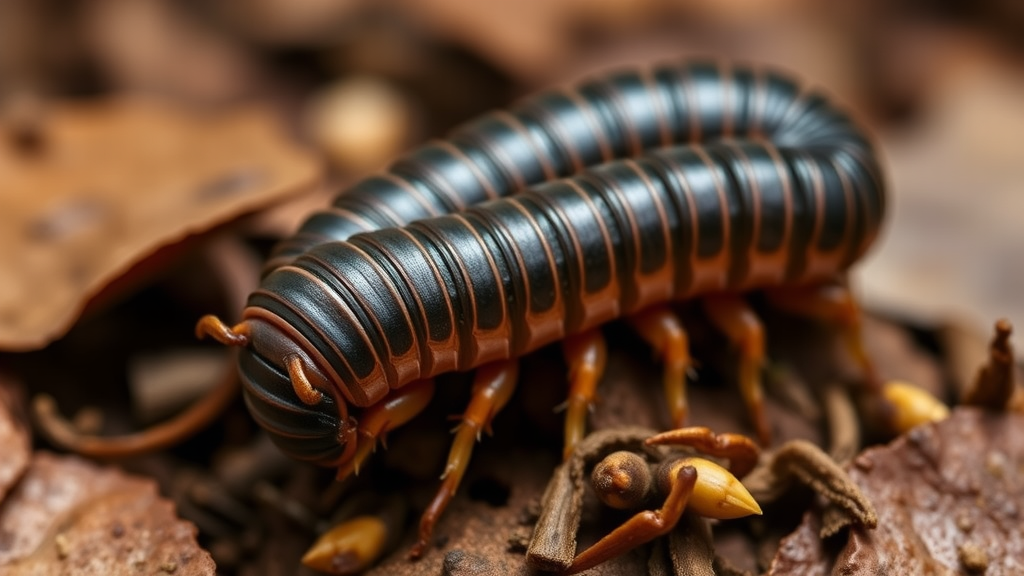
Beneath the fallen leaves of China’s shrinking urban forests, an unassuming detritivore is quietly rewriting what scientists know about how soil animals adapt to city life. The millipede Spirobolus bungii, a widespread litter-feeding species found across fragmented forest patches in China, has long been valued by ecologists for its role in breaking down dead plant matter and churning through soil. Now, a new study published in the journal Plant and Soil has used DNA barcoding to reconstruct the species’ diet in remarkable detail, revealing that these millipedes are far from indiscriminate eaters. Instead, they consume leaf litter from dozens of plant genera, show clear preferences for certain species, and appear to adjust their dietary breadth in response to how fragmented their forest habitat has become.
The research, led by Gaoji Zhang and Hongyi Liu of Nanjing Forestry University together with colleagues at Nanjing Xiaozhuang University, set out to answer a deceptively simple question: what does a soil-dwelling millipede actually eat, and does it choose? Understanding diet is fundamental to understanding how animals adapt to their environments, yet for cryptic soil invertebrates, direct observation is nearly impossible. The team therefore turned to molecular methods, combining DNA barcoding of gut contents with detailed surveys of the surrounding plant communities, soil properties, and the elemental composition of available leaf litter. This multi-pronged approach allowed the researchers to compare what the millipedes ate against what was actually available to them, a crucial step in distinguishing true dietary selection from mere opportunistic consumption.
The results were striking in their breadth. Across the sampled populations, S. bungii was found to have consumed litter from 76 plant genera spanning 48 families and 30 orders. This extraordinary dietary range suggests that the species functions as a generalist at the population level, capable of exploiting a wide variety of plant material. Population-level niche width, a statistical measure of how broad a population’s resource use is, was correspondingly large, registering 15.32 at the family level and 16.46 at the genus level. Such values indicate that collectively, these millipede populations draw on a deep pool of plant diversity, a flexibility that may underpin the species’ success in habitats heavily altered by human activity.
Yet the broad population-level diet masked considerable variation between individual mountain populations. Analysis of similarity, a non-parametric multivariate technique known as ANOSIM, revealed significant differences in dietary composition among millipedes collected from different mountains. In other words, each population has its own distinct dietary signature, shaped largely by the local plant community on offer. Niche overlap analysis reinforced this picture: most mountain populations showed little dietary overlap, with Ojk values below 0.6, the threshold typically interpreted as meaningful separation. The one notable exception involved populations from Jiangjun Mountain and Fang Mountain, which overlapped at Ojk = 0.65, hinting at either similar local vegetation or genuine sharing of preferred resources between these two sites.
Perhaps the most consequential finding concerns habitat fragmentation itself. The researchers measured fragmentation using two standard landscape metrics: patch density (PD), which counts habitat patches per unit area, and edge density (ED), which quantifies the amount of forest edge relative to area. Both were strongly correlated with the class-level trophic niche width of the millipedes, with patch density showing a Spearman correlation of ρ = 0.93 (p = 0.007) and edge density ρ = 0.79 (p = 0.048). In practical terms, as forests become more chopped up and edge-dominated, the dietary repertoire of S. bungii appears to shift. This is one of the clearest demonstrations to date that the spatial configuration of urban habitat, not just its total area, can leave a measurable imprint on the feeding ecology of a soil animal.
The study also uncovered pronounced selectivity. When the researchers compared consumption against availability using null-model approaches, S. bungii exhibited a positive selection tendency toward three plant genera: Cinnamomum, the genus that includes camphor and cinnamon trees; Carya, the hickories; and Ailanthus, the tree of heaven. Conversely, the millipedes showed a negative selection tendency toward Trachelospermum, a genus of woody vines and lianas common in Chinese forest understories. The avoidance of Trachelospermum is intriguing from a biochemical standpoint, as the genus is known to contain a rich arsenal of phytochemical compounds, some of which may render its litter unpalatable or even deterrent to detritivores. Preference for the favored genera, by contrast, may reflect more favorable litter chemistry, softer tissues, or higher nutritional returns per bite.
Elemental analysis added another layer to the story. The team found that S. bungii tended to consume plants with high calcium content, with a Spearman correlation of ρ = 0.83 and a p-value of 0.058, just shy of conventional significance thresholds but strongly suggestive of a pattern. Calcium matters enormously to millipedes. Their calcified exoskeletons, which must be built and repeatedly rebuilt through successive molts, demand substantial calcium reserves drawn directly from their food. A millipede that preferentially grazes calcium-rich litter is, in effect, mining the leaf fall for skeletal raw material. This finding connects the feeding behavior of a humble arthropod to the broader biogeochemistry of the forest floor, where leaf elemental composition varies widely among tree species and shapes the entire decomposer food web.
The implications extend beyond millipede biology. Detritivores such as S. bungii are engine rooms of soil nutrient cycling: by fragmenting litter and converting it into faeces, they accelerate organic matter turnover, release nutrients locked in dead leaves, and create conditions that favor microbial decomposition. Their bioturbation, the mixing of organic and mineral soil layers as they burrow, further alters soil structure and water movement. If urban fragmentation changes what these animals eat, it may also change how efficiently they perform these ecosystem services. A population forced onto a narrower or lower-quality diet could process litter more slowly, with knock-on effects for soil fertility in the very green spaces that cities depend on for cooling, flood regulation, and recreation.
The study also fits into a growing body of work on urban soil biodiversity. Previous research by some of the same authors showed that urbanization affects millipede gut microbiota by impeding host gene flow, and other studies have found that even small urban forest fragments can maintain complex food webs of litter-dwelling arthropods. Taken together, these findings challenge the assumption that fragmented urban habitats are ecological deserts. Instead, they suggest that the dietary flexibility of generalist detritivores, combined with thoughtful conservation of plant diversity within fragments, could sustain functioning decomposer communities even in heavily built-up landscapes. For urban planners, the message is concrete: preserving a diverse mix of native trees, including calcium-rich species that detritivores favor, may be as important for soil health as simply preserving green space.
Methodologically, the study showcases the power of DNA barcoding for diet analysis in organisms that cannot be observed feeding directly. By sequencing plant DNA recovered from millipede gut contents and matching it against reference libraries, the researchers achieved a taxonomic resolution that traditional gut-content microscopy could never match. All raw sequences from the study were deposited in the NCBI Sequence Read Archive under accession number PRJNA1182097, ensuring that other researchers can verify and build upon the work. As cities continue to expand and fragment the forests around them, studies like this one make clear that the fate of above-ground biodiversity and the hidden economy of the soil are tightly intertwined, and that even a millipede’s dinner menu can tell us whether an urban forest is truly thriving.
Subject of Research: Dietary selection and trophic niche of the millipede Spirobolus bungii in fragmented urban forests
Article Title: Dietary selection of millipedes (Spirobolus bungii) in fragmented urban forests
Article References: Dietary selection of millipedes (Spirobolus bungii) in fragmented urban forests. (n.d.). https://doi.org/10.1007/s11104-026-09152-9
Image Credits: AI Generated
DOI: 10.1007/s11104-026-09152-9
Keywords: millipedes, Spirobolus bungii, DNA barcoding, diet selection, habitat fragmentation, urban forests, soil biodiversity, detritivores, leaf litter, calcium, trophic niche, nutrient cycling
Cite Scienmag News
Gavin Prescott. (September 23, 2026). Urban Millipedes Reveal Surprisingly Picky Diets in China’s Fragmented Forests. Scienmag. https://scienmag.com/urban-millipedes-reveal-surprisingly-picky-diets-in-chinas-fragmented-forests/
Gavin Prescott. "Urban Millipedes Reveal Surprisingly Picky Diets in China’s Fragmented Forests." Scienmag, 23 September 2026, https://scienmag.com/urban-millipedes-reveal-surprisingly-picky-diets-in-chinas-fragmented-forests/. Accessed 5 October 2026.
Gavin Prescott. "Urban Millipedes Reveal Surprisingly Picky Diets in China’s Fragmented Forests." Scienmag. September 23, 2026. https://scienmag.com/urban-millipedes-reveal-surprisingly-picky-diets-in-chinas-fragmented-forests/


