


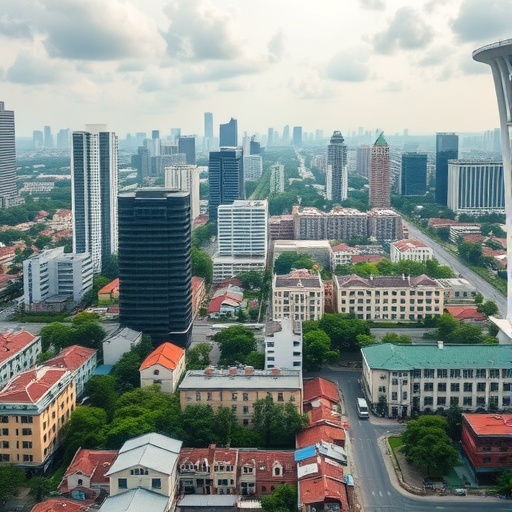
In an era marked by accelerating urbanization and growing environmental sensitivities, understanding the trajectories of urban land change has become an imperative for scientists, policymakers, and urban planners alike. The future of cities—vast, dynamic entities growing both upwards and outwards—hinges on deciphering how our landscapes will transform amid socio-economic pressures and environmental constraints. The study by Güneralp and Ahasan, published in npj Urban Sustainability, offers a comprehensive exploration of this pivotal subject, drawing attention to current understandings, persistent challenges, and profound implications embedded within urban land-change futures.
At its core, urban land change refers to the conversion of rural or undeveloped land into urban uses, encompassing residential, commercial, industrial, and infrastructural developments. However, this process is far from straightforward; it is influenced by a mosaic of interacting factors including population dynamics, economic development patterns, governance frameworks, technological innovation, and climate change. Understanding how these factors coalesce to reshape urban terrains is crucial for anticipating the multifaceted impacts of urbanization on ecosystems, societies, and economies.
One of the pivotal insights emerging from contemporary research is the heterogeneity of urban growth patterns. Cities across the globe do not evolve uniformly; instead, spatial growth is often uneven, contingent upon geographic location, resource availability, cultural contexts, and policy decisions. For instance, megacities in Asia and Africa experience rapid peri-urban expansion driven by demographic surges and rural-to-urban migration, while many cities in Europe and North America are witnessing more compact growth or even shrinkage. This diversity challenges conventional urban models and calls for localized, nuanced frameworks capable of capturing the unique trajectories of urban land change in different contexts.
Technological advancements in remote sensing, geographic information systems (GIS), and big data analytics have revolutionized the capacity to monitor and model urban land changes in near real-time. These tools enable researchers to map urban expansion with unprecedented spatial and temporal precision, uncovering subtle patterns of land-use transitions and the underlying drivers. Machine learning algorithms and scenario-based simulations further enrich this endeavor by enabling the projection of future land-use changes under varied socio-economic and environmental scenarios, thus equipping stakeholders to make informed decisions rooted in scientific foresight.
Yet, despite these analytical breakthroughs, formidable challenges persist in projecting urban land futures with accuracy. One major obstacle is the intrinsic uncertainty embedded in socio-economic trajectories, such as economic shocks, migration trends, and policy reforms, which can abruptly alter urban growth dynamics. Moreover, the nonlinear feedback mechanisms between urban form and environmental systems—such as how land-cover changes influence local microclimates or hydrological cycles—add layers of complexity that are difficult to incorporate fully into predictive models.
Climate change introduces an additional, often underestimated, dimension to urban land-change futures. Rising temperatures, altered precipitation patterns, sea-level rise, and increasing frequency of extreme weather events not only directly impact urban areas but also influence land suitability and human settlement patterns. As urban regions grapple with these challenges, it becomes imperative to integrate climate resilience into urban planning, ensuring that future land changes do not exacerbate vulnerabilities but rather enhance adaptive capacities.
The governance of urban expansion emerges as another critical axis shaping land-change futures. Institutional arrangements, land tenure systems, and planning frameworks significantly affect where and how urban growth occurs. In many rapidly urbanizing regions, weak enforcement of zoning laws and rampant informal settlements complicate efforts to manage urban sprawl sustainably. Conversely, cities with robust governance mechanisms have demonstrated success in implementing growth boundaries, greenbelts, and incentives for densification, mitigating negative ecological impacts while accommodating growth.
The social equity dimension of urban land change is equally pressing. Urban expansion often displaces marginalized communities, exacerbates socio-spatial segregation, and diminishes access to essential services. Addressing these inequities necessitates inclusive planning approaches that recognize the rights and needs of diverse populations, ensuring that urban transformations contribute to social cohesion rather than division. Incorporating community participation and fostering transparent decision-making processes can bridge gaps between policy intentions and lived realities.
Economic drivers also profoundly influence urban land trajectories. As cities strive for competitiveness in the global economy, demand for commercial spaces, industrial parks, and infrastructure intensifies. These demands often fuel land speculation and rapid land-use conversion that can prioritize short-term economic gains over long-term sustainability. Understanding these economic dynamics alongside environmental and social factors is vital for crafting balanced urban development strategies.
Sustainability frameworks are becoming indispensable in guiding urban land-change management. Concepts such as compact city models, transit-oriented development, and green infrastructure underscore the move towards harmonizing urban growth with ecological preservation. Embedding sustainability principles prompts the redesign of urban form and function to reduce resource consumption, lower carbon footprints, and enhance biodiversity corridors within metropolitan landscapes.
Interdisciplinary collaboration stands out as a cornerstone for advancing urban land-change research and application. Integrating insights from urban ecology, economics, sociology, climatology, and computational sciences fosters a holistic understanding of urban systems. Such transdisciplinary approaches enable the generation of robust, replicable models and innovative governance tools tailored to diverse urban contexts, facilitating scalable solutions to global urbanization challenges.
An emerging frontier in this field is the exploration of urban land change through the lens of emerging technologies such as artificial intelligence and the Internet of Things. These innovations promise more adaptive and responsive urban systems capable of real-time environmental monitoring, dynamic infrastructure management, and enhanced citizen engagement. However, technological integration also raises questions about data privacy, digital divides, and ethical governance, necessitating cautious, equitable articulation of these tools within urban frameworks.
Looking ahead, urban land-change futures are inevitably shaped by global megatrends including demographic shifts, technological disruptions, and environmental transformations. The COVID-19 pandemic has further underscored the vulnerability and adaptability of urban areas, revealing how crises can transiently alter land-use patterns and mobility behaviors. Capitalizing on lessons from recent global perturbations will be vital to foster resilient, livable urban environments that can withstand and recover from future shocks.
In summation, the future of urban land change encapsulates a complex interplay of biological, physical, social, and technological factors. The challenges are multifaceted, spanning scientific uncertainties, governance deficits, socio-economic disparities, and ecological impacts. Yet, these challenges also present unprecedented opportunities to reimagine urban landscapes in ways that prioritize sustainability, equity, and resilience. The insights from Güneralp and Ahasan’s research articulate a compelling call to action—urging a paradigmatic shift towards integrative knowledge and proactive policies that cogently steer the urban metamorphosis of the 21st century.
Cite Scienmag News
Courtney Benton. (December 20, 2025). Urban Land Change: Insights, Challenges, and Future Impacts. Scienmag. https://scienmag.com/urban-land-change-insights-challenges-and-future-impacts/
Courtney Benton. "Urban Land Change: Insights, Challenges, and Future Impacts." Scienmag, 20 December 2025, https://scienmag.com/urban-land-change-insights-challenges-and-future-impacts/. Accessed 5 September 2026.
Courtney Benton. "Urban Land Change: Insights, Challenges, and Future Impacts." Scienmag. December 20, 2025. https://scienmag.com/urban-land-change-insights-challenges-and-future-impacts/


