

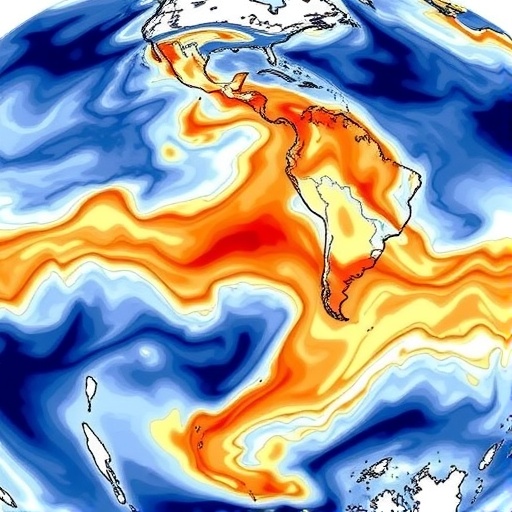
In a groundbreaking study set to reshape our understanding of climate dynamics in the coming decades, researchers have unveiled how changes in upper-ocean stratification are pivotal in modulating the amplitude of the El Niño-Southern Oscillation (ENSO) amid sustained global warming. The findings, recently published in Nature Communications, elucidate complex ocean-atmosphere interactions, highlighting how rising surface ocean temperatures alter vertical density gradients, ultimately dictating ENSO’s intensity and variability.
ENSO, a dominant driver of global climate variability, exerts profound effects on weather patterns, marine ecosystems, and agricultural productivity worldwide. Historically, scientists have sought to predict ENSO behavior under future climatic conditions due to its socio-economic significance. However, the mechanism behind ENSO amplitude shifts remained elusive, largely because ocean stratification—how water layers of differing temperatures and salinities stack vertically—had been underappreciated in this context.
Led by Zhang RH, Chen M, and Gao C, the investigative team applied advanced coupled ocean-atmosphere models integrated with comprehensive observational datasets. Their analyses revealed that upper-ocean stratification alters the heat content exchange between the ocean surface and subsurface layers. This transformation influences the feedback loops between oceanic thermal gradients and atmospheric convection patterns, thus modulating ENSO’s strength. Specifically, as global warming intensifies, decreased vertical mixing due to enhanced stratification diminishes the ocean’s capability to regulate surface temperatures, resulting in more pronounced ENSO events.
Delving into the physics underlying this phenomenon, the research team demonstrated that the amplified ocean stratification stems from differential warming rates between the ocean surface and underlying layers. Surface waters warm more rapidly due to direct radiative forcing, while the denser subsurface layers lag behind in warming. This creates a sharper pycnocline, the boundary between water layers of distinct density, which becomes increasingly resistant to vertical mixing. The steepened pycnocline, the study revealed, directly contributes to ENSO amplitude enhancement by restricting the vertical transport of cooler water that normally suppresses sea surface temperature anomalies.
This reframed understanding confronts previous assumptions that focused predominantly on tropical Pacific atmospheric circulation changes to explain ENSO’s future variability. Instead, the identification of upper-ocean stratification as a crucial controller introduces a nuanced oceanic dimension to the ENSO discourse. The authors argue that any reliable ENSO projections must now incorporate stratification metrics, especially given the accelerating warming of upper ocean layers under anthropogenic pressure.
One striking aspect of the study is how it bridges observational evidence and predictive modeling. Historical oceanographic records have hinted at stratification trends, but lacked the temporal resolution and spatial coverage to link these explicitly with ENSO amplitude fluctuations. The integration of state-of-the-art satellite remote sensing data, in-situ Argo float measurements, and paleoclimate reconstructions allowed the researchers to validate their modeling outcomes with exceptional robustness.
Moreover, the findings implicate significant ramifications for global climate policy and disaster preparedness frameworks. The amplification of ENSO could exacerbate extreme weather events such as droughts, floods, and storms in susceptible regions, intensifying the vulnerability of ecosystems and human populations dependent on climatological stability. Anticipating these shifts offers policymakers a critical window to bolster adaptive infrastructures and improve early warning systems.
The research also challenges climate models to improve their representation of vertical ocean dynamics. Current Earth system models often simplify ocean stratification processes, which can understate the predicted ENSO variability. The authors suggest refining model parameterizations to capture thermohaline structure alterations will enhance the fidelity of climate projections, informing sectors ranging from fisheries management to agricultural planning.
Attention was further drawn to the interplay between ocean stratification and coupled atmospheric processes. Enhanced stratification not only modifies heat content but also influences the distribution of nutrients and gases, with cascading effects on marine productivity and biogeochemical cycles. These interdependencies illustrate the multifaceted consequences stemming from what might superficially appear as subtle changes in ocean layering.
Interestingly, the study underscores regional disparities in stratification-driven ENSO shifts. The central and eastern tropical Pacific exhibited the most pronounced stratification changes, correlating with more intense ENSO events. This spatial heterogeneity suggests region-specific adaptation strategies may be required, tailoring local responses to the nuanced oceanographic changes documented.
The authors also investigate feedback mechanisms wherein altered ENSO amplitude feeds back onto stratification itself. Stronger ENSO events affect trade wind patterns and upwelling intensity, which in turn influence the ocean’s thermal structure. Such nonlinear feedback loops contribute to the complexity of projecting future climate variability, reinforcing the importance of continued observational campaigns and model advancement.
Crucially, this research signals an urgent need for enhanced interdisciplinary collaboration. Climate scientists, oceanographers, and atmospheric physicists must converge their expertise to unravel the dynamic interplay between ocean stratification and ENSO, especially as these interactions will increasingly dictate climate extremes. The study thus establishes a new scientific paradigm emphasizing the ocean’s layered structure as a fundamental variable in climate change assessment.
Further investigations may also explore how other climatic oscillations interact with ocean stratification trends. Preliminary hypotheses suggest that the Pacific Decadal Oscillation and Indian Ocean Dipole might modulate or be modulated by shifts in upper-ocean layering, creating complex teleconnections with ENSO. Understanding these interrelations could unlock deeper insights into Earth’s climatic machinery.
Ultimately, Zhang and colleagues’ work represents a pivotal advancement in climate science. By identifying upper-ocean stratification changes as a key driver of ENSO amplitude shifts, the study provides a vital piece of the puzzle in anticipating the future trajectory of one of the planet’s most influential climate phenomena under the relentless pressure of anthropogenic warming.
Subject of Research: Changes in upper-ocean stratification and their role in controlling ENSO amplitude shifts under sustained global warming.
Article Title: Upper-ocean stratification changes control ENSO amplitude shift under sustained global warming.
Article References:
Zhang, RH., Chen, M., Gao, C. et al. Upper-ocean stratification changes control ENSO amplitude shift under sustained global warming. Nat Commun (2026). https://doi.org/10.1038/s41467-026-69931-x
Image Credits: AI Generated


