

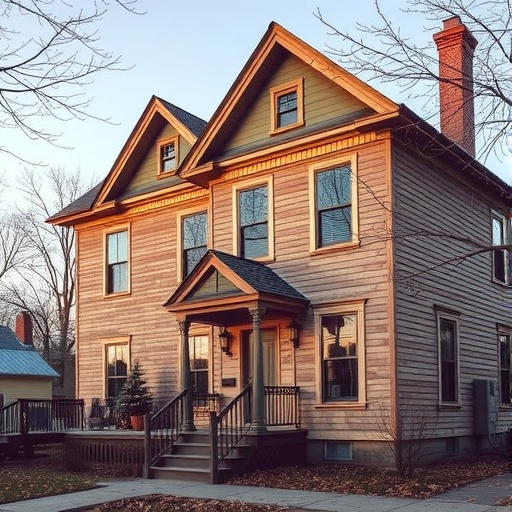
In the face of a rapidly changing climate and an escalating global energy crisis, the renewal of aging residential buildings stands out as a critical frontier for electricity conservation and carbon dioxide mitigation. Recent research published in npj Urban Sustainability delves deeply into how retrofitting and upgrading the existing residential housing stock can yield substantial benefits, not only for the environment but also for the resilience and sustainability of urban communities worldwide. This comprehensive study, led by Hu, Gao, Zhang, and colleagues, offers a groundbreaking approach to understanding and harnessing the untapped potential of older buildings, which often constitute a significant portion of city infrastructure but remain energy inefficient and carbon-intensive.
Residential buildings, particularly those constructed decades ago without modern energy standards, tend to consume disproportionately high amounts of electricity, primarily for heating, cooling, lighting, and appliances. This inefficiency results in elevated carbon footprints, making them critical targets for achieving national and global climate goals. The researchers employ sophisticated modeling techniques to evaluate the current electricity consumption patterns of aging buildings and forecast the impacts of targeted renewals under different climate scenarios. Their methodology couples data-driven simulation with real-world renovation case studies, bridging theory with practice.
One of the paper’s key revelations is that climate change itself reshapes the electricity demand profile of residential buildings, intensifying cooling needs over heating in many regions due to rising summer temperatures. This shift complicates traditional energy-saving approaches that have historically focused on insulating homes against cold weather. The team highlights the importance of adaptive designs and materials that function efficiently across a broader temperature spectrum, enabling buildings to modulate energy use more responsively and maintain thermal comfort without excessive electricity consumption.
Furthermore, the study uncovers regional disparities in both the challenges and opportunities posed by residential building renewals. For instance, older housing in temperate zones might primarily benefit from enhanced insulation and passive shading techniques, while buildings in tropical or subtropical zones require advanced ventilation systems and reflective materials to combat intense heat gains. This nuanced understanding underlines the necessity for localized solutions, tailored to the climatic realities and socioeconomic contexts of urban areas, to maximize electricity savings and carbon mitigation.
Crucially, the researchers incorporate the evolving landscape of renewable energy into their assessment framework. They explore how integrating solar panels, energy storage, and smart grid technologies into retrofit projects can amplify the environmental benefits by shifting the electricity load towards cleaner, renewable sources. This integrative approach not only curtails grid dependency but also empowers residents to actively participate in energy management, driving a bottom-up transformation in urban sustainability.
The paper also addresses barriers to widespread implementation of building renewals, notably financial constraints, regulatory hurdles, and occupant disruption. It proposes innovative policy interventions like incentivized financing models, streamlined permitting processes, and occupant engagement strategies to overcome these obstacles. By doing so, the research transcends purely technical analyses and advocates for holistic pathways that engage both stakeholders and policymakers in fostering sustainable urban transformations.
Beyond energy and climate considerations, the renewal of aging residential buildings yields ancillary benefits that enhance the quality of urban life. Improved indoor air quality, thermal comfort, and reduced noise pollution from upgraded building envelopes contribute to healthier, more livable homes. The paper highlights that such co-benefits can catalyze greater public support for retrofit initiatives by aligning environmental goals with human well-being.
Another focal point of the study is the role of cutting-edge materials science in the efficient renewal of buildings. The authors emphasize the potential of novel insulation materials, phase-change composites, and dynamic glazing technologies that adapt to environmental stimuli, reducing the need for active climate control systems. These advancements, combined with digital monitoring tools and AI-driven energy management platforms, redefine what building retrofits can achieve in the era of smart cities.
The interplay between urban form and building energy performance also receives considerable attention in the research. The team underscores how urban density, street orientation, and green infrastructure influence thermal dynamics and therefore electricity demand. By integrating urban planning with building renewal efforts, cities can harness synergistic effects that amplify the efficiency of both individual homes and neighborhoods as a whole.
From a global policy perspective, the paper stresses the urgency of incorporating residential building renewals into national climate commitments, particularly under frameworks like the Paris Agreement. Given that residential buildings can account for a sizable share of total urban emissions, neglecting their renewal risks undermining broader climate targets. The authors advocate for robust data collection and transparent reporting to benchmark progress and guide evidence-based policymaking.
The study’s projections suggest that aggressive renewal efforts, if scaled up, could yield a significant reduction in electricity consumption and greenhouse gas emissions by mid-century. These outcomes depend on comprehensive deployment of best practices—ranging from material upgrades to decentralized renewable energy integration—and the removal of systemic barriers. Importantly, the researchers present a pathway for cities of varying income levels, emphasizing equity and accessibility to ensure that climate benefits are broadly distributed across society.
The potential for job creation also emerges from the research as a positive economic dimension of building renewals. Skilled labor is required to implement retrofits, install advanced materials, and maintain new energy systems, presenting an opportunity to stimulate local economies while advancing environmental goals. This aligns with the global shift towards green industries and just transitions for workers facing disruption from carbon-intensive sectors.
Incorporating behavioral insights into energy use patterns among residents enhances the study’s realism and applicability. The multidisciplinary team accounts for occupant habits, preferences, and willingness to adopt new technologies, reinforcing the notion that technical solutions alone are insufficient without social acceptance and active engagement. Educational campaigns and participatory design processes are identified as key enablers to align human behavior with the sustainability potential of building renewals.
By synthesizing these diverse dimensions—technical, social, economic, and climatic—the research establishes a comprehensive framework for renewing aging residential buildings as pivotal agents in combating climate change. The paper’s findings not only command attention in scientific circles but resonate with urban planners, policymakers, and citizens who face the intertwined challenges of energy security, environmental stewardship, and quality of life.
Ultimately, this work represents a call to action for concerted efforts at multiple scales—local, national, and global—to mobilize resources, expertise, and political will towards revitalizing the homes that millions inhabit. The research by Hu and colleagues reaffirms that in the race to mitigate climate change, the humble residential building holds transformative power, waiting to be unleashed through innovation, collaboration, and determination.
Subject of Research: Renewal of aging residential buildings for electricity saving and carbon mitigation under climate change.
Article Title: Renewal of aging residential buildings for electricity saving and carbon mitigation under climate change.
Article References:
Hu, Q., Gao, X., Zhang, T. et al. Renewal of aging residential buildings for electricity saving and carbon mitigation under climate change. npj Urban Sustain 5, 110 (2025). https://doi.org/10.1038/s42949-025-00298-6
Image Credits: AI Generated


