


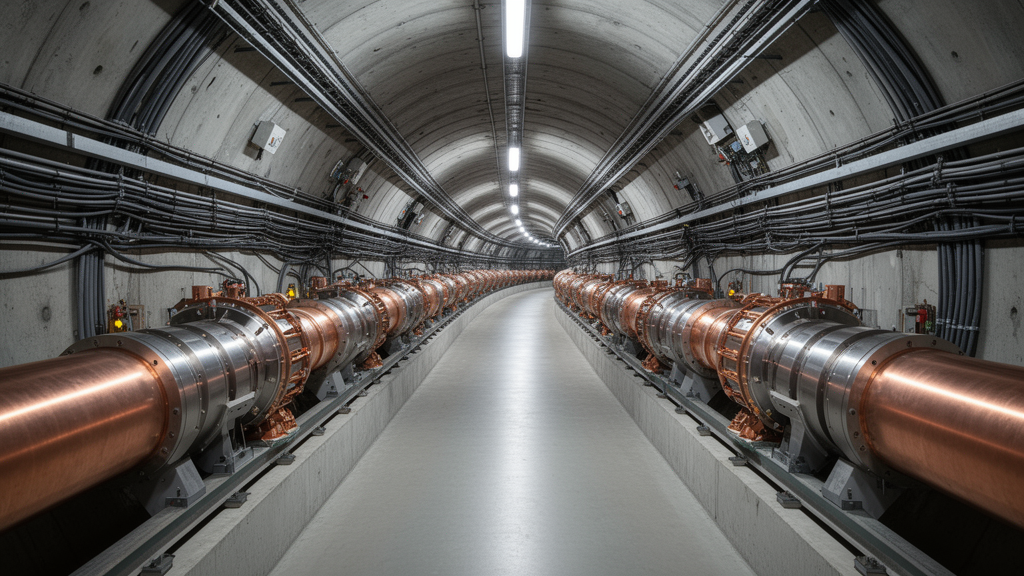
Advanced numerical simulations evaluating the proposed Future Circular Collider electron-positron stage (FCC-ee) at CERN indicate that its updated four-interaction-point baseline configuration successfully suppresses disruptive electron cloud build-up below critical performance-limiting thresholds. Particle accelerator physicists Fatih Yaman, Giovanni Iadarola, Roberto Kersevan, Salim Ogur, Kazuhito Ohmi, Frank Zimmermann, and Mikhail Zobov conducted extensive computer modeling to assess how primary photoelectrons and secondary electron emission degrade positron beam quality. Their study evaluates both the pre-injector damping ring and the collider arcs, scanning surface secondary emission yields and primary photoelectron generation rates to determine design thresholds. In circular accelerators, accumulating clouds of liberated electrons within the vacuum beam chamber can perturb circulating beams, driving rapid vertical emittance blow-up through head-tail-type single-bunch instabilities when central electron densities surpass analytical limits. By contrasting earlier Conceptual Design Report specifications against the newly adopted machine layout, the researchers revealed that increasing bunch separation to thirty or thirty-two nanoseconds, alongside engineered surface properties and photon-absorbing antechambers, keeps central electron densities well below the instability threshold of approximately four times ten to the tenth particles per cubic meter.
The investigation focuses on addressing the fundamental physics challenges underlying the proposed high-energy circular electron-positron collider, conceived as the opening phase of CERN’s integrated Future Circular Collider project. Designed to operate across collision energies ranging from 88 to 365 gigaelectronvolts within an expansive ninety-one to one-hundred-kilometer tunnel infrastructure, the FCC-ee facility aims to explore foundational questions in modern particle physics. Alongside the primary double-ring collider, which shares the subterranean tunnel with a full-energy booster synchrotron providing continuous top-up injection, the complex requires a dedicated pre-injector chain comprising a linear accelerator, a positron damping ring, a pre-booster, and a top-up booster. The damping ring plays an indispensable operational role by rapidly cooling and reducing the emittance of injected positron beams at an operating energy of 1.54 gigaelectronvolts within a sufficiently short timescale.
Within high-intensity storage rings, electron cloud formation begins when relativistic positively charged beam bunches emit intense synchrotron radiation that strikes the interior walls of the beam vacuum chamber, liberating primary photoelectrons. Additional primary electrons arise from the direct ionization of residual gas molecules inside the pipe and the uncontrolled loss of stray beam particles navigating the magnetic lattice. As these primary electrons are drawn toward the passing positive bunches, they gain kinetic energy and subsequently strike the opposing chamber walls, ejecting secondary electrons. Such exponential electron amplification generates both incoherent emittance growth and coherent collective beam instabilities, historically observed in pioneering accelerators such as the KEK Photon Factory, the PEP-II B factory, the KEKB facility, and proton operations in the Large Hadron Collider.
To capture the intricate spatial and temporal dynamics of this phenomenon, the research team deployed two independent computational codes, PyECLOUD and VSim, executing two-dimensional electrostatic particle-in-cell simulations of the cloud build-up process. Inside the computational domain, cloud electrons are discretized as macroparticles representing approximately one hundred thousand physical particles, whose electrostatic fields are evaluated by solving Poisson’s equation at each discrete time step across a uniform two-dimensional Cartesian grid. Convergence of the numerical framework was confirmed through rigorous parameter scans varying time steps, grid cell sizes, and macroparticle allocations, while PyECLOUD utilized an adaptive charge-scaling scheme to regulate macroparticle counts. In addition, the circular copper vacuum chamber was modeled with a pipe radius of 35 millimeters for the collider arc dipoles and varied between 10 and 30 millimeters for the damping ring. Because the transverse dimensions of the collider beam are substantially smaller than the vacuum chamber dimensions, the researchers established an optimal computational radius of 7.5 millimeters around the beam axis to accurately monitor the central electron density that directly dictates beam stability.
A critical aspect of the modeling methodology involved comparing two distinct physical formulations for secondary electron emission: the Furman–Pivi model and the ECLOUD model. The Furman–Pivi parameterization, developed from empirical surface measurements performed for the PEP-II collider on copper samples, separates the secondary emission yield into three constituent phenomena: elastically backscattered electrons, rediffused electrons, and true-secondary electrons. In contrast, the ECLOUD model, calibrated against laboratory measurements performed at CERN for the copper surfaces of the Large Hadron Collider, omits the rediffused electron component. In the simulations, the true-secondary emission parameter was methodically adjusted to achieve specific total secondary electron yields, benchmarking against peak energy values of approximately 276.8 electronvolts. Because physical prototype vacuum chambers for the FCC-ee are not yet available for direct benchtop testing, comparing these two predictive formulations provided a transparent measure of theoretical uncertainty, with the Furman–Pivi model consistently producing higher, more conservative electron accumulation levels.
Simulations dedicated to the FCC-ee damping ring examined how initial uniform electron seeds evolve inside copper vacuum chambers under transverse magnetic fields of 1.8 teslas in the damping wigglers and 0.66 teslas in the arc dipoles. Modeling sixteen positron bunches spaced by fifty nanoseconds followed by a clearing gap revealed that for peak secondary emission yields equal to or below 1.5, initial electron populations uniformly loaded across the chamber completely decay and vanish over time. Even when the secondary yield was elevated to 1.7, no upward deviation from the initial electron seed was observed. Noticeable build-up dynamics emerged only when the secondary emission yield reached 2.1, generating density oscillations up to eight times ten to the eighth electrons per meter within narrow ten-millimeter pipes loaded with initial densities of ten to the twelfth per cubic meter. These findings confirm that maintaining peak secondary yields below 1.9 ensures safe operation without electron avalanche, an objective easily met using standard technical surfaces such as copper, stainless steel, or non-evaporable getter coatings.
Detailed examination of damping ring extraction conditions demonstrated that the dramatic sixty-fold shrinkage of the vertical beam size between injection and extraction produces only marginal changes in saturated electron densities. However, time-resolved kinetic energy distributions tracked across the 50-nanosecond inter-bunch intervals revealed energetic electron interactions inside the wiggler vacuum chambers. Just sixty-two picoseconds prior to bunch arrival, low-energy electrons settle into characteristic stripe patterns along vertical magnetic field lines. When the positively charged bunch passes at 150 nanoseconds, electrons concentrated near the chamber center accelerate rapidly, acquiring kinetic energies reaching up to 2.5 kiloelectronvolts. These energized particles are driven along the vertical field lines into the top and bottom chamber walls, generating secondary electrons that penetrate back into the chamber until the initial energy dissipates. Despite these localized energy spikes, maintaining a secondary yield below 2.0 precludes run-away amplification, though the authors caution that choosing aluminum vacuum chambers would introduce substantial operational risk due to their tendency to exhibit yields exceeding 2.0.
For the main collider arcs operating on the Z-pole resonance at 45.6 gigaelectronvolts, simulations addressed a far more restrictive operational regime governed by exceptionally low instability thresholds. Under the earlier Conceptual Design Report baseline, which featured two interaction points and tight bunch spacings between ten and twenty nanoseconds, the Furman–Pivi model predicted saturated central electron densities approaching ten to the twelfth particles per cubic meter at ten-nanosecond spacing. This value exceeded the analytical threshold of four times ten to the tenth per cubic meter by more than an order of magnitude. Strong dynamic bunch pinching generated an order-of-magnitude difference between the minimum density prior to bunch arrival and the peak density reached during bunch passage. Furthermore, parametric scans varying the primary photoelectron rate between 10^-3 and 10^-6 per meter alongside secondary yields between 1.1 and 1.4 revealed that secondary emission strongly dominated cloud evolution at tight spacings, rendering the earlier design highly sensitive to surface physics and model discrepancies.
However, the most decisive operational advantage emerged when testing the newly established FCC-ee parameter baseline for a ninety-one-kilometer circumference featuring four interaction points. Across approximately 450 hours of intensive computing run time, the researchers simulated collider arc dipoles with 142-gauss magnetic fields and drift regions under relaxed bunch spacings of thirty and thirty-two nanoseconds, with bunch populations of 2.76 times ten to the eleventh positrons. At these wider spacings, the model-dependent divergences between Furman–Pivi and ECLOUD calculations largely converged, and central electron densities consistently remained below the critical threshold across realistic secondary emission yields ranging from 1.1 to 1.4.
Crucially, under the updated four-interaction-point baseline, suppressing electron cloud instabilities hinges upon combining achievable surface secondary emission yields with effective synchrotron radiation management. The simulations established that maintaining primary photoemission rates at or below 10^-4 per meter in arc dipoles, coupled with a secondary yield of 1.4, reliably prevents destructive emittance growth. Achieving a secondary emission yield of 1.4 is well within demonstrated engineering capabilities, as operational campaigns in the Large Hadron Collider during Run 2 achieved surface yields between 1.15 and 1.35 across all arc vacuum sectors. Concurrently, a photoemission rate of 10^-4 per meter is practically attainable given a standard chamber-wall photoelectron yield of 0.1, provided that dedicated vacuum chamber antechambers and photon stops successfully absorb ninety-nine percent of emitted synchrotron photons before they strike the main beam channel. Consequently, the authors conclude that the updated parameter baseline provides a robust, feasible framework that eliminates previous design ambiguities and ensures reliable electron cloud mitigation for the future FCC-ee collider.
Subject of Research: Numerical simulation of electron cloud build-up and mitigation in the FCC-ee collider
Article Title: Mitigation of electron cloud effects in the FCC-ee collider
Article References: Yaman, F., Iadarola, G., Kersevan, R., Ogur, S., Ohmi, K., Zimmermann, F., & Zobov, M. (2022). Mitigation of electron cloud effects in the FCC-ee collider. EPJ Techniques and Instrumentation, 9(1), Article 9. https://doi.org/10.1140/epjti/s40485-022-00085-y
Image Credits: AI Generated
DOI: 10.1140/epjti/s40485-022-00085-y
Keywords: FCC-ee, electron cloud, secondary electron yield, PyECLOUD, VSim, positron beam, particle accelerators, CERN, beam instability, damping ring, photoemission rate, vacuum chamber, synchrotron radiation, Furman-Pivi model, ECLOUD model, emittance blow-up, bunch spacing
Cite Scienmag News
Denise Maddox. (November 12, 2026). Updated Future Circular Collider Design Mitigates Disruptive Electron Cloud Instabilities. Scienmag. https://scienmag.com/updated-future-circular-collider-design-mitigates-disruptive-electron-cloud-instabilities/
Denise Maddox. "Updated Future Circular Collider Design Mitigates Disruptive Electron Cloud Instabilities." Scienmag, 12 November 2026, https://scienmag.com/updated-future-circular-collider-design-mitigates-disruptive-electron-cloud-instabilities/. Accessed 12 November 2026.
Denise Maddox. "Updated Future Circular Collider Design Mitigates Disruptive Electron Cloud Instabilities." Scienmag. November 12, 2026. https://scienmag.com/updated-future-circular-collider-design-mitigates-disruptive-electron-cloud-instabilities/




