


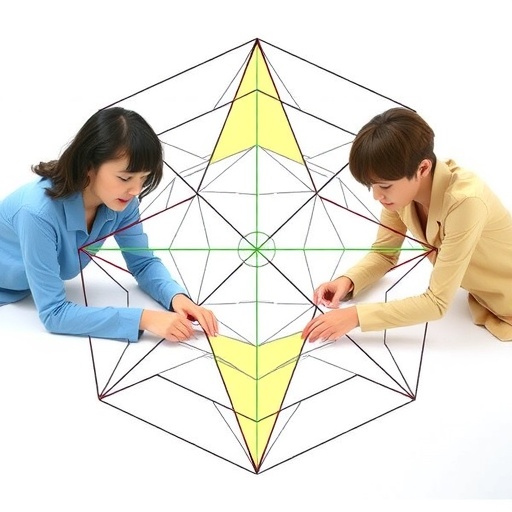
Mathematics education is an essential aspect of teacher training, particularly as it relates to fostering future educators capable of delivering complex concepts effectively. Recent studies have focused on understanding the processes that pre-service mathematics teachers undergo, especially in geometry-related topics. A compelling contribution to this dialogue comes from Tessema, Michael, and Areaya (2025), whose research sheds light on the mathematization process that these future educators engage in while solving geometry problems.
Understanding geometrical concepts not only involves rote memorization of formulas but also requires deep comprehension and the ability to apply knowledge in various contexts. Tessema and colleagues emphasize the importance of developing rich mathematical understanding during teacher training. This process is characterized by recognizing the relationships among different geometric figures, deriving formulas, and employing visual representations to solve complex problems.
One of the key findings detailed in the study is the different pathways that pre-service teachers take when confronting geometry problems. These pathways not only reflect the individual cognitive processing styles but also highlight significant differences based on prior mathematical knowledge. Some students demonstrate an innate ability to visualize geometric configurations and manipulate them mentally, while others may struggle with visualization but excel in algebraic manipulation of geometric principles.
The study also delves into the pedagogical implications of these findings. It argues that teacher education programs should not only focus on content knowledge but also on the development of pedagogical strategies that can nurture students’ inherent geometrical reasoning abilities. This alignment is crucial to ensure that future teachers can effectively scaffold their students’ learning experiences and help them transition from basic recognition of shapes to applying geometric principles in problem-solving scenarios.
Moreover, Tessema and colleagues uncover that emotional and motivational factors significantly influence the mathematization process. Pre-service teachers who exhibit a strong passion for mathematics are more likely to engage deeply with geometric problems. These enthusiastic educators often make connections between different mathematical concepts and engage in discussions that promote collective reasoning among their peers. Thus, the study underscores the necessity of cultivating a positive mathematics culture within teacher education programs.
A significant segment of the research involves qualitative interviews with pre-service teachers. This qualitative approach permits a closer examination of the cognitive and emotional dimensions of the learning process. The researchers identified that many students encountered moments of frustration and uncertainty, particularly when faced with challenging geometry tasks. These experiences can potentially dissuade future educators from pursuing a career in mathematics education. The findings suggest that teacher education programs should incorporate robust support systems, including mentorship and collaborative learning opportunities, to alleviate these pressures.
Additionally, the study reveals that diverse instructional strategies can enhance the mathematization process among future teachers. By varying teaching methods—from direct instruction to exploratory learning—pre-service educators can develop a more flexible understanding of geometric concepts. The exploratory approach, in particular, was highlighted as a powerful technique that encourages students to explore geometric relations actively and hypothesize about the effects of changing variables within geometric contexts.
Furthermore, Tessema and colleagues advocate for the integration of technology within mathematics education as an effective tool for enhancing the understanding of geometry. Utilizing dynamic geometry software or interactive applications allows pre-service teachers to visualize geometric transformations and grasp spatial relationships intuitively. Such tools exemplify how technology can bridge cognitive gaps and enable deeper learning experiences, making complex ideas more accessible.
The results of the research indicate a strong positive correlation between the use of technology and improved problem-solving performance among pre-service teachers. As teacher candidates leverage these tools, they not only enhance their skills but also learn to incorporate technology as a pedagogical asset in their future classrooms. The study thus serves as a call for comprehensive professional development programs that can fully equip future educators with the necessary skills to use technology effectively.
Core concept promotion is another essential aspect highlighted in the research. The authors suggest frameworks and strategies for effectively teaching geometry that allow for holistic understanding. This approach emphasizes the interconnections between the various geometric properties, encouraging a conceptual rather than procedural understanding. By focusing on explaining and teaching core concepts, pre-service teachers can cultivate a deep, robust foundation for their students, ultimately favoring long-term mathematical competence.
In conclusion, the study by Tessema, Michael, and Areaya (2025) contributes significantly to the field of mathematics education, offering valuable insights into the mathematization processes of pre-service teachers in geometry. The findings of this research provide actionable recommendations for reform in teacher education, advocating for the incorporation of diverse pedagogical strategies, the utilization of technology, and a supportive learning environment that prioritizes emotional well-being.
The implications of this study extend beyond the classroom; they resonate throughout the educational landscape, impacting future generations of students. By better understanding how pre-service teachers engage with geometry, educators and policymakers can create more effective training programs that not only prepare teachers but also foster a love for mathematics among all students. Ultimately, the aim is to cultivate a generation of educators who will inspire their students to pursue mathematical understanding with confidence and enthusiasm.
Tessema, G., Michael, K. & Areaya, S. Pre-service mathematics teachers’ mathematization process in solving geometry problems.
Discov Educ 4, 358 (2025). https://doi.org/10.1007/s44217-025-00551-1
Cite Scienmag News
Courtney Benton. (September 27, 2025). Unveiling Pre-Service Teachers’ Geometry Problem Solving. Scienmag. https://scienmag.com/unveiling-pre-service-teachers-geometry-problem-solving/
Courtney Benton. "Unveiling Pre-Service Teachers’ Geometry Problem Solving." Scienmag, 27 September 2025, https://scienmag.com/unveiling-pre-service-teachers-geometry-problem-solving/. Accessed 3 September 2026.
Courtney Benton. "Unveiling Pre-Service Teachers’ Geometry Problem Solving." Scienmag. September 27, 2025. https://scienmag.com/unveiling-pre-service-teachers-geometry-problem-solving/


