

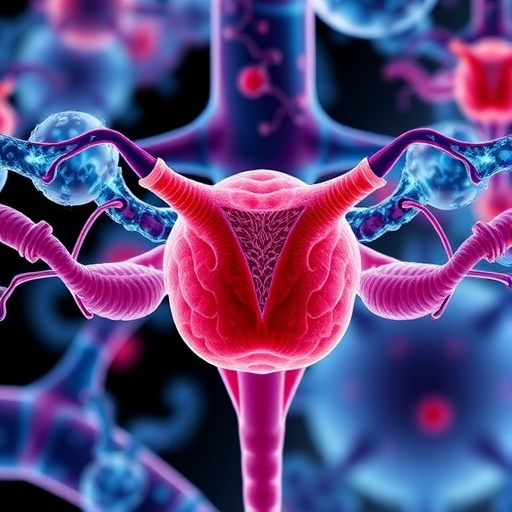
Ovarian cancer remains one of the most challenging malignancies, due in part to its insidious onset and the complexity of its biological mechanisms. Recent studies have significantly advanced our understanding of this disease, with a particular focus on multi-omics approaches that integrate various biological data types to elucidate the intricate interplay between genetic, epigenetic, proteomic, and metabolic landscapes. In a remarkable study published in the Journal of Ovarian Research, researchers led by X. Li, W. Wu, and S. Lin, among others, delve deeply into this multi-omics analysis to uncover potential mechanisms of innate immunity in ovarian cancer tumorigenesis and the associated responses to immunotherapy.
This groundbreaking research highlights the importance of innate immunity in the development of ovarian cancer, emphasizing how dysregulation of immune responses can contribute to both tumor initiation and progression. By employing cutting-edge technologies in genomics, transcriptomics, proteomics, and metabolomics, the authors establish a comprehensive framework that elucidates the multifactorial nature of ovarian cancer. Such insights are critical for developing targeted therapies and improving immunotherapeutic strategies in this field.
The researchers initiated their investigation by constructing a robust data set from clinical samples obtained from ovarian cancer patients. This included not only tumor samples but also adjacent normal tissue, which served as a comparative baseline. The multi-omics approach employed in this research allows for a more holistic view of the tumor microenvironment and how it interacts with the immune system. Through high-throughput sequencing and profiling, the team was able to capture a wide array of molecular alterations linked to innate immune pathways.
One of the pivotal discoveries of this study is the identification of key pathways that are modulated during the tumorigenesis of ovarian cancer. These pathways show a remarkable correlation with the expression of immune-related genes, suggesting that innate immune evasion plays a significant role in the disease’s progression. The team utilized bioinformatics tools to analyze differential expression profiles and pinpoint mutations that adversely affected immune function, which often allows tumors to escape immune surveillance.
Importantly, the analysis also revealed that these immune-related pathways were not merely passive bystanders but were actively involved in shaping the tumor microenvironment. Tumor-associated macrophages, dendritic cells, and other innate immune cells were found to exhibit altered activation states, which contributed to an immunosuppressive milieu, thereby facilitating tumor growth. This emphasizes the dual role of the immune system in both fighting and promoting cancer, depending on how these cells are activated or inhibited.
In their investigation, Li and colleagues found that certain immune checkpoint molecules were overexpressed in tumor samples, further corroborating the concept that ovarian tumors can utilize these pathways to evade immune responses. This aligns with previous research suggesting that immune checkpoint inhibitors may hold promise as therapeutic options for treating ovarian cancer. However, the study adds a layer of complexity by indicating that the effectiveness of such therapies may depend on the underlying innate immune landscape specifically present in each tumor’s microenvironment.
Furthermore, the researchers also explored the potential of using multi-omics data to develop predictive models for patient outcomes. By integrating clinical data with the molecular profiles obtained, they could generate risk stratification models, which could be invaluable for personalizing treatment regimens. These models could allow clinicians to identify which patients would benefit most from aggressive treatment strategies and which might be suitable for more conservative approaches.
Another critical aspect of this research is its implications for immunotherapy. The efficacy of immunotherapeutic strategies, such as CAR-T cells or checkpoint inhibitors, can vary significantly among individuals, often due to pre-existing immune landscape variations. By understanding the innate immune mechanisms that govern tumor biology, researchers can potentially enhance the effectiveness of these therapies, paving the way for more successful treatment options for ovarian cancer patients.
Additionally, the collaborative nature of this research project highlights the importance of multidisciplinary efforts in tackling complex medical challenges. The integration of expertise from various fields—ranging from molecular biology to bioinformatics—showcases a contemporary approach in cancer research, fostering innovation and new discoveries that may not have been possible through traditional research methods alone.
As the study concludes, it leaves a compelling call to action for the scientific community. The insights gained from this multi-omics analysis provide a blueprint for future research endeavors aimed at unraveling the complexities of ovarian cancer. It is clear that understanding the interactions between tumor biology and the immune system will be crucial for developing new therapeutic strategies in the coming years.
This research represents a significant advancement in the field of cancer biology and opens new avenues for future investigation. By revealing the potential mechanisms linking innate immunity with ovarian cancer progression, this study underscores the vital role that immune systems play in oncogenesis and therapy responses. As the landscape of ovarian cancer treatment continues to evolve, studies such as this are invaluable in guiding the development of precision medicine approaches tailored to individual patient profiles.
In sum, this meticulous research encapsulates the intricate relationship between ovarian cancer biology and innate immune mechanisms, offering critical insights that could transform our approach to therapy and lead to improved patient outcomes. As we look forward to the implications of these findings, the intersection of multi-omics analysis with clinical practice continues to hold promise in the fight against ovarian cancer.
In conclusion, ongoing research into the mechanisms of immune evasion and tumor microenvironment dynamics will be essential for refining existing treatment modalities and for innovating new therapies. Maintaining a rigorous focus on how innate immunity interacts with tumor cells can pave the way for breakthroughs that might one day shift the paradigm in the management of ovarian cancer, ultimately leading to enhanced survival rates and quality of life for patients battling this formidable disease.
Subject of Research: Ovarian cancer tumorigenesis and immunotherapy responses in the context of innate immunity.
Article Title: Integrative multi-omics analysis reveals the potential mechanisms of innate immunity in ovarian cancer tumorigenesis and immunotherapy responses.
Article References:
Li, X., Wu, W., Lin, S. et al. Integrative multi-omics analysis reveals the potential mechanisms of innate immunity in ovarian cancer tumorigenesis and immunotherapy responses.
J Ovarian Res (2026). https://doi.org/10.1186/s13048-025-01947-1
Image Credits: AI Generated
DOI:
Keywords: Ovarian cancer, innate immunity, multi-omics, tumorigenesis, immunotherapy, immune evasion, tumor microenvironment, predictive models.


