


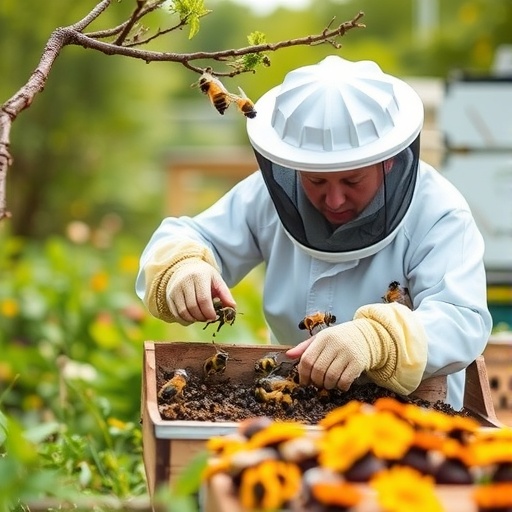
In an era where environmental sustainability urgently intersects with economic development, novel approaches to poverty alleviation that do not compromise ecological integrity are increasingly critical. One such approach, meticulously examined in a groundbreaking study, is the adoption of beekeeping as a green entrepreneurial practice among low-income households in Peninsular Malaysia. This research, published in Humanities and Social Sciences Communications, undertakes a rigorous analysis to decipher the dynamics that encourage or hinder the uptake of beekeeping, using advanced structural equation modeling and artificial neural network analysis to elucidate the underlying behavioral mechanisms.
Beekeeping, traditionally practiced in many cultures, offers multifaceted benefits including income generation, biodiversity enhancement, and pollination services critical to agricultural productivity. However, its promotion as a sustainable business venture among economically marginalized groups requires an understanding beyond simple economic incentives. The study reveals that the intersection of environmental consciousness, entrepreneurial mindset, and available startup resources forms a complex behavioral tapestry that ultimately determines the intention and realization of beekeeping practices in these communities.
Central to this investigation is the conceptual framework deploying the Theory of Planned Behavior (TPB), integrated with environmental concern (EC) and environmental literacy (EL), to predict and analyze attitude toward the environment (ATE), subjective norms (SUN), perceived behavioral control (PBC), beekeeping intention (BKI), and finally, beekeeping startup behavior (BSB). The research confirmed that EC and EL profoundly influence ATE among low-income households, establishing positive environmental attitudes as a cornerstone for the pursuit of green entrepreneurship.
Environmental concern, representing the degree of awareness and worry about ecological degradation, is instrumental in shaping attitudes that favor sustainable practices. Complementing this, environmental literacy encompasses knowledge and understanding of environmental issues and solutions, empowering individuals with the intellectual tools to make informed decisions. The synergy between these two factors fosters an attitudinal environment conducive to embracing beekeeping—an activity inherently aligned with conservation and sustainability goals.
Nevertheless, attitudes alone do not dictate behavior. The study underscores the importance of subjective norms—social pressures and expectations that influence individual decision-making—and perceived behavioral control, which encapsulates the confidence individuals possess regarding their capacity to execute a behavior. In this context, startup resources (SR) such as technical know-how, financial capital, and pertinent skills are critical control beliefs that determine self-efficacy about beekeeping adoption.
Pragmatically, the availability of startup resources and expertise is a significant barrier to entry for many low-income families. Without access to adequate training and financial support, positive environmental attitudes may not translate into actionable beekeeping ventures. The researchers advocate for developmental organizations to bridge this gap by offering comprehensive training programs and easing financial constraints, thereby reducing perceived control barriers and facilitating the establishment of beekeeping enterprises.
The study’s methodological rigor is notable, employing structural equation modeling to parse relationships between latent behavioral constructs and adopting artificial neural network analysis to capture complex nonlinear interactions. This dual analytical approach enhances the robustness of findings, revealing not only direct influences but also intricate interdependencies among variables driving beekeeping adoption.
Importantly, the model derived indicates that ATE, SUN, and PBC collectively foster strong beekeeping intentions, which in turn significantly predict actual beekeeping startup behaviors. This sequential relationship confirms the TPB’s applicability in the environmental entrepreneurship context, providing empirical support for theoretical constructs traditionally used in social psychology.
Beyond academic insights, the study’s implications bear weighty practical significance. By framing beekeeping as a green business model, it highlights a pathway for simultaneous socioeconomic upliftment and ecological stewardship. Policymakers and practitioners engaged in poverty alleviation and environmental management are thus encouraged to consider beekeeping promotion strategies as part of inclusive development frameworks.
Yet, the research does not shy away from acknowledging its limitations. The focus on a single income group within a specific geographical context limits the generalizability of its conclusions. The cross-sectional and quantitative methodology, while powerful, is subject to common method biases and temporal constraints, which future longitudinal and mixed-methods studies could address to provide deeper causal inferences.
The authors propose expanding research designs with larger and more diverse samples to validate and extend the applicability of findings across different sociocultural and economic landscapes. Incorporating longitudinal data would also allow for tracking changes over time, revealing evolving behavioral patterns and the long-term sustainability of beekeeping ventures in low-income communities.
From a policy perspective, the study advocates for inclusive strategies that target the most marginalized populations, ensuring that green practices like beekeeping do not remain confined to economically privileged groups but become accessible tools in poverty eradication and environmental protection efforts.
In summary, this study robustly supports the notion that beekeeping represents a viable green entrepreneurial practice capable of addressing dual goals: economic advancement for low-income families and ecological conservation. The foundational role of environmental attitudes intertwined with practical resource availability forms a blueprint for effective interventions and policies oriented towards sustainable community development.
Ultimately, the successful integration of environmental concern, literacy, positive social norms, and perceived control into behavioral intention models provides a valuable roadmap for fostering green business adoption. By strategically enhancing knowledge, skills, and resource accessibility, stakeholders can significantly improve the adoption rates of environmentally friendly enterprises such as beekeeping, transforming them into powerful agents of change in the global agenda for sustainable development.
The intersection of ecological stewardship and economic empowerment through beekeeping elucidated in this research underscores a transformative approach that resonates beyond Peninsular Malaysia. Its principles may inspire analogous applications in diversified contexts worldwide, particularly where environmental challenges disproportionately affect impoverished populations.
This endeavor sets the stage for a broader cultural shift where sustainability becomes entwined with livelihoods, inspiring communities to champion green innovation organically. As the world confronts escalating climate threats, such hybrid solutions bridging ecology and economy are paramount, positioning beekeeping as a microcosm of hope and progress for generations to come.
Cite Scienmag News
Courtney Benton. (November 28, 2025). Unveiling Beekeeping Insights with AI and SEM. Scienmag. https://scienmag.com/unveiling-beekeeping-insights-with-ai-and-sem/
Courtney Benton. "Unveiling Beekeeping Insights with AI and SEM." Scienmag, 28 November 2025, https://scienmag.com/unveiling-beekeeping-insights-with-ai-and-sem/. Accessed 3 September 2026.
Courtney Benton. "Unveiling Beekeeping Insights with AI and SEM." Scienmag. November 28, 2025. https://scienmag.com/unveiling-beekeeping-insights-with-ai-and-sem/


