
Friday, February 6, 2026
Science
No Result
View All Result
  • Login
  • HOME
  • SCIENCE NEWS
  • CONTACT US
  • HOME
  • SCIENCE NEWS
  • CONTACT US
No Result
View All Result
Scienmag
No Result
View All Result
Home Science News Chemistry

Unveiling a new quantum frontier: frequency-domain entanglement

April 26, 2024
in Chemistry
Reading Time: 2 mins read
0
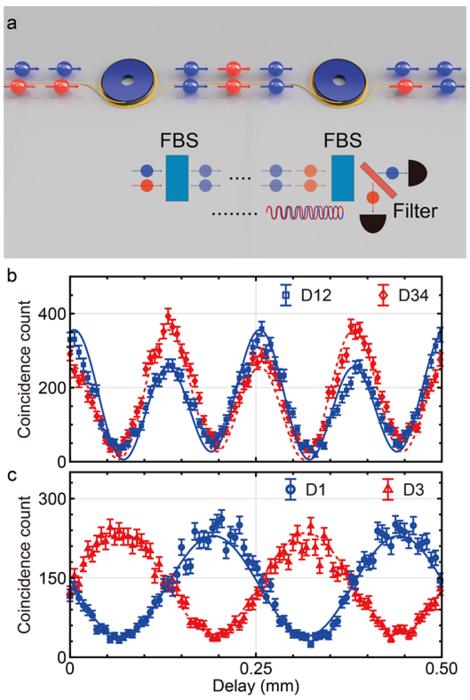
Figure | Experimental schematics and result of the frequency-domain entanglement.
66
SHARES
602
VIEWS
Share on FacebookShare on Twitter
ADVERTISEMENT

Scientists have introduced a groundbreaking form of quantum entanglement known as frequency-domain photon number-path entanglement. This leap in quantum physics involves an innovative tool called a frequency beam splitter, which has the unique ability to alter the frequency of individual photons with a 50% success rate.

Figure | Experimental schematics and result of the frequency-domain entanglement.

Credit: by Dongjin Lee, Woncheol Shin, Sebae Park, Junyeop Kim, and Heedeuk Shin

Scientists have introduced a groundbreaking form of quantum entanglement known as frequency-domain photon number-path entanglement. This leap in quantum physics involves an innovative tool called a frequency beam splitter, which has the unique ability to alter the frequency of individual photons with a 50% success rate.

For years, the scientific community has delved into spatial-domain photon number-path entanglement, a key player in the realms of quantum metrology and information science. This concept involves photons arranged in a special pattern, known as NOON states, where they’re either all in one pathway or another, enabling groundbreaking applications like super-resolution imaging that surpasses traditional limits, the enhancement of quantum sensors, and the development of quantum computing algorithms designed for tasks requiring exceptional phase sensitivity.

In a new paper published in Light Science & Application, a team of scientists, led by Professor Heedeuk Shin from Department of Physics, Pohang University of Science and Technology, Korea, have developed an entangled states in the frequency domain, a concept akin to spatial-domain NOON states but with a significant twist: instead of photons being divided between two paths, they’re distributed between two frequencies. This advancement has led to the successful creation of a two-photon NOON state within a single-mode fiber, showcasing an ability to perform two-photon interference with double the resolution of its single-photon counterpart, indicating remarkable stability and potential for future applications.

“In our research, we transform the concept of interference from occurring between two spatial paths to taking place between two different frequencies. This shift allowed us to channel both color components through a single-mode optical fiber, creating an unprecedented stable interferometer,” Dongjin Lee, the first author of this paper, added.

This discovery not only enriches our understanding of the quantum world but also sets the stage for a new era in quantum information processing in the frequency domain. The exploration of frequency-domain entanglement signals promising advancements in quantum technologies, potentially impacting everything from quantum sensing to secure communication networks.


Journal

Light Science & Applications

DOI

10.1038/s41377-024-01439-9

Share26Tweet17
Previous Post

Climb stairs to live longer

Next Post

ETRI develops an automated benchmark for labguage-based task planners

Related Posts

blank
Chemistry

Scientists Develop Hand-Held “Levitating” Time Crystals

February 6, 2026
blank
Chemistry

Observing a Key Green-Energy Catalyst Dissolve Atom by Atom

February 6, 2026
blank
Chemistry

Saarbrücken Chemists Break New Ground: Iconic Aromatic Molecule Synthesized with Silicon After Decades of Global Pursuit

February 6, 2026
blank
Chemistry

How Cancer Cells Harness Water Pressure to Navigate the Body

February 6, 2026
blank
Chemistry

Harnessing Molecular Sieve Control to Enhance Dynamic Coupling Effects in Fe Nanoparticles

February 6, 2026
blank
Chemistry

FSU Researchers Pioneer Advanced Materials for Next-Gen X-Ray Technologies

February 6, 2026
Next Post
Results of Procedural Generation Performance Evaluation Across Various Large Language Models

ETRI develops an automated benchmark for labguage-based task planners

  • Mothers who receive childcare support from maternal grandparents show more parental warmth, finds NTU Singapore study

    Mothers who receive childcare support from maternal grandparents show more parental warmth, finds NTU Singapore study

    27610 shares
    Share 11040 Tweet 6900
  • University of Seville Breaks 120-Year-Old Mystery, Revises a Key Einstein Concept

    1017 shares
    Share 407 Tweet 254
  • Bee body mass, pathogens and local climate influence heat tolerance

    662 shares
    Share 265 Tweet 166
  • Researchers record first-ever images and data of a shark experiencing a boat strike

    529 shares
    Share 212 Tweet 132
  • Groundbreaking Clinical Trial Reveals Lubiprostone Enhances Kidney Function

    515 shares
    Share 206 Tweet 129
Science

Embark on a thrilling journey of discovery with Scienmag.com—your ultimate source for cutting-edge breakthroughs. Immerse yourself in a world where curiosity knows no limits and tomorrow’s possibilities become today’s reality!

RECENT NEWS

  • New Study Uncovers Mechanism Behind Burn Pit Particulate Matter–Induced Lung Inflammation
  • Nanophotonic Two-Color Solitons Enable Two-Cycle Pulses
  • Cannabidiol’s Sex- and Dose-Dependent Impact on Cocaine Use
  • Winter Teleconnection Shifts Explain Ice Age Oxygen Signals

Categories

  • Agriculture
  • Anthropology
  • Archaeology
  • Athmospheric
  • Biology
  • Biotechnology
  • Blog
  • Bussines
  • Cancer
  • Chemistry
  • Climate
  • Earth Science
  • Editorial Policy
  • Marine
  • Mathematics
  • Medicine
  • Pediatry
  • Policy
  • Psychology & Psychiatry
  • Science Education
  • Social Science
  • Space
  • Technology and Engineering

Subscribe to Blog via Email

Enter your email address to subscribe to this blog and receive notifications of new posts by email.

Join 5,190 other subscribers

© 2025 Scienmag - Science Magazine

Welcome Back!

Login to your account below

Forgotten Password?

Retrieve your password

Please enter your username or email address to reset your password.

Log In
No Result
View All Result
  • HOME
  • SCIENCE NEWS
  • CONTACT US

© 2025 Scienmag - Science Magazine

Discover more from Science

Subscribe now to keep reading and get access to the full archive.

Continue reading