


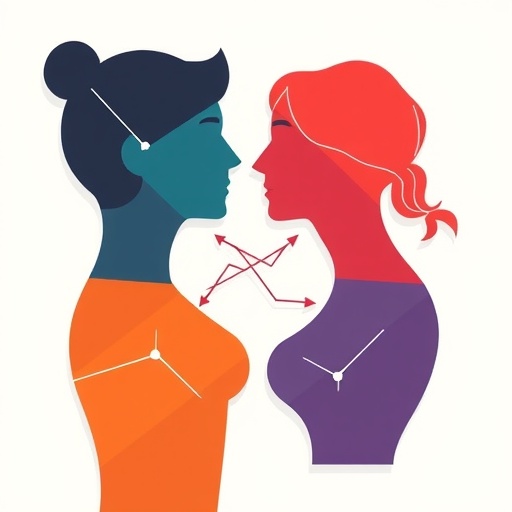
In the evolving discourse surrounding biology and gender studies, a pivotal paper has emerged that challenges the conventional perceptions of sex and gender. The work by Maney, Duchesne, and Grossi titled “Sex/gender entanglement: A problem of knots and buckets,” published in the journal Biological Sex Differences, serves to unveil the complex and often tangled nature of these two fundamental concepts. Spanning over various academic disciplines, it articulates the nuanced interactions between biological sex, gender identity, and societal constructs, presenting a compelling argument that moves beyond simplistic binaries.
The authors begin by situating their research within the framework of biological determinism versus social constructivism, two dominant paradigms that have historically shaped our understanding of gender and sex. Traditionally, sex has been viewed as a biologically fixed category, while gender has been seen as a culturally and socially constructed identity. However, this dichotomy fails to account for the intricate relationships and intersections that exist between the biological and social realms. Maney and colleagues argue that recognizing the entanglement between sex and gender is crucial to fully understanding human identity and behavior.
In their analysis, Maney et al. delve into the implications of this entanglement, pointing out how the dichotomous categorization into “male” and “female” can restrict our understanding of the diversity of human experiences. Drawing on empirical data and theoretical frameworks, the authors present evidence that biological characteristics do not exist in a vacuum; they are influenced by a myriad of social, cultural, and environmental factors. This leads to a re-evaluation of how researchers and the general public should think about sex and gender, calling for a more integrated approach that acknowledges the fluidity and complexity inherent in these concepts.
Furthermore, the paper discusses the metaphor of “knots and buckets,” which provides a visual and analytical tool to comprehend the entanglement of sex and gender. Just as knots can symbolize the intertwined relationships that resist linear categorization, the buckets represent rigid classifications that often oversimplify the nuances of human experiences. This metaphor serves as a powerful reminder that enforcing boundaries can obscure the rich interplay between biological, psychological, and sociocultural determinants of identity.
To substantiate their arguments, the authors turn to contemporary case studies and data drawn from various fields, including psychology, sociology, and genetics. This interdisciplinary approach allows them to illustrate how sex and gender are not merely biological or social but are deeply interwoven in complex patterns that shape our identities. For instance, research in genomics shows that genetic predispositions do not solely define gender identity; instead, these predispositions may be expressed differently across various cultural contexts, highlighting the inadequacies of a strictly biological viewpoint.
In addition, the paper brings attention to the impact of language and discourse surrounding gender. Maney, Duchesne, and Grossi argue that the way we talk about sex and gender is far from neutral. Language influences perceptions and can either reinforce or challenge societal norms. This embedded nature of language can perpetuate stereotypes and limit the understanding of diverse gender identities, thus necessitating a critical examination of the words we use in everyday discourse.
The authors also touch upon the significant role that intersectionality plays in the understanding of gender. They argue that race, class, ethnicity, and sexual orientation intersect with sex and gender, creating unique experiences that cannot be understood through a monolithic lens. By examining the multifaceted experiences of individuals at the intersection of these identities, the research emphasizes the need for a more holistic approach to gender studies.
The implications of this work extend beyond the academic sphere; they resonate within public policy, healthcare, and education. For example, a deeper understanding of sex/gender entanglement can inform more inclusive healthcare practices that consider the diverse needs of various gender identities. This knowledge could help dismantle barriers to access and improve health outcomes for marginalized populations, demonstrating that a nuanced understanding of gender is essential in various sectors of society.
As awareness of these issues grows, the authors advocate for the necessity of educational reform that integrates this complexity into curricula across disciplines. By fostering a more inclusive and comprehensive education around sex and gender, future generations can be equipped with the tools to challenge binary notions and to celebrate the diverse spectrum of human identity.
In conclusion, “Sex/gender entanglement: A problem of knots and buckets” by Maney, Duchesne, and Grossi serves as a seminal contribution to the ongoing discourse on sex and gender. By deconstructing the binary understanding of these concepts, the research paves the way for a nuanced appreciation of the complexities surrounding identity. As society grapples with issues of gender and inclusivity, the insights presented in this paper are timely and essential, providing a foundation for future research and practice.
The entangled nature of sex and gender themes explored in this work encapsulate a critical evolution within social sciences. It is an invitation to rethink outdated paradigms and embrace a more integrated view that honors the richness of human experience. More importantly, it beckons us to foster a more inclusive society where diverse identities are acknowledged and celebrated—a vision that the authors suggest should be at the forefront of contemporary discussions surrounding sex and gender.
Maney, D.L., Duchesne, A. & Grossi, G. Sex/gender entanglement: A problem of knots and buckets. Biol Sex Differ 16, 85 (2025). https://doi.org/10.1186/s13293-025-00758-9
Cite Scienmag News
Ophelia Keating. (October 30, 2025). Untangling the Complexities of Sex and Gender. Scienmag. https://scienmag.com/untangling-the-complexities-of-sex-and-gender/
Ophelia Keating. "Untangling the Complexities of Sex and Gender." Scienmag, 30 October 2025, https://scienmag.com/untangling-the-complexities-of-sex-and-gender/. Accessed 4 September 2026.
Ophelia Keating. "Untangling the Complexities of Sex and Gender." Scienmag. October 30, 2025. https://scienmag.com/untangling-the-complexities-of-sex-and-gender/


