

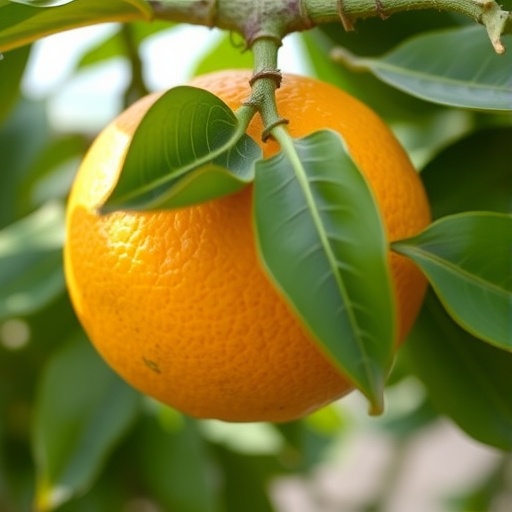
In a groundbreaking study, researchers have delved into the complex interactions between transcription processes and metabolism in sweet orange plants, particularly under conditions of boron deficiency. Boron is an essential micronutrient for plants, playing a vital role in various physiological functions, including cell wall structure and reproductive development. However, its deficiency can lead to significant agricultural challenges, including reduced yields and compromised fruit quality. Understanding how sweet orange plants respond at a molecular level to this deficiency could pave the way for improved agricultural practices and enhanced crop resilience.
Through a meticulous analysis of gene expression and metabolic pathways, the research team has documented how boron deficiency alters the metabolic landscape of sweet orange plants. Their findings reveal that when boron levels drop, a series of transcriptional activations and repressions occur, affecting numerous biochemical pathways integral to plant growth and development. This transcription-metabolism association highlights the intricate connections between nutrient availability and gene regulation, shedding new light on how plants adapt to nutrient stress.
The study identified key transcription factors that are significantly upregulated in response to boron deficiency. These transcription factors act as molecular switches, activating specific genes that help the plant cope with the stress associated with low boron levels. In parallel, the research showcases the downregulation of genes involved in metabolic processes that are detrimental under nutrient-limited conditions. This dynamic adjustment in gene expression underscores the adaptive mechanisms that sweet orange plants employ to mitigate the adverse effects of boron deficiency.
One particularly striking finding of the research is the role of secondary metabolites in the plant’s response. Secondary metabolites are organic compounds that are not directly involved in the normal growth, development, or reproduction of plants, but they play crucial roles in plant defense mechanisms and stress responses. The researchers found that the biosynthesis of several key secondary metabolites was significantly altered under boron deficiency, suggesting that these compounds may contribute to the plant’s ability to withstand stress conditions.
In addition to exploring gene expression and metabolic pathways, the research involved a comprehensive analysis of the environmental and developmental contexts in which boron deficiency occurs. By understanding the specific circumstances that lead to boron deficiency in sweet orange crops, the researchers can better predict and manage its impact on agricultural yield. Their findings are not just relevant to sweet oranges, but also have broader implications for other crops that share similar metabolic pathways and nutrient requirements.
Moreover, the team employed advanced metabolomics techniques to map the metabolic changes that occur in response to boron deficiency. This high-throughput approach allowed them to quantify numerous metabolites simultaneously, providing a detailed view of the metabolic shifts that take place at a cellular level. The integration of transcriptomic and metabolomic data forms a holistic picture of the physiological adjustments that occur in sweet orange plants facing nutrient stress.
The implications of this research extend beyond theoretical knowledge; they point toward practical applications in agricultural biotechnology. By identifying the molecular pathways involved in the response to boron deficiency, this research opens doors for targeted breeding programs aimed at developing sweet orange varieties that are more resilient to nutrient stress. Farmers may soon benefit from crops that not only yield better but are also more efficient in utilizing available nutrients, ultimately leading to sustainable agricultural practices.
Another noteworthy aspect of the research is its potential to inform fertilization strategies for sweet orange cultivation. With a deeper understanding of how boron influences metabolic processes, agronomists can devise more effective fertilizer regimes that optimize nutrient uptake and minimize waste. This could reduce the economic burden on farmers while also decreasing the environmental impact associated with excessive fertilizer use.
The research also addresses a critical gap in our understanding of plant responses to abiotic stressors—such as nutrient deficiencies—by providing a comprehensive framework for studying these interactions. The innovative use of transcriptomic analysis allows researchers to uncover the global changes in gene expression patterns, offering insights that could be applied to a wide variety of crops. Such knowledge is invaluable in the face of changing environmental conditions, where plants must constantly adapt to survive.
In aligning molecular biology with agronomy, this study exemplifies the potential of interdisciplinary research in addressing real-world agricultural issues. By bridging the gap between laboratory research and field application, scientists can transform fundamental insights into actionable strategies for crop management. The findings related to transcription and metabolism not only contribute to our growing knowledge of plant biology, but they also serve as a catalyst for innovation in agricultural research.
As global populations continue to rise and the demand for food increases, studies like this one are essential in developing strategies to enhance crop productivity. The pressures on agricultural systems necessitate an urgent response, and uncovering the mechanisms that underlie plant adaptation to nutrient deficiencies is a crucial step in this process. This research is a testament to the resilience of plants and the ongoing quest to understand and harness their capabilities for improved agricultural outcomes.
In conclusion, the exploration of transcription-metabolism associations in sweet orange plants facing boron deficiency marks a significant contribution to the field of plant sciences. With insights into molecular responses and adaptive mechanisms, researchers are better equipped to tackle the challenges posed by nutrient deficiencies. As agricultural systems evolve, such foundational research will undoubtedly play a pivotal role in fostering sustainable practices that secure food sources for future generations.
Subject of Research: The response of sweet orange plants to boron deficiency, focusing on transcription and metabolism.
Article Title: Transcription-metabolism association analysis of molecular mechanisms in sweet orange plants in response to boron deficiency.
Article References:
Yang, X., Wen, K., Yang, X. et al. Transcription-metabolism association analysis of molecular mechanisms in sweet orange plants in response to boron deficiency.
BMC Genomics (2025). https://doi.org/10.1186/s12864-025-12408-w
Image Credits: AI Generated
DOI: 10.1186/s12864-025-12408-w
Keywords: Boron deficiency, sweet orange, transcription, metabolism, secondary metabolites, gene expression, nutrient stress, agricultural biotechnology, crop resilience, metabolomics.


