

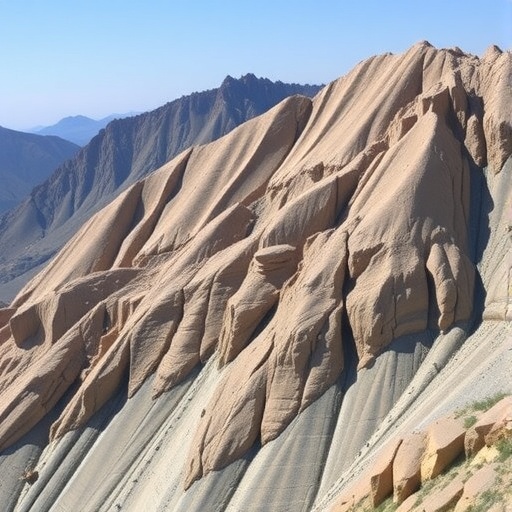
In a groundbreaking study published in Natural Resources Research, researchers A.M. Eldosouky, M.H. Bencharef, and A. Henaish delve into the intricate relationships governing lead-zinc (Pb-Zn) mineralization in the Es Souabaa Anticline, Algeria. The research stands at the intersection of geology, remote sensing, and geochemistry, forming an essential nexus for understanding mineral deposits in tectonically complex terrains. By integrating various datasets, the authors have crafted a comprehensive analysis that not only elucidates the structural influences shaping these valuable ore deposits but also enhances our broader comprehension of mineral exploration techniques.
The work meticulously examines the structural geology of the Es Souabaa Anticline, which is situated in a region characterized by complex tectonic activity. Throughout geological history, this area has undergone multiple tectonic phases, resulting in a dynamic landscape marked by faults, folds, and other geological structures that play pivotal roles in mineralization. The authors project that the deformational history of the anticline significantly influences the genesis and distribution of Pb-Zn mineralization, making it a prime location for their research.
Utilizing advanced remote sensing techniques, the researchers employed satellite imagery to analyze surface features indicative of mineral deposits. This approach allowed for the identification of key zones of alteration and potential mineral concentration. Remote sensing offers a non-invasive means to survey large areas, minimizing the need for extensive ground surveys and enabling geologists to pinpoint regions of interest swiftly. The integration of remote sensing with geological and geochemical data has become increasingly essential in modern mineral exploration, enabling researchers to construct three-dimensional models of mineralization.
Complementing remote sensing, the study incorporated geophysical methods to provide insights into subsurface structures. Techniques such as magnetic and electromagnetic surveys have enriched the dataset, revealing anomalies consistent with the presence of mineral deposits. These geophysical techniques are pivotal for delineating mineralization patterns beneath the surface, guiding exploration efforts more effectively. The findings underscore the necessity of employing multifaceted approaches in understanding geological processes and their implications for mineral wealth.
Geochemical analyses further complemented the study, as samples were taken from various locations within the anticline. The analyses focused on the elemental composition of the soil and rock samples, revealing the concentrations of Pb and Zn in connection with structural features. Such geochemical mapping is crucial for developing a coherent picture of mineralization and provides insights into the geochemical processes responsible for ore deposition. The interplay between geochemical signatures and structural controls serves as a roadmap for identifying prospective areas for mining.
The research emphasizes the interplay between geology and mineralization within the context of regional tectonics. The authors detail how fault systems interact with depositional processes, leading to varying levels of mineral concentration. Understanding these relationships is vital not only for academic research but also for practical mining applications. The findings could inform future mining strategies, targeting specific structural features known to harbor Pb-Zn mineralization.
By synthesizing remote sensing, geophysical, and geochemical data, the researchers present a holistic view of the Es Souabaa Anticline. This integrative approach is particularly pertinent in today’s fast-evolving exploration climate, where efficient and accurate resource assessment is paramount. The study stands as a testament to the necessity of interdisciplinary methods in addressing complex geological questions.
As the demand for Pb and Zn continues to rise, fueled by technological advancements and infrastructure development, the importance of this research cannot be overstated. The insights gleaned from the Es Souabaa Anticline can serve as a model for similar tectonically active regions worldwide. By understanding the structural factors that influence mineralization, geologists can develop targeted exploration strategies that minimize environmental impact while maximizing resource recovery.
The implications of this study extend beyond the immediate geographical area, contributing to the broader discourse on sustainable mineral extraction. With increasing scrutiny on mining practices, the ability to locate and extract minerals in a responsible manner is more crucial than ever. By leveraging advanced scientific methods, this research aligns with global efforts to promote efficient resource management in line with sustainable development goals.
In summary, the research conducted by Eldosouky and colleagues signifies a significant step forward in our comprehension of Pb-Zn mineralization in complex tectonic settings. By embracing a scale-integrated methodology, the authors not only shed light on the specific geologic conditions of the Es Souabaa Anticline but also provide valuable frameworks applicable to a multitude of geological contexts. This integrative strategy will likely prove advantageous for future explorations, paving the way for discoveries that resonate with both economic and environmental considerations.
As the global mineral industry continually adapts to the challenges posed by an evolving marketplace, research such as this fosters a deeper understanding of the geological underpinnings that govern mineral deposits. The collaborative efforts of scientists in fields such as geology, remote sensing, and geochemistry pave the way for innovative solutions and enhanced exploration strategies in the quest for essential resources.
The data derived from this study will indeed contribute to more efficient mineral exploration and could stimulate further studies that investigate similar geological settings. As researchers build upon these findings, the potential for significant advances in the understanding and management of mineral resources grows, marking a promising horizon for the industry.
Ultimately, the research by Eldosouky, Bencharef, and Henaish encapsulates the mounting potential of integrating technology with traditional geological methods. Such approaches not only enhance our scientific knowledge but also equip us with the tools necessary to navigate the complexities associated with modern mineral exploration.
Subject of Research: Pb–Zn Mineralization in a Complex Tectonic Setting
Article Title: Structural Controls on Pb–Zn Mineralization in a Complex Tectonic Setting: Insights from a Scale-Integrated Study of Remote Sensing, Geophysical, and Geochemical Data of the Es Souabaa Anticline, Algeria
Article References:
Eldosouky, A.M., Bencharef, M.H., Henaish, A. et al. Structural Controls on Pb–Zn Mineralization in a Complex Tectonic Setting: Insights from a Scale-Integrated Study of Remote Sensing, Geophysical, and Geochemical Data of the Es Souabaa Anticline, Algeria. Nat Resour Res (2025). https://doi.org/10.1007/s11053-025-10578-8
Image Credits: AI Generated
DOI: https://doi.org/10.1007/s11053-025-10578-8
Keywords: Pb-Zn mineralization, Es Souabaa Anticline, remote sensing, geophysical methods, geological structures, geochemical analysis, tectonic settings, mineral exploration, sustainable resource management.


