

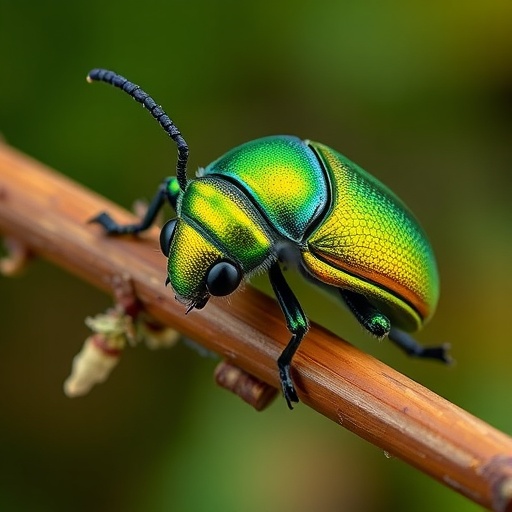
In the world of entomology, few subjects foster as much intrigue as the mechanisms behind color polymorphism within species. This biological phenomenon, characterized by individuals within the same species exhibiting different coloration patterns, has profound implications for understanding evolutionary dynamics, adaptation, and ecological interactions. A recent study led by an international team of researchers, published in the esteemed journal Frontiers in Zoology, delves into the structural background of intraspecific color variation in the shining leaf chafer, a beetle found across various geographic locales.
The research not only elucidates the underlying biological mechanisms that contribute to color differentiation but also highlights how geographic distribution influences these patterns. As this study suggests, the shimmering hues of these beetles are no mere aesthetic choice; rather, they reflect a complex interplay of genetic, environmental, and behavioral factors that facilitate survival and reproduction within varying ecological contexts. By decoding these relationships, scientists hope to uncover insights that could advance our understanding of evolutionary processes.
The shining leaf chafer exemplifies a striking case in the study of color polymorphism. This beetle is well-known for displaying an array of colors, from iridescent greens to deep blues and golds, which appear to serve various adaptive functions. Coloration in many species significantly impacts thermoregulation, camouflage, and even mating success. Understanding the intricacies of these color patterns thus provides essential information on how species adapt to their environments. Researchers employed a multi-disciplinary approach combining genetic analysis, structural biology, and ecological modeling to investigate this phenomenon holistically.
The study’s team, composed of leading scientists including Lu, Kovalev, and Li, meticulously examined the structural characteristics of the chafer’s exoskeleton, which plays a pivotal role in light scattering and reflection. Their results showed that the nanoscale structures of the beetles’ exoskeleton facilitate specific colorations, an aspect key to understanding the optical properties responsible for their vivid appearance. This structural insight is vital for figuring out how polygenic traits contribute to physical characteristics in other species as well.
Moreover, the geographical distribution of the shining leaf chafer reveals a striking correlation with environmental factors, such as climate variations and habitat types. Certain color morphs were found to thrive in specific regions, suggesting that these variations are not random but are instead adaptive responses to local conditions. The research conducted in diverse locales emphasizes how organisms can dynamically interact with their ecosystems, an ongoing dialogue influenced by the colors they exhibit.
Additionally, the study points to evolutionary pressures that play a significant role in maintaining color polymorphism. For instance, predators often adapt to their prey’s coloration, leading the beetles to continuously evolve and adjust their hues in response to these predation pressures. The researchers found that specific color variants offered better camouflage in particular habitats, thus enhancing individual survival rates. Such adaptive strategies are critical for the evolutionary success of this and other species, as they underline the importance of natural selection in shaping the characteristics of organisms over time.
Another aspect of the research is its contribution to our understanding of sexual selection. In many species, coloration is not merely a survival tool but also a signal for potential mates. The study explored how male and female beetles of different colors interacted during mating rituals, revealing that certain color morphs were preferred over others. This preference can lead to shifts in population dynamics as selective pressures dictate which traits are favored and propagated through generations.
Notably, the findings of this study highlight a broader ecological principle: the importance of genetic diversity within populations. By examining different color morphs, researchers garnered insights regarding genetic variation, which serves as a foundation for adaptability in changing environments. This genetic plasticity is essential for species resilience in the face of climate change and habitat destruction, emphasizing the need to conserve diverse ecosystems that support these remarkable adaptations.
As the scientific community continues to explore the mechanisms of color polymorphism, this study serves as a crucial stepping stone. It not only provides a detailed structural basis for understanding the shining leaf chafer but also offers valuable implications for biodiversity and conservation strategies around the globe. As species faces mounting pressures from human activity and environmental shifts, understanding the intricacies of their adaptation mechanisms will prove paramount.
The implications of such research can extend beyond entomology; they can inform broader ecological and evolutionary theories applied to other taxa. By understanding how specific traits evolve within organisms, scientists can better predict how biodiversity will respond in the face of global change.
In conclusion, the structural grounding of color polymorphism in the shining leaf chafer reflects an intricate dance between genetics and environment, showcasing the resilience of nature. Through the lens of this study, it becomes clearer that understanding the visual diversity of our planet is essential—not just for elucidating the beauty of life but for ensuring its continuity in an ever-changing world.
In essence, the research encapsulates a fascinating intersection of biology, ecology, and evolutionary theory, shedding light on how organisms evolve in response to their environments and, in turn, how these traits impact their survival and reproduction. As scientists, we stand at the brink of deeper inquiries powered by such findings, reminding us that in every color lies a story of adaptation and survival.
Understanding the complexities of polymorphism empowers both scientists and conservationists in their efforts to protect these delicate yet resilient systems. As we unravel the mysteries ingrained in the colors of the natural world, we come to appreciate both the artistry of evolution and the critical importance of fostering diversity in our ecosystems.
Subject of Research: Color polymorphism in the shining leaf chafer
Article Title: Structural background of intraspecific color polymorphism and the driver of geographic patterns in a shining leaf chafer
Article References: Lu, Y., Kovalev, A., Li, L. et al. Structural background of intraspecific color polymorphism and the driver of geographic patterns in a shining leaf chafer. Front Zool 22, 18 (2025). https://doi.org/10.1186/s12983-025-00571-5
Image Credits: AI Generated
DOI: https://doi.org/10.1186/s12983-025-00571-5
Keywords: color polymorphism, shining leaf chafer, adaptation, ecology, evolution, genetic diversity, structural biology, sexual selection, natural selection


