


This work is supervised by Prof. Li-Hua Chen and Prof. Bao-Lian Su from Laboratory of Living Materials at the State Key Laboratory of Advanced Technology for Materials Synthesis and Processing, Wuhan University of Technology, Wuhan, China. This material was synthesized by Dr. Shen Yu who was used to introduce hydroperoxide into the synthesis system of titanium silicates. At first, he treated this material as a reference sample for another project and conducted catalytic oxidative desulfurization tests on this catalyst. Accidently, he found that this catalyst completely removed all thiophenic sulfurs in minutes, much more efficient than all the rest catalysts. “I almost convinced myself that there may be something wrong with my operations” Dr. Yu says.

Credit: ©Science China Press
This work is supervised by Prof. Li-Hua Chen and Prof. Bao-Lian Su from Laboratory of Living Materials at the State Key Laboratory of Advanced Technology for Materials Synthesis and Processing, Wuhan University of Technology, Wuhan, China. This material was synthesized by Dr. Shen Yu who was used to introduce hydroperoxide into the synthesis system of titanium silicates. At first, he treated this material as a reference sample for another project and conducted catalytic oxidative desulfurization tests on this catalyst. Accidently, he found that this catalyst completely removed all thiophenic sulfurs in minutes, much more efficient than all the rest catalysts. “I almost convinced myself that there may be something wrong with my operations” Dr. Yu says.
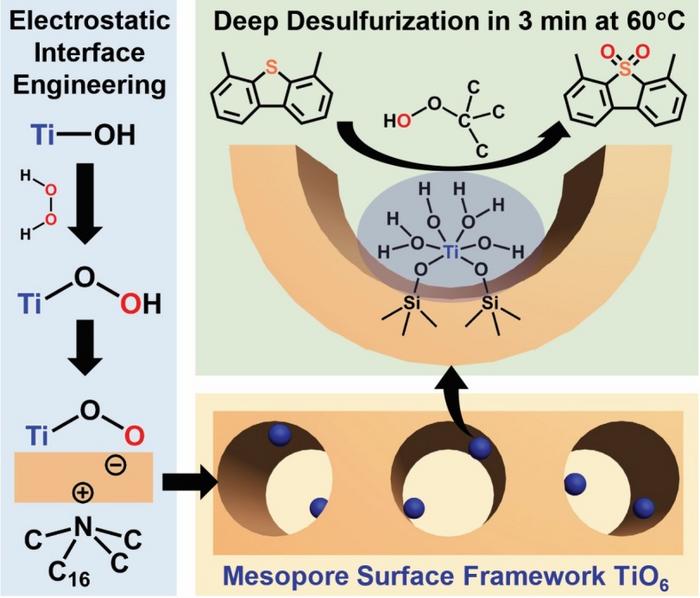
The supervisor Prof. Li-hua Chen and Prof. Bao-Lian Su thought that systematical investigations should be carried out to confirm whether there were some special catalytic sites in this material. The team further used a series of advanced spectroscopy techniques to determine the active sites inside. They found that a novel hexa-coordinated Ti (TiO6) sites existed on the surface of mesopores. Such TiO6 sites were asymmetrical and singly distributed, being able to accommodating bulky guest molecules. Since reactant molecules can only access the mesopore surface and only TiO6 sites can be observed on the mesopore surface. This team attributed the superior catalytic oxidative desulfurization performance to the novel TiO6 single sites. “We are so excited to locate the specific active sites but we should figure out why they are so active,” Prof. Chen says.
Dr. Yu therefore conducted theoretical calculations for further insight into the catalytic mechanism. He discovered that two Ti-OH groups of the TiO6 site can interact with oxidant via additional hydrogen bond network and led to a low-energy reaction pathway. “They appear like two old friends who can easily cooperate and accomplish any assignment,” Dr. Yu says metaphorically.
In order to evidence that this material was not an occasional situation, Dr, Yu performed systematical experimental investigations and thorough characterizations to reveal the formation mechanism of Ti sites. A unique hydrolysis product of TiOOH was identified. TiOOH possesses an ionization ability that is 155 times higher than the conventional hydrolysis product of TiOH, which means that considerable TiOO– formed and distributed at the electrostatic interface via electrostatic interaction with positively charged surfactant micelles. After removing the surfactant micelles, mesopores formed and Ti sites were located on the mesopore surface. Notably, this TiOO– can only be transformed into TiO6 sites. “These new findings will definitely attract massive attention for designing highly accessible, highly active catalytic centers at interface to boost the development of interface catalysis” Prof. Su says excitedly.
The precise construction of catalytic sites is a huge challenge in the field of catalysis aiming at maximizing the catalytic efficiency of catalysts. The relationship of catalytic site structure and distribution model with target catalytic reaction is still under investigation. This work provides a typical example of precisely designing the structure and location of active sites, which might contribute to the new era of interface catalysis with minimized energy consumption and high efficiency.
Journal
National Science Review
Cite Scienmag News
Denise Maddox. (May 9, 2024). Unprecedented deep oxidative desulfurization with precisely designed Ti sites. Scienmag. https://scienmag.com/unprecedented-deep-oxidative-desulfurization-with-precisely-designed-ti-sites/
Denise Maddox. "Unprecedented deep oxidative desulfurization with precisely designed Ti sites." Scienmag, 9 May 2024, https://scienmag.com/unprecedented-deep-oxidative-desulfurization-with-precisely-designed-ti-sites/. Accessed 4 September 2026.
Denise Maddox. "Unprecedented deep oxidative desulfurization with precisely designed Ti sites." Scienmag. May 9, 2024. https://scienmag.com/unprecedented-deep-oxidative-desulfurization-with-precisely-designed-ti-sites/

