


Deep beneath the Earth’s crust, buried more than 3,000 kilometers beneath our feet, lies a vast reservoir of precious metals, including gold, ruthenium, and other rare elements. Contrary to the popular belief that the world’s richest gold stocks are stored in man-made vaults like Fort Knox, recent research has revealed that the lion’s share of these valuable metals dwells hidden within the Earth’s core. A groundbreaking study led by scientists from the University of Göttingen has uncovered compelling evidence that metallic materials, once thought to be locked away permanently in the core, are in fact leaking into the rocky mantle above and potentially traveling all the way to the surface through volcanic activity.
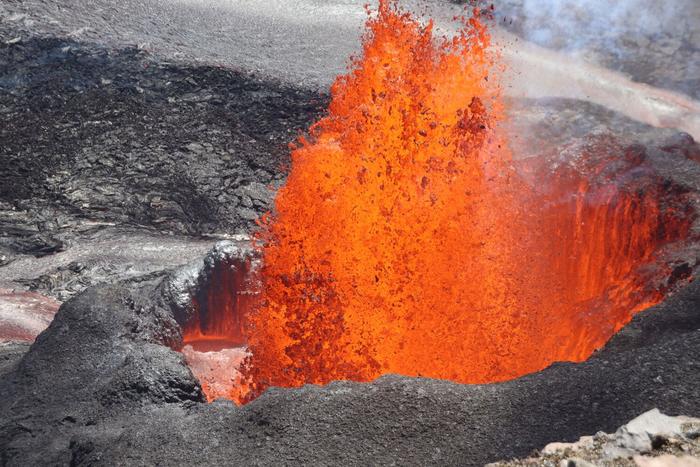
This astonishing revelation stems from the meticulous analysis of isotopes found in volcanic rocks erupted in Hawaii. The team focused on traces of the precious transition metal ruthenium (Ru), paying particular attention to a specific isotope – ruthenium-100 (^100Ru). Isotopic compositions serve as fingerprints that can discern the origins of geological materials, allowing researchers to separate mantle-derived material from core-derived components. The core’s ruthenium isotopic signature differs ever so slightly from that found in the mantle due to their distinct formation histories dating back 4.5 billion years to Earth’s early differentiation.
These isotopic differences, while minute and previously undetectable, were resolved through innovative analytical techniques developed at Göttingen. These methods enabled the scientists to identify an anomalously high signal of ^100Ru within the Hawaiian lavas, a discovery that unequivocally points to the leakage of core material. According to Dr. Nils Messling, a geochemist involved in the study, this marks a landmark moment: “We realized we had literally struck gold.” Their data provide direct geochemical proof that the Earth’s core is not the impervious reservoir it was once thought to be but rather a dynamic, interacting region leaking metallic components into the overlying mantle.
Extending beyond ruthenium, this discovery implies that other precious metals, including gold itself along with associated elements such as tungsten (W), are migrating from the core through the deep mantle. Such upward transport likely occurs via superheated plumes of mantle rock originating at the enigmatic core-mantle boundary, a transition zone situated roughly 2,900 kilometers beneath the surface. These mantle plumes ascend through vast distances, eventually feeding volcanic hotspots that produce ocean island basalts like those that form the Hawaiian archipelago.
Professor Matthias Willbold, a senior researcher at the University of Göttingen, elaborates on the broader ramifications of these findings. “Our research fundamentally challenges long-standing assumptions about the Earth’s inner isolation. The volume of mantle material fed by core leakage is immense, amounting to several hundreds of quadrillion metric tonnes of rock rising towards the surface.” This insight sheds new light on the dynamic processes governing the Earth’s interior and has profound implications for understanding how deep Earth chemistry influences surface geology and resource distribution.
The implications for natural resource science are profound. The precious metals essential for countless industrial applications — from electronics to renewable energy technologies — may be sourced, at least in part, from these core-derived materials. Previously, the genesis and replenishment of such metals in the mantle were poorly understood; now it seems the Earth’s core serves as an unexpectedly active reservoir feeding these economically crucial elements into the mantle and crust through volcanic activity.
Understanding the mechanisms underpinning this core leakage requires a deep dive into the Earth’s geochemical evolution. During the planet’s formative period, differentiation separated the dense metallic core from the lighter silicate mantle. Elements like ruthenium and gold were sequestered preferentially into the core due to their siderophile (iron-loving) nature. Over billions of years, minute but continuous exchanges at the core-mantle boundary have persisted, challenging the previously held notion that the core and mantle are entirely isolated reservoirs.
These new findings also provide a fresh perspective on the geodynamics of mantle plumes and volcanic hotspots. It appears that some of the signature materials in hotspot lavas, traditionally interpreted solely as products of mantle convection, have a more complex provenance. The integration of core components into ascending mantle plumes suggests a greater compositional diversity and dynamic complexity in the Earth’s interior. This intermingling offers a powerful window into deep Earth processes inaccessible by other means.
Furthermore, the technical achievements enabling this discovery highlight advances in isotopic geochemistry. The resolution of such subtle isotopic anomalies requires ultra-precise mass spectrometry and rigorous sample preparation techniques to eliminate contamination and background signals. These methods are opening new frontiers in tracing the pathways of elements from the deepest Earth reservoirs to its surface environment, providing clues about planetary formation, differentiation, and ongoing evolution.
While these findings paint an exciting picture of an Earth still dynamically evolving deep beneath the surface, many questions remain. It is not yet clear whether the processes of core leakage observed today have operated continuously over geological time or represent a more recent phenomenon. Clarifying the temporal and spatial scales of this material exchange will require further multidisciplinary efforts combining geochemistry, geophysics, and modeling.
In summary, the discovery that the Earth’s core is leaking precious metals such as ruthenium and gold into the mantle—and by extension, possibly to the surface—reshapes our understanding of Earth’s internal workings profoundly. It challenges entrenched models of an isolated core, reveals a previously hidden supply chain of critical metals, and provides tantalizing insights into the complex geochemical interplay deep within our planet. These insights push the frontiers of mantle geochemistry and have far-reaching implications for resource exploration, geodynamic theory, and our broader grasp of Earth as a dynamic and evolving planet.
—
News Publication Date: 21-May-2025
Web References: https://www.nature.com/articles/s41586-025-09003-0
References: Messling N et al. “Ru and W isotope systematics in ocean island basalts reveals core leakage,” Nature 2025. DOI: 10.1038/s41586-025-09003-0.
Cite Scienmag News
Violet Maxwell. (May 22, 2025). Unlocking the World’s Largest Gold Reserves: A Scientific Breakthrough. Scienmag. https://scienmag.com/unlocking-the-worlds-largest-gold-reserves-a-scientific-breakthrough/
Violet Maxwell. "Unlocking the World’s Largest Gold Reserves: A Scientific Breakthrough." Scienmag, 22 May 2025, https://scienmag.com/unlocking-the-worlds-largest-gold-reserves-a-scientific-breakthrough/. Accessed 5 September 2026.
Violet Maxwell. "Unlocking the World’s Largest Gold Reserves: A Scientific Breakthrough." Scienmag. May 22, 2025. https://scienmag.com/unlocking-the-worlds-largest-gold-reserves-a-scientific-breakthrough/


