

CLEVELAND—The evolution of resistance to diseases, from infectious illnesses to cancers, poses a formidable challenge.

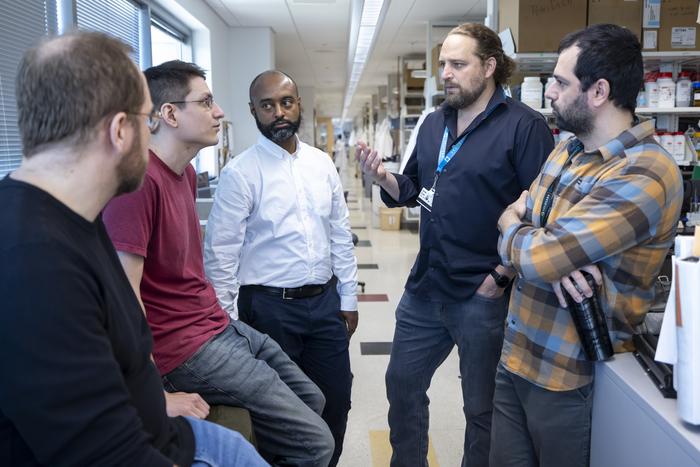
Credit: Case Western Reserve University
CLEVELAND—The evolution of resistance to diseases, from infectious illnesses to cancers, poses a formidable challenge.
Despite the expectation that resistance-conferring mutations would dwindle in the absence of treatment due to a reduced growth rate, preexisting resistance is pervasive across diseases that evolve—like cancer and pathogens—defying conventional wisdom.
In cancer, it is well known that small numbers of drug-resistant cells likely exist in tumors even before they’re treated. In something of a paradox, before treatment, these mutants have been repeatedly shown to have lower fitness than the surrounding ancestor cells from which they arose. It leads to a scenario that seems to break Darwin’s rules: Why do these least fit cells survive?
In a new study, researchers at Case Western Reserve University and Cleveland Clinic reveal a fascinating discovery: Interactions between these mutants and their ancestors, like two species in an ecosystem, may hold the key to understanding this paradox.
Their findings suggest these ecological interactions play a pivotal role in reducing the costs of resistance, providing a path to survival for preexisting resistance. And not just in lung cancer, but across various biomedical contexts where drug resistance is a challenge, including other cancers, pathogens and even parasites.
The study
Combining computer simulations and analytical results, the study establishes a mathematical framework to examine the impact of these ecological interactions on the evolutionary dynamics of resistance.
“This is a really exciting finding because it settles some fundamental disagreements between classical population genetics and theoretical ecology,” said the study’s principal investigator Jacob Scott, staff physician-scientist at Cleveland Clinic and an associate professor of physics and medicine at Case Western Reserve. Scott is also associate director for data science at the Case Comprehensive Cancer Center.
The study also highlights the clinical relevance of these findings by genetically engineering common resistance mechanisms observed in non-small-cell lung cancer, a disease notorious for preexisting resistance to targeted therapies, and the leading cause of cancer death in the United States.
Each genetically engineered cancer cell line experienced a benefit from being with its ancestor, in the group’s evolutionary game assay when cultured with their treatment sensitive ancestor, just as the new theory predicted—bringing closure to the paradox.
“Our findings offer an attractive new hypothesis for why treatment resistance is so common: The resistant cells are saved from extinction by the other cells surrounding them through an ecological mechanism,” said Jeff Maltas, the study’s lead author and a post-doctoral fellow at Case Western Reserve. “These results provide a novel treatment strategy: designing treatments that disrupt the ecological interaction that allows resistance to gain a foothold in the first place, rather than developing new drugs for increasingly resistant populations.”
This multidisciplinary research, including physics, genetics, theoretical ecology and mathematical oncology, published in PRX Life, represents a significant step toward understanding resistance evolution. The hope is it may lead to innovative approaches to fighting cancer and infectious diseases, the researchers said.
###
Case Western Reserve University is one of the country’s leading private research institutions. Located in Cleveland, we offer a unique combination of forward-thinking educational opportunities in an inspiring cultural setting. Our leading-edge faculty engage in teaching and research in a collaborative, hands-on environment. Our nationally recognized programs include arts and sciences, dental medicine, engineering, law, management, medicine, nursing and social work. About 6,200 undergraduate and 6,100 graduate students comprise our student body. Visit case.edu to see how Case Western Reserve thinks beyond the possible.
Journal
PRX Life
Method of Research
Observational study
Subject of Research
Not applicable
Article Title
Frequency-Dependent Ecological Interactions Increase the Prevalence, and Shape the Distribution, of Preexisting Drug Resistance
Article Publication Date
3-Jun-2024

