

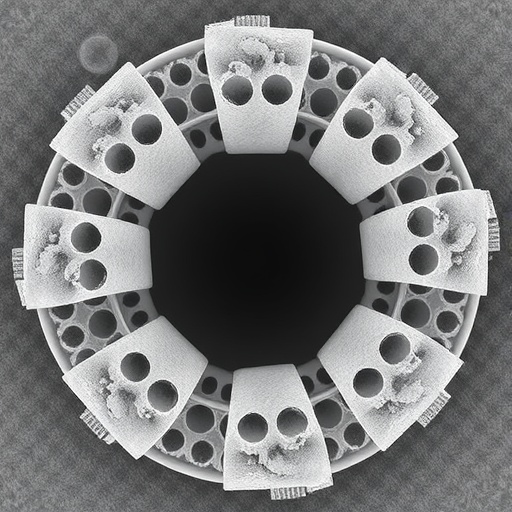
Ceramic ultrafiltration membranes have long been considered a cornerstone in advanced water purification and industrial filtration processes due to their remarkable chemical stability and mechanical strength. However, their efficiency is severely compromised over time by a phenomenon known as pore blockage fouling. This persistent issue, which culminates in decreased permeate flux and increased operational costs, has challenged researchers and engineers attempting to optimize membrane longevity and performance. Recently, a groundbreaking study led by Sheng, Wang, Zhang, and colleagues has leveraged cutting-edge focused ion beam scanning electron microscopy (FIB-SEM) technology to reconstruct and analyze the complex architecture of fouled ceramic membranes with unprecedented resolution and precision.
Until now, fouling mechanisms within ceramic ultrafiltration membranes were often studied through indirect methods such as flux decline measurements, surface chemical analysis, or conventional electron microscopy techniques that limited three-dimensional insight into pore-scale processes. The study conducted by Sheng et al. breaks new ground by employing FIB-SEM to slice through ceramic membranes layer by layer, generating detailed three-dimensional reconstructions of the fouling morphology. This innovative approach allows scientists to visualize, in situ, exactly how particulate matter, colloids, biofilms, and other foulants accumulate to obstruct the membrane’s pores and channels, offering unparalleled clarity into the fouling evolution at micro and nanoscale levels.
Membrane fouling is a complex multifaceted phenomenon involving physical, chemical, and biological interactions that vary over time and space within the porous material. The authors meticulously analyzed ceramic ultrafiltration membranes after different operational durations to observe dynamic changes in pore blockage patterns. Their data reveals that fouling does not occur uniformly; instead, it manifests heterogeneously with distinct spatial distributions related to pore size, local flow velocity, and foulant composition. Importantly, the study highlights that certain preferential pathways develop where fouling is delayed, maintaining partial permeability, while other zones become completely plugged, severely restricting fluid permeation.
In addition to providing spatial insights, the high-resolution three-dimensional reconstructions empower researchers to quantify volumetric changes in pore structure throughout the fouling process. For example, the team measured reductions in available pore volume and alterations in tortuosity – factors that intrinsically influence hydraulic resistance and solute transport. By correlating these morphometric parameters with operational metrics like transmembrane pressure and flux decline, the researchers established robust predictive relationships between fouling morphology and membrane performance degradation, paving the way for real-time fouling diagnostics and modeling.
Beyond morphology, the study also delves into the physicochemical nature of the accumulated foulants by combining FIB-SEM imaging with energy-dispersive X-ray spectroscopy (EDS) and other complementary analytical tools. This multifaceted characterization confirms that inorganic precipitates, organic matter, and biological debris often coexist within the fouling layers, interacting synergistically to create stubborn composite blockages. Such insights clarify why traditional cleaning protocols often fail to fully restore membrane functionality and underscore the need for targeted fouling mitigation strategies that address this complex foulant interplay.
One of the most compelling aspects of Sheng et al.’s work is the revelation of nanoscale heterogeneities within fouling deposits that may govern macroscopic membrane behavior. For instance, the FIB-SEM revealed that foulant clusters exhibit hierarchical porosity, with micro and mesopores within the deposits potentially acting as reservoirs that trap contaminants or foster microbial growth. This multilayer fouling organization has substantial implications for developing advanced antifouling coatings or designing membranes with tailored pore architectures to resist clogging.
Furthermore, this research sets new standards for combining imaging with computational fluid dynamics (CFD) simulations to predict fluid transport in fouled membrane structures. By integrating detailed structural data extracted from FIB-SEM reconstructions into CFD models, the team could simulate how fouling-induced changes alter local velocity fields, shear stress distributions, and permeate flux patterns. Such computational-experimental synergy represents a powerful tool for guiding membrane design improvements and operation optimization, especially in industrial contexts where fouling control remains a costly challenge.
The implications of this study extend far beyond ceramic membranes and ultrafiltration. The methodology and findings offer a blueprint for investigating fouling phenomena in various porous materials used in catalysis, energy storage, and biomedical applications. For example, similar imaging and analytical strategies could elucidate pore blockage in battery electrodes or tissue scaffolds, enabling cross-disciplinary innovation driven by nanoscale structural understanding.
Moreover, the ability to visualize and quantify fouling at the nanoscale opens new avenues for the development of smart membranes capable of self-diagnosis and responsive cleaning. Integrating sensors with membrane materials to monitor fouling progression informed by in-depth structural studies could revolutionize maintenance protocols and increase system sustainability. Ultimately, this research champions a paradigm shift in membrane fouling research from macroscopic phenomenological observation to precise nanoscale engineering science.
Likewise, the insights gained may accelerate the transition towards modular and regenerative membrane technologies tailored to specific feedwaters or foulant types. By focusing on how fouling morphology evolves with different contaminants or operational conditions, engineers can fine-tune cleaning cycles, chemical dosing, and membrane materials to enhance durability and minimize environmental footprints. This is especially pertinent in water-scarce regions where membrane filtration plays a critical role in ensuring safe and reliable water supplies.
In summary, Sheng, Wang, Zhang, and their team have provided the water treatment and membrane science community with an invaluable new lens through which to understand and counteract pore blockage fouling. The combination of focused ion beam milling with advanced electron microscopy empowers unprecedented reconstruction of fouled membrane architecture, enabling detailed structure-performance correlations and paving the way for innovative membrane design, fouling diagnostics, and targeted cleaning strategies.
By unmasking the complex micro and nanoscale interplay of chemical, physical, and biological processes that underlie fouling within ceramic ultrafiltration membranes, this research not only addresses a persistent industrial challenge but also enriches fundamental knowledge in colloidal and interfacial science. The transformative potential of this study is already resonating across filtration technology and beyond, inspiring new approaches to maintaining permeability and functionality of vital porous materials in diverse high-impact applications.
As industries increasingly seek sustainable solutions to complex separation challenges, the pioneering techniques demonstrated here will undoubtedly become an essential part of the membrane research toolkit. The detailed visual and quantitative data herald an era where fouling can be anticipated, managed, and even engineered, fundamentally altering the landscape of filtration technologies for generations to come.
Subject of Research: Pore blockage fouling mechanisms in ceramic ultrafiltration membranes
Article Title: Reconstruction and analysis of pore blockage fouling in ceramic ultrafiltration membranes through FIB-SEM
Article References:
Sheng, D., Wang, T., Zhang, Y. et al. Reconstruction and analysis of pore blockage fouling in ceramic ultrafiltration membranes through FIB-SEM. Nat Commun (2025). https://doi.org/10.1038/s41467-025-67662-z
Image Credits: AI Generated


