


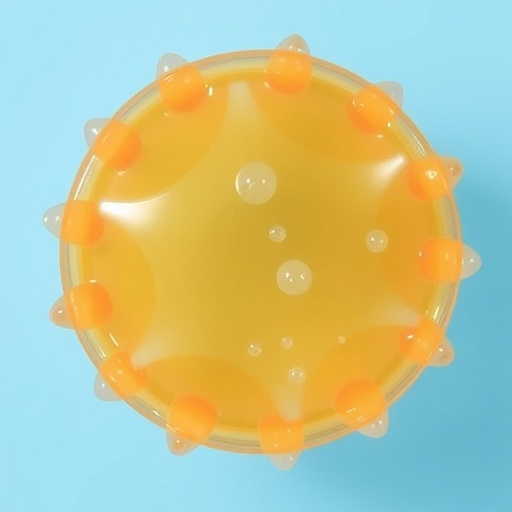
The world of materials science has taken a significant leap forward with groundbreaking advancements in hydrogel technology. Researchers led by Professor Gong at WPI-ICReDD, Hokkaido University, have developed a new class of underwater-adhesive hydrogels that showcase exceptional adhesive strength, outperforming all known hydrogels to date. These innovative materials demonstrate promises that could revolutionize fields ranging from biomedical engineering to deep-sea exploration.
Hydrogels are remarkable substances; made up of hydrophilic polymer networks that can retain large amounts of water, they possess unique characteristics that make them indispensable in various applications. The inherent qualities of hydrogels can be tailored by altering their polymer compositions to achieve desired outcomes. In this recent study, the focus was on creating hydrogels that exhibit not only strong adhesive properties but also self-healing capabilities and resilience in underwater environments. However, achieving rapid, strong, and consistent adhesion underwater has been a persistent challenge for researchers until now.
Utilizing a mix of data mining and machine learning techniques, Professor Gong, along with Professors Takigawa and Fan, and their diligent graduate student Liao, unlocked new potential in hydrogel adhesive technology. Their research unveiled hydrogels with adhesive strengths exceeding 1 megapascals (MPa). These hydrogels are designed to demonstrate both immediate bond formation and durability across various surfaces, even in various salinity levels, from distilled water to seawater.
The researchers illustrated the hydrogel’s remarkable strength through a compelling demonstration. A rubber duck was affixed to a seaside rock using the adhesive hydrogel, where it successfully withstood the relentless forces of ocean tides and wave impacts. This simple yet powerful visual serves to underscore the practical implications of hydrogel technology in real-world scenarios.
By taking inspiration from nature itself, the team based their design on polymer networks derived from adhesive proteins found in a broad array of living organisms—from archaea to viruses. The commonality of these proteins is their ability to bond in wet environments, a trait that has been exploited in the development of their new hydrogel. An extensive dataset of approximately 25,000 adhesive protein sequences was meticulously mined from the National Center for Biotechnology Information (NCBI) database for this study.
These protein sequences were integrated into the polymer networks of the hydrogels. A total of 180 different hydrogels were synthesized, each featuring distinct properties stemming from their unique polymer configurations. By applying machine learning algorithms to analyze the data acquired from these varied hydrogels, the researchers were able to identify the most effective polymer sequences for achieving superior underwater adhesive properties.
The initial findings from the synthesis of the 180 hydrogels were already promising, indicating adhesive capabilities superior to those documented in existent literature. However, the final iterations of hydrogels, influenced by machine learning insights, achieved unprecedented qualities that the research team had hoped for. The result was a suite of hydrogels that not only met but exceeded the desired adhesive qualities, establishing a new benchmark for underwater adhesion technologies.
The practical applications of these advanced hydrogels are vast and exciting. With the ability to bond instantly and repeatedly, they could be instrumental in repairs during underwater explorations or in medical settings, such as effectively sealing wounds in surgical scenarios. The ability of these hydrogels to function efficiently in variable environments opens doors to numerous possibilities for their real-world applications.
Quantitatively, the strength demonstrated in laboratory settings is staggering. For example, if these advanced hydrogels were trimmed down to the size of a standard postage stamp, they could theoretically support weights of approximately 63 kilograms—equivalent to the weight of an average adult. Such metrics underscore the impressive potential for these materials to hold significant structural integrity, even under strenuous conditions.
As the scientific community continues to explore the depths of hydrogel capabilities, the findings published in the prestigious journal Nature not only contribute to material sciences but also signify a profound step in biocompatible technology. The study effectively portrays how interdisciplinary approaches—melding biology, chemistry, and data science—can yield revolutionary advancements that benefit society.
With the viability of these super-adhesive hydrogels established, future research may focus on optimizing production processes and exploring new areas where these materials can be applied. As scientists refine these hydrogels, the potential becomes boundless in areas that require both adhesion and flexibility in dynamic environments.
In conclusion, the recent breakthroughs in hydrogel technology reflect a blend of innovative research methodologies and nature-inspired designs, showcasing the capabilities of science in addressing engineering challenges faced in real-world applications. The work led by Professor Gong and his collaborators at Hokkaido University exemplifies the best of contemporary scientific endeavors, paving the way for future explorations into materials that can fundamentally change interactions in aquatic settings.
Keywords
Physical sciences, Materials science, Materials engineering, Chemistry, Chemical compounds, Polymers, Computational chemistry
Cite Scienmag News
Neil Sanderson. (August 6, 2025). Unlocking Adhesive Potential: The Breakthrough Hydrogel Polymer for Underwater Applications. Scienmag. https://scienmag.com/unlocking-adhesive-potential-the-breakthrough-hydrogel-polymer-for-underwater-applications/
Neil Sanderson. "Unlocking Adhesive Potential: The Breakthrough Hydrogel Polymer for Underwater Applications." Scienmag, 6 August 2025, https://scienmag.com/unlocking-adhesive-potential-the-breakthrough-hydrogel-polymer-for-underwater-applications/. Accessed 8 September 2026.
Neil Sanderson. "Unlocking Adhesive Potential: The Breakthrough Hydrogel Polymer for Underwater Applications." Scienmag. August 6, 2025. https://scienmag.com/unlocking-adhesive-potential-the-breakthrough-hydrogel-polymer-for-underwater-applications/


