


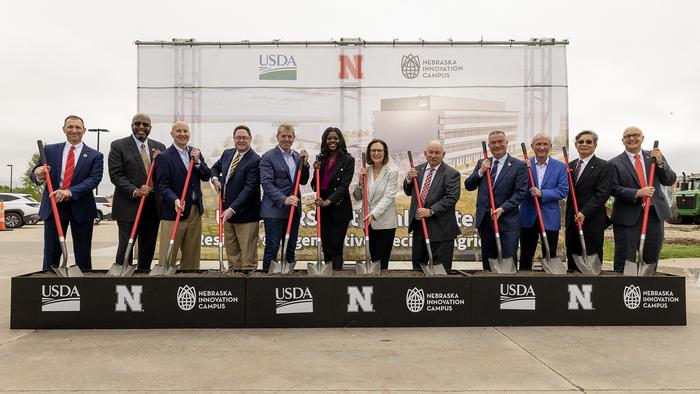
Construction of the National Center for Resilient and Regenerative Precision Agriculture at Nebraska Innovation Campus launched with a ceremonial turning of dirt on May 6.

Credit: Craig Chandler/University Communication & Marketing/University of Nebraska Lincoln
Construction of the National Center for Resilient and Regenerative Precision Agriculture at Nebraska Innovation Campus launched with a ceremonial turning of dirt on May 6.
The state-of-the-art research center is a partnership between the U.S. Department of Agriculture’s Agricultural Research Service, University of Nebraska–Lincoln and Nebraska Innovation Campus. The center will focus on the challenges and opportunities in agricultural innovation for the 21st century.
“There is a long history of scientific innovation and collaboration between ARS and UNL, typical of the USDA-land-grant university partnerships across the country,” said Chavonda Jacobs-Young, USDA chief scientist and undersecretary for research, education and economics. “Updated facilities ensure our best and brightest scientists work in the environment and with the tools they need to successfully meet the challenges agriculture faces.”
During this digital era, agricultural production and agricultural landscapes are transforming. Farmers and producers need the latest information technology, tools and data to make informed and innovative decisions for their unique operations. The center will focus on key research areas to address these challenges and promote sustainable, resilient and highly efficient agriculture practices.
“This project is a testament to the long history of innovation, ingenuity and adaptability of agricultural producers across the United States and right here in Nebraska. It celebrates an incredibly productive 120-year partnership between USDA-ARS and the University of Nebraska-Lincoln, and it exemplifies the passion and dedication of agricultural, state, and federal leaders,” said Mike Boehm, vice chancellor for UNL’s Institute of Agriculture and Natural Resources. “Nebraska is a special place with incredible people, and the ripples of what we do here often extend around the globe. I believe the work that will take place in this facility will usher in a new era of American agriculture, and I’m thrilled that what happens next in agriculture will happen first in Nebraska.”
The National Center for Resilient and Regenerative Precision Agriculture will be a $160 million USDA laboratory. It is expected to double the USDA’s science and support staff presence at the University of Nebraska–Lincoln. The first phase will feature 15,000 square feet of greenhouses and 10,000 square feet of headhouse space. It will connect to the Greenhouse Innovation Center at Nebraska Innovation Campus.
The new greenhouse space will allow ARS to perform research on wheat, barley, sorghum, forage and bioenergy grasses, and other crops. Research on how these plants respond to emerging pests and pathogens under a full range of environmental conditions will empower scientists to make cutting-edge discoveries with the goal of developing climate-resilient crops for the U.S. agriculture industry.
Once fully completed, the agriculture research complex will function as a central hub for multidisciplinary experts, scientists and engineers who will collaborate with industry and producers to improve water and food security, increase the resilience of agricultural landscapes and enhance agricultural profitability.
“The complex problems we face today in the ag industry require unprecedented levels of collaboration to overcome. This facility will help us achieve that goal, aligning resources and magnifying impressive impacts on agriculture nationwide,” Chancellor Rodney D. Bennett said. “This national center will become the model for excellence in ag-focused innovation.”
The establishment of the National Center for Resilient and Regenerative Precision Agriculture will further strengthen the long-lasting collaboration over the past century between ARS and UNL. These partnerships have advanced research on sustainable bioenergy crops and production systems in an age where agriculture is expected to supply 40 percent of U.S. liquid fuels within the next three decades, in addition to providing food and fiber to the nation’s growing population.
The Wheat, Sorghum and Forage Research Unit and the Agroecosystem Management Research Unit are currently located at UNL. The scientists working in these units are making significant contributions to crop and livestock production systems by improving productivity, stability of production, sustainability and profitability.
Leaders who provided remarks during the groundbreaking ceremony include: Chris Kabourek, interim president of the University of Nebraska system; Chancellor Rodney D. Bennett; Gov. Jim Pillen; U.S. Reps. Don Bacon and Mike Flood; U.S. Sens. Deb Fischer and Pete Ricketts; and Simon Liu, USDA-ARS administrator.
Cite Scienmag News
Denise Maddox. (May 7, 2024). University of Nebraska-Lincoln, USDA partner on ground-breaking precision ag research center. Scienmag. https://scienmag.com/university-of-nebraska-lincoln-usda-partner-on-ground-breaking-precision-ag-research-center/
Denise Maddox. "University of Nebraska-Lincoln, USDA partner on ground-breaking precision ag research center." Scienmag, 7 May 2024, https://scienmag.com/university-of-nebraska-lincoln-usda-partner-on-ground-breaking-precision-ag-research-center/. Accessed 7 September 2026.
Denise Maddox. "University of Nebraska-Lincoln, USDA partner on ground-breaking precision ag research center." Scienmag. May 7, 2024. https://scienmag.com/university-of-nebraska-lincoln-usda-partner-on-ground-breaking-precision-ag-research-center/

