

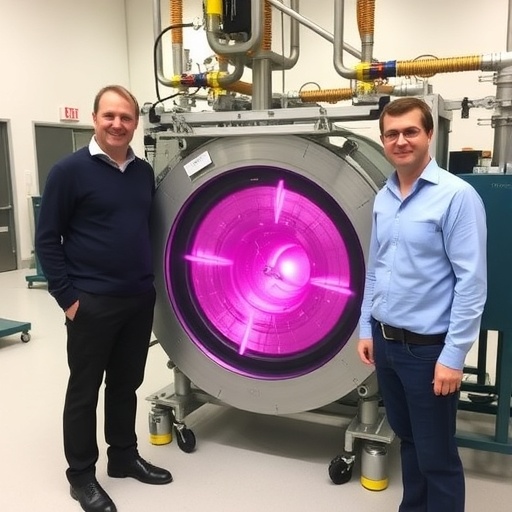
In a groundbreaking advancement in particle physics, scientists from the University of Manchester have played a pivotal role in the discovery of a novel subatomic particle at CERN’s Large Hadron Collider (LHC). This particle, designated as the Ξ_cc⁺ (Xi-cc-plus), represents an unprecedented type of heavy proton-like particle that contains two charm quarks coupled with a single down quark. This discovery marks a significant milestone made possible by the newly upgraded LHCb detector, which harnesses the combined efforts of over a thousand scientists spanning 20 countries. The UK, spearheaded by significant leadership from Manchester, has contributed the largest national input to this ambitious upgrade project.
The Ξ_cc⁺ particle emerges as a heavier relative of the familiar proton, a particle famously uncovered in Manchester by Ernest Rutherford in the early 20th century. While the conventional proton consists of two up quarks and one down quark, the Ξ_cc⁺ replaces both up quarks with the heavier charm quarks, thus offering physicists a new window into the interactions and configurations of heavier flavor quarks within baryons. This discovery also extends a rich legacy originating in the 1950s, when Manchester physicists were the first to identify a member of the Ξ (Xi) family of particles, thereby reinforcing the city’s historic contributions to particle physics.
At the forefront of this international collaboration was Professor Chris Parkes, the head of the University of Manchester’s Department of Physics and Astronomy. His leadership spanned the critical phases from the initial approval to the realization and operation of the upgraded LHCb detector. Under his guidance, Manchester played a key role in the design and fabrication of central components of the upgraded tracking system, including the silicon pixel detector modules crafted within the University’s iconic Schuster Building. These modules proved critical in enabling the precise reconstruction of the decay patterns through which the Ξ_cc⁺ particle was identifiable.
The silicon pixel detectors act as an ultra-fast and ultra-precise imaging system, effectively serving as a “camera” that captures particle production events occurring at the staggering frequency of 40 million frames per second within the LHC collision environment. This imaging relies on custom-designed silicon chips, which also have technological derivatives applicable for advanced medical imaging technologies. Dr. Stefano De Capua, who directed the production of these silicon modules, highlighted the dual-use nature of this technology, which not only advances particle physics but also holds promise for improved diagnostic tools in healthcare.
The identification of the Ξ_cc⁺ particle was achieved by observing its characteristic decay into three lighter particles—Λ_c⁺, K⁻, and π⁺—in proton-proton collisions during 2024. This first full year of operation using the LHCb Upgrade detector yielded a statistically significant peak of approximately 915 events centered around a mass of 3619.97 MeV/c². These findings align closely with theoretical predictions, refining our understanding of baryonic states that include double heavy flavors and providing a contrasting benchmark against earlier, inconclusive claims of the particle’s existence that were made over two decades ago.
Insights garnered from this particle serve to deepen the understanding of Quantum Chromodynamics (QCD), the theory governing the behavior of quarks and gluons inside hadrons. The precise measurement of the mass and decay patterns of Ξ_cc⁺ offers invaluable empirical data to test and refine QCD models, particularly in regimes involving charm quark interactions. It also paves the way toward comprehending how heavy quark dynamics differ significantly from those of the light quarks, thus enriching the standard model’s treatment of strong nuclear forces.
This discovery has immediate implications for the next generation of LHC physics programs. The University of Manchester, continuing its leadership role, is actively preparing for LHCb Upgrade 2, which aims to exploit the advent of the High-Luminosity LHC accelerator. The enhanced luminosity will dramatically increase the number of collision events, thereby allowing physicists to explore rare phenomena such as double heavy baryons with higher precision and to search for potential physics beyond the standard model.
Historically, the proton discovery by Rutherford nearly a century ago revolutionized our conception of matter at its most fundamental level. Today, as Professor Chris Parkes noted, this new breakthrough at CERN, facilitated by state-of-the-art instrumentation and global collaboration, signifies a profound extension of that legacy. It embodies the remarkable power of curiosity-driven research and underlines the importance of technological innovation combined with international scientific partnership.
The new data on Ξ_cc⁺ also resolves long-standing controversies regarding earlier purported sightings of the particle. The measured mass is incompatible with the previously disputed findings but perfectly consistent with theoretical expectations tied to its doubly charged counterpart, the Ξ_cc⁺⁺. This congruence confirms not only the particle’s existence but validates the theoretical frameworks that had predicted its properties years ago.
The upgraded LHCb detector itself represents a technological marvel, equipped to handle unprecedented data throughput and to achieve unprecedented spatial and temporal resolution in detecting particle trajectories. This makes it exquisitely sensitive to the fleeting signals from rare particle decays. The University of Manchester’s instrumental contributions to these detector enhancements underscore the institution’s leading role in particle physics experiments on the global stage.
Furthermore, this discovery enriches the wider understanding of the baryon family, expanding the chart of subatomic particles by introducing new heavy-flavored states. Such discoveries are pivotal as they provide constraints and testing grounds for the complex interactions governed by the strong force, which is notoriously difficult to calculate precisely. Insights from these studies are fundamental for comprehending the composition and stability of matter throughout the universe.
In conclusion, the observation of the Ξ_cc⁺ at CERN’s LHCb experiment not only marks a historic milestone in particle physics but also exemplifies the synergy between technological prowess and international collaboration. It lays a robust foundation for future explorations of subatomic matter and exemplifies the relentless human pursuit of knowledge about the universe’s fundamental building blocks.
Subject of Research: Particle physics, discovery of a new heavy baryon particle containing charm quarks
Article Title: University of Manchester Leads Discovery of New Heavy Proton-like Particle at CERN’s LHC
News Publication Date: 2024
Web References:
https://research.manchester.ac.uk/en/persons/chris.parkes/
https://research.manchester.ac.uk/en/persons/stefano.decapua
Image Credits: Chris Parkes / Artist’s illustration of this heavy proton-like particle
Keywords
Particle physics, subatomic particles, heavy baryons, charm quarks, Large Hadron Collider, LHCb upgrade, silicon pixel detector, Quantum Chromodynamics, proton, baryon family, CERN, high-luminosity accelerator, detector technology


