


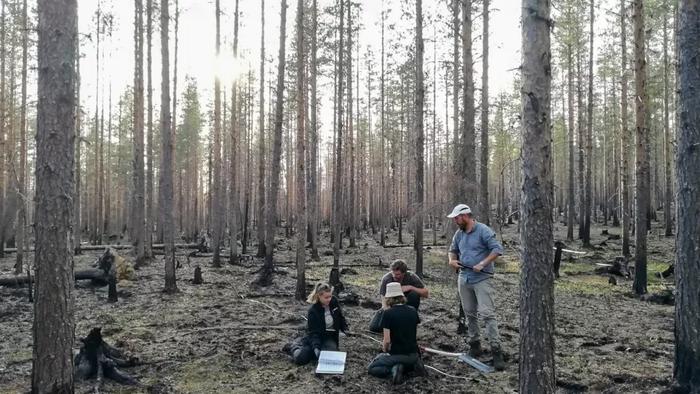
During the unusually dry year of 2018, Sweden was hit by numerous forest fires. A research team led from Lund University in Sweden has investigated how climate change affects recently burnt boreal forests and their ability to absorb carbon dioxide.

Credit: Geerte Fälthammar-de Jong
During the unusually dry year of 2018, Sweden was hit by numerous forest fires. A research team led from Lund University in Sweden has investigated how climate change affects recently burnt boreal forests and their ability to absorb carbon dioxide.
The boreal forests form a single biome that spans the entire Northern Hemisphere. These forests play a key role in the global climate system by absorbing carbon dioxide from the atmosphere. Increasing forest fires, in the wake of climate change, threaten to undermine this ecosystem service.
In the aftermath of the summer 2018 forest fires in Sweden, a team of researchers began the most extensive field campaign ever performed in boreal forests to study how the fires affected 50 forests spread across the country.
“We found that climate change may reduce the ability of burnt forests to absorb carbon after a fire. Many of the old trees remain, but some of their important functions appear to be weakened,” explains Johan Eckdahl, a physical geographer at Lund University.
The study shows that regrowth after a fire is influenced by the climate-sensitive partnership between plants and soil microbes. As the climate changes, the carbon storing function of this interaction is weakened because of a mismatch between the adaptive capacities of plants and microbes. Namely, the current northward migration of fast-growing, warmth-adapted plant species might not pace increasing rates of microbial decomposition under escalating growing season temperatures.
“During global warming, plant species migration is a necessary process to maintain biodiversity and ecosystem services. If it does not keep pace with climate change, the ability of Sweden’s boreal forests to function as effective carbon sinks will be compromised,” says Johan Eckdahl.
The boreal region, also known as the taiga, serves as an immense global carbon reservoir. Research shows that the boreal region may experience greatly reduced carbon storage capacity in the coming century due to climate change and increased wildfire activity, reducing its traditional role as an absorber of greenhouse gases. A better understanding of the response of boreal forests to external influences is essential in predicting their resilience to climate change and the increased frequency of forest fires.
“Biodiversity is not only important in tropical rainforests, it is also important in the taiga! Our study highlights the often overlooked relationship between biodiversity and carbon storage in northern ecosystems. The results emphasise the need for continued research and environmental monitoring in the vast boreal region,” concludes Johan Eckdahl.
Journal
Communications Earth & Environment
Article Title
Restricted plant diversity limits carbon recapture after wildfire in warming boreal forests
Cite Scienmag News
Sloane Callahan. (April 17, 2024). Unique field study shows how climate change affects fire-impacted forests. Scienmag. https://scienmag.com/unique-field-study-shows-how-climate-change-affects-fire-impacted-forests/
Sloane Callahan. "Unique field study shows how climate change affects fire-impacted forests." Scienmag, 17 April 2024, https://scienmag.com/unique-field-study-shows-how-climate-change-affects-fire-impacted-forests/. Accessed 4 September 2026.
Sloane Callahan. "Unique field study shows how climate change affects fire-impacted forests." Scienmag. April 17, 2024. https://scienmag.com/unique-field-study-shows-how-climate-change-affects-fire-impacted-forests/

