


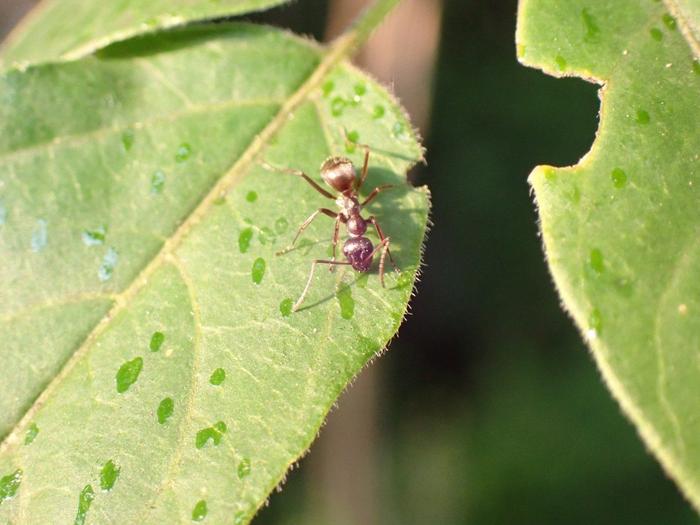
In the relentless battle against invasive species threatening ecosystems and agriculture, scientists are constantly seeking innovative methods for early detection and management. A groundbreaking approach from Virginia Tech researchers introduces an unexpected natural ally: ants. These tiny, tireless foragers are poised to become a crucial tool in locating spotted lanternfly infestations, a pest that has wreaked havoc across parts of the United States since its accidental introduction in 2014.
The spotted lanternfly (Lycorma delicatula), native to Asia, has become one of the most destructive invasive insects in North America. Feeding voraciously on sap from a wide array of plants including grapevines, hops, and hardwood trees, the lanternfly compromises plant health and productivity. Their feeding produces copious amounts of a sweet, sticky residue known as honeydew. This honeydew not only facilitates the growth of sooty mold, further weakening plants, but astonishingly carries traces of the pest’s DNA – a detail that has opened new avenues for detection.
Assistant Professor Scotty Yang, leading the research from Virginia Tech’s Department of Entomology, observed that ants are naturally drawn to honeydew as a food resource. Known as nature’s sugar seekers, ants track down and collect honeydew, sharing it amongst nestmates and essentially sampling the environment extensively as they forage. This behavior suggested an intriguing hypothesis: Could ants act as biological samplers, carrying environmental DNA (eDNA) of spotted lanternflies and thus serving as early-warning indicators of their presence?
To validate this hypothesis, Yang and his team employed environmental DNA testing techniques, a molecular method of detecting organisms by analyzing DNA fragments left behind in the environment. By collecting ants in various areas and conducting polymerase chain reaction (PCR) analyses, the researchers successfully identified the presence of lanternfly DNA within the ants’ bodies. Remarkably, this detection was possible even when the lanternflies themselves were not visually present, highlighting the sensitivity and potential wide applicability of the technique.
The newly coined method, termed “antDNA,” demonstrated impressive accuracy and sensitivity. Ants that consumed honeydew from spotted lanternflies retained detectable levels of lanternfly DNA for up to five days after feeding. Given ants’ expansive foraging range – they can travel up to 100 meters from their nests – this natural behavior effectively extends the surveillance perimeter far beyond traditional direct observation methods.
Early detection of invasive pests like the spotted lanternfly is critical due to the serious economic and ecological damage they can inflict. Traditional monitoring often relies on manually spotting the pest or its egg masses, a labor-intensive and sometimes ineffective process, especially when populations are initially low or dispersed. AntDNA offers a revolutionary complement to this by enabling rapid, scalable, and cost-effective monitoring through molecular analyses of ants sampled from any environment – be it forests, farms, or urban areas.
The implications of this research extend beyond the spotted lanternfly alone. Many sap-feeding insects produce honeydew as a metabolic byproduct, suggesting that antDNA could be adapted as a universal tool for detecting a range of invasive or cryptic pest species that leave behind molecular traces in the environment. This expands the potential for proactive biosecurity and pest management interventions globally.
To enhance field applicability, Yang’s lab is now developing a portable, field-ready antDNA testing kit. This device aims to streamline molecular analysis directly at sampling sites, delivering results within hours rather than days. Such rapid diagnostics will empower agricultural managers, foresters, and biosecurity personnel to make timely decisions, potentially halting the spread of invasive species before outbreaks escalate.
This innovative strategy leverages the natural ecology of ants and cutting-edge molecular biology, bridging behavioral ecology with applied pest management. Leveraging ants’ ubiquitous presence, their broad foraging behavior, and the exquisite sensitivity of PCR to detect trace DNA enables a novel biosurveillance platform. It epitomizes how understanding organismal interactions and deploying advanced technology can transform invasive species management.
In sum, the antDNA method not only presents a paradigm shift for detecting spotted lanternflies but also heralds a new era in environmental surveillance, where tiny insects become key informants, conveying essential information about cryptic species invasions. As global ecosystems face mounting pressures from invasive pests, such innovative, scalable, and non-invasive monitoring approaches will be indispensable tools in safeguarding agriculture, biodiversity, and natural resources.
News Publication Date: 28-Apr-2025
Web References:
https://scijournals.onlinelibrary.wiley.com/doi/10.1002/ps.8814
https://neobiota.pensoft.net/article/151420/
Cite Scienmag News
Gavin Prescott. (June 30, 2025). Unexpected Allies in Combating the Spotted Lanternfly: The Role of Ants. Scienmag. https://scienmag.com/unexpected-allies-in-combating-the-spotted-lanternfly-the-role-of-ants/
Gavin Prescott. "Unexpected Allies in Combating the Spotted Lanternfly: The Role of Ants." Scienmag, 30 June 2025, https://scienmag.com/unexpected-allies-in-combating-the-spotted-lanternfly-the-role-of-ants/. Accessed 4 September 2026.
Gavin Prescott. "Unexpected Allies in Combating the Spotted Lanternfly: The Role of Ants." Scienmag. June 30, 2025. https://scienmag.com/unexpected-allies-in-combating-the-spotted-lanternfly-the-role-of-ants/


