


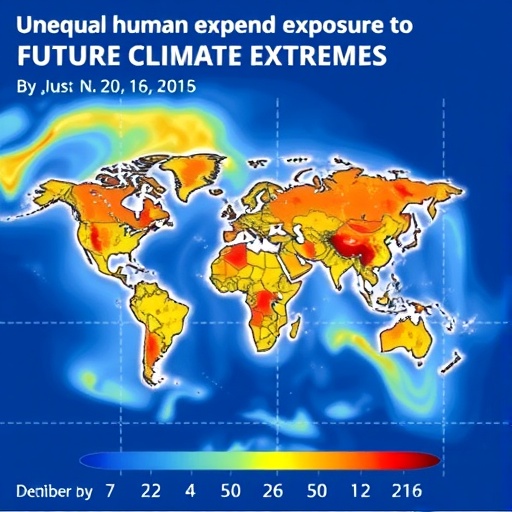
In recent years, the escalating threat of climate change has dominated global scientific discourse, but where this research stands apart is in its striking revelation about the unequal distribution of human exposure to future climate extremes. A groundbreaking study published in Nature Communications by Hosseinzadehtalaei, Hamdi, Moradkhani, and colleagues shines an unforgiving light on a dimension of climate vulnerability that is often overlooked: the stark inequalities embedded within the very way climate extremes will manifest across populations. Far from being a uniform force, the advancing climate crisis threatens to exacerbate social and geographic disparities in unprecedented ways, as the research meticulously elucidates.
At the core of this work is a sophisticated synthesis of climate modeling and socio-demographic data, designed to project not only how severe climate events will become but, crucially, who will bear the brunt of these calamities. The authors combined cutting-edge climate models with high-resolution population data, enabling a granular view of exposure risks spanning decades into the future. This innovative approach allows the study to move beyond aggregate assessments and capture the uneven terrain of vulnerability driven by factors such as wealth, geography, and infrastructural resilience. The result is a haunting map of inequality etched into the future climate landscape.
The study’s technical foundation rests on an ensemble of global climate models (GCMs) from the Coupled Model Intercomparison Project Phase 6 (CMIP6), employing multiple future greenhouse gas concentration scenarios known as Shared Socioeconomic Pathways (SSPs). By simulating a range of possible futures, the researchers accounted for diverse socioeconomic trajectories alongside physical climate changes, thereby integrating human dimensions directly into the climate exposure framework. This fusion of physical and social sciences creates a multidimensional perspective critical for understanding complex interactions driving climate vulnerability.
One of the most unsettling implications emerging from this research is the intensification of already existing geographic disparities. Regions with historically marginalized populations, including parts of Africa, South Asia, and Latin America, are projected to experience some of the harshest increases in climate damage risk. These areas face compounded challenges: limited adaptive capacity due to economic constraints, fragile health systems, and infrastructure ill-equipped to handle extreme heat waves, floods, and droughts. Consequently, the study predicts a disproportionate escalation of climate-induced hardship for millions living in these vulnerable zones.
Moreover, the analysis unveils the nuanced ways climate extremes will manifest—intense heatwaves, unprecedented precipitation events, drought severity, and the rising frequency of compound events that involve the simultaneous occurrence of multiple stressors. Notably, the research underscores the multidimensional nature of climate exposure, highlighting that populations may face concurrent risks rather than isolated events, a factor that exponentially complicates adaptation strategies. Such compound extremes create a cascading effect whereby the impact of one hazard is magnified by another, escalating overall vulnerability.
The study’s demographic insights further reveal stark inequalities at the subnational scale. Urban and rural populations will experience divergent exposure patterns, largely driven by local infrastructure quality and land-use dynamics. Urban heat islands, for example, magnify heat stress in cities, disproportionately affecting lower-income neighborhoods. Meanwhile, rural areas might face acute water scarcity or agricultural losses, with livelihoods hinged on vulnerable natural resources. This spatial heterogeneity in exposure calls for tailored mitigation and adaptation policies that recognize the complexity of local contexts.
Importantly, socioeconomic status emerges as a pivotal determinant of climate exposure inequality. Poorer communities typically reside in hazard-prone areas—floodplains, arid regions, or urban slums—with limited access to protective infrastructure. This entrenched socioeconomic vulnerability interacts synergistically with climate stressors, producing a grim feedback loop that exacerbates health risks, economic instability, and social marginalization. The authors argue that addressing climate inequality demands integration of environmental and social policy frameworks, a call to action for policymakers worldwide.
Technically, the research advances in its use of exposure metrics that transcend traditional hazard-based assessments. Rather than focusing solely on climate variables, the study integrates population density and projected demographic shifts, capturing the dynamic evolution of exposure risk over time. This approach allows for a refined quantification of how demographic trends such as urbanization and migration intersect with climate hazard frequency and intensity, providing a forward-looking assessment of human vulnerability.
The modeling framework also incorporates uncertainty quantification rigorously, an essential step given the inherent unpredictability in climate projections. By applying probabilistic techniques to model outputs and demographic forecasts, the researchers delineate confidence bounds around exposure estimates. This methodological sophistication empowers policymakers with a spectrum of plausible future scenarios rather than single deterministic outcomes, enabling more resilient and flexible climate risk management strategies.
Another vital contribution of the paper is its forward-looking perspective on adaptation needs. The study identifies critical thresholds where climate extremes cross tipping points in human exposure, illuminating windows of opportunity and urgency for intervention. These tipping points demarcate conditions under which existing coping mechanisms are overwhelmed, necessitating transformative adaptations rather than incremental changes. Recognizing such thresholds facilitates proactive resource allocation and planning to minimize the human toll of inevitable climate disruptions.
In teasing out policy implications, the authors emphasize the ethical dimensions of climate exposure inequality. The injustice of disproportionate climate risk falling upon those least responsible for greenhouse gas emissions is starkly apparent. This asymmetry underscores the critical necessity of incorporating equity principles into international climate finance, capacity-building, and technological transfer initiatives. The study substantiates the imperative for a climate justice framework as central to the global response, highlighting how exposure disparities translate into real-world consequences spanning health, economic security, and social cohesion.
Communicating these complex findings to diverse stakeholders is another challenge the research grapples with. By leveraging data visualization techniques and multi-scale analysis, the authors present an accessible yet comprehensive depiction of exposure inequalities. These visualizations serve as crucial tools for advocacy and policymaking, translating technical climate data into impactful narratives that resonate with communities, governments, and global institutions alike. The study exemplifies how rigorous science can fuel informed and equitable decision-making processes.
Beyond immediate policy relevance, the paper contributes fundamentally to climate science methodology by bridging disciplinary divides. The integrative use of socio-demographic and physical climate data represents a vital advancement in holistic climate risk assessment. This interdisciplinary approach paves the way for future research to incorporate additional dimensions such as economic vulnerability, health impacts, and social networks, promoting a more nuanced understanding of human-climate interactions.
As the world grapples with accelerating climate change, this illuminating study serves as a sobering reminder that the crisis will not be borne equally. Its detailed projections foresee a world where climate extremes amplify existing inequalities, with marginalized populations shouldering disproportionate risks. Yet, this grim forecast also offers a roadmap for targeted interventions grounded in robust science and equity considerations. By highlighting inequality in exposure, the authors open a vital dialogue on how to structure climate resilience efforts that are not only effective but just.
In conclusion, the work by Hosseinzadehtalaei and colleagues represents a seminal contribution to climate science, bringing into sharp focus the human dimension of future climate extremes. With its methodologically rigorous, data-driven insights and compelling ethical imperatives, the study challenges the global community to rethink adaptation strategies and climate governance through an equity lens. It is a call for a more inclusive, aware, and scientifically informed approach to confronting the unequal burdens of a warming world—one that ensures no population is left behind in the race to safeguard humanity’s future against the mounting threats of climate change.
Cite Scienmag News
Denise Maddox. (August 28, 2025). Unequal Human Exposure to Future Climate Extremes. Scienmag. https://scienmag.com/unequal-human-exposure-to-future-climate-extremes/
Denise Maddox. "Unequal Human Exposure to Future Climate Extremes." Scienmag, 28 August 2025, https://scienmag.com/unequal-human-exposure-to-future-climate-extremes/. Accessed 3 September 2026.
Denise Maddox. "Unequal Human Exposure to Future Climate Extremes." Scienmag. August 28, 2025. https://scienmag.com/unequal-human-exposure-to-future-climate-extremes/


