

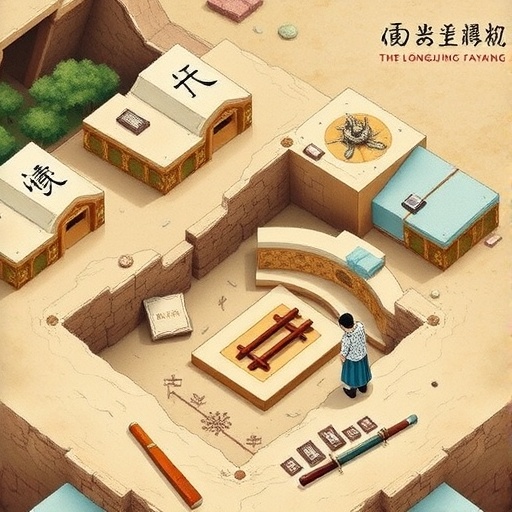
In the verdant landscapes of Jilin Province, an archaeological team led by researchers Zhao and Lu has embarked on a groundbreaking field investigation of the Longjing Taiyang site, a location believed to hold critical insights into ancient human civilization. Their latest report, published in the journal Asian Archaeology, sheds light on the rich tapestry of history that this site encapsulates. The research aims to excavate and analyze artifacts from this area, which is suspected to have been home to a vibrant community during its peak.
The Longjing Taiyang site is situated amidst lush hills and flowing rivers, offering not just geographical significance but also a treasure trove of archaeological potential. The researchers have identified the area as an ancient settlement, linked closely to various cultural and economic practices of its time. This assessment was made possible through the careful mapping and analysis of surrounding environmental features. By combining geology with archaeology, the team aims to contextualize their findings within the broader narrative of human history.
As the team commenced with their first phase of excavation, they utilized advanced techniques such as ground-penetrating radar and remote sensing. These technologies have allowed them to visualize subsurface structures without extensive digging. Such methods are essential as they help in formulating a comprehensive understanding of the site’s layout and the potential locations of significant artifacts. This approach not only preserves the integrity of the site but also maximizes the efficiency of the excavations that follow.
The excavation revealed a remarkable suite of artifacts, including pottery shards, ancient tools, and remnants of structural foundations. Initial findings point to a society that practiced agriculture, as evidenced by the discovery of grinding stones and ceramic vessels that would have been used for food storage and preparation. These artifacts underscore the community’s reliance on farming as a means of sustenance, which likely played a pivotal role in the social and economic organization of the group.
Additionally, the team uncovered evidence of trade networks that may have existed between Longjing Taiyang and neighboring regions. Analysis of the materials used in certain artifacts suggests that they were not locally sourced, indicating the possibility of regional exchange. This finding provides a glimpse into how ancient societies interacted, shared resources, and expanded their cultural horizons. As the research progresses, this aspect of the excavation will become increasingly important in drawing connections to other archaeological sites.
The project’s significance extends beyond mere artifact recovery; it relates directly to understanding the demographic shifts and cultural transformations within the region over thousands of years. The site provides a crucial test case for theories surrounding the development of early complex societies in Northeast Asia. By documenting the life cycles of these ancient communities, researchers hope to paint a broader picture of humanity’s collective past.
One noteworthy aspect of the Longjing Taiyang site is its potential to redefine prevailing narratives around ancient Asian civilizations. Traditionally, much of the academic focus has been placed on well-known centers of civilization, often overlooking lesser-known sites like Longjing Taiyang. The current investigation pushes back against this trend, emphasizing the importance of regional studies in further elucidating the diverse pathways of human development.
As the team meticulously sifts through layers of earth, it becomes increasingly clear that their findings may challenge established timelines of human activity in the area. Initial dating of the artifacts suggests that the site may be several centuries older than previously assumed. This revelation could potentially necessitate a reevaluation of the chronological frameworks used by scholars to understand early human societies in Northeast Asia.
Moreover, the project is set against the backdrop of rising concerns regarding climate change and its impact on historical sites. The researchers are keenly aware of the need to document these findings expeditiously, as environmental changes pose significant risks to archaeological sites worldwide. Their work at Longjing Taiyang is not only a quest to uncover history but also acts as a reminder of the fragility of our cultural heritage.
In addition to the primary excavation, the team is collaborating with local universities and institutions to ensure that the findings are disseminated widely and responsibly. Educational outreach initiatives aimed at engaging local communities are an integral part of the project, fostering a sense of shared history and heritage. By involving community members in discussions around the excavation, the researchers hope to cultivate a deeper appreciation for their cultural legacy.
The findings from Longjing Taiyang are expected to catalyze further research in the region, encouraging more archaeologists to explore the untold stories hidden beneath the soil. The excitement generated by this project has already inspired a wave of interest among scholars, leading to new collaborative efforts that aim to connect disparate archaeological sites across the region. In forging these connections, researchers can better understand the complexities and nuances of ancient human societies.
As Zhao and Lu prepare to publish their detailed analysis in the upcoming edition of Asian Archaeology, anticipation grows within the archaeological community. The implications of their findings have the potential to reshape academic discourse and foster more extensive interdisciplinary collaboration in the field. With each passing day, the Longjing Taiyang site is becoming not only a microcosm of ancient life but a beacon for future archaeological inquiry.
The fieldwork conducted at Longjing Taiyang stands as a testament to the endurance of human curiosity and the relentless pursuit of knowledge. Each artifact unearthed carries with it fragments of stories long forgotten, offering us the chance to reconnect with those who walked these lands thousands of years ago. The meticulous efforts of Zhao and Lu, alongside their team, underscore the significance of archaeological exploration in preserving our shared human history, ensuring that the lessons of the past continue to resonate with generations to come.
In conclusion, the Longjing Taiyang site is not merely an archaeological dig but a pivotal journey into the heart of human civilization. It serves as a reminder of humanity’s shared aspirations, struggles, and triumphs. As the team continues to unveil the layers of history, they invite us to join them in exploring the pathways that shaped our world and the enduring legacies left behind by those who came before us.
Subject of Research: Archaeological investigation of the Longjing Taiyang site in Jilin Province
Article Title: A field work report on archaeological investigation of Longjing Taiyang site in Jilin Province
Article References:
Zhao, Y., Lu, C. A field work report on archaeological investigation of Longjing Taiyang site in Jilin Province.
asian archaeol 9, 241–250 (2025). https://doi.org/10.1007/s41826-025-00116-z
Image Credits: AI Generated
DOI: 10 December 2025
Keywords: Archaeology, Longjing Taiyang, Jilin Province, ancient civilization, excavation, artifacts, socio-economic practices, trade networks, regional studies


