

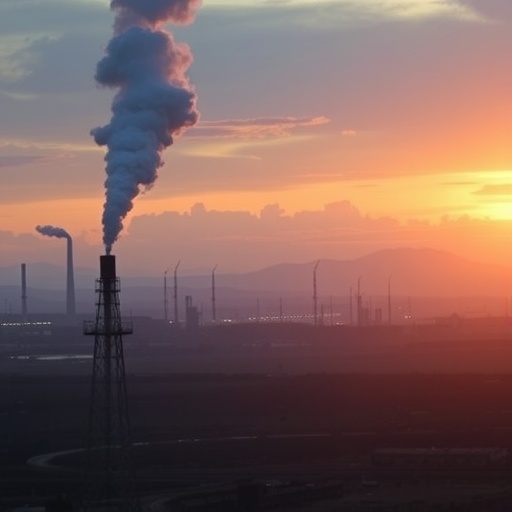
New Insights into Urban Methane Emissions Unveil Hidden Sources in Osaka
Methane, a greenhouse gas with a global warming potential approximately 80 times greater than that of carbon dioxide over a 20-year period, plays a critical role in climate change dynamics. While much of the global discourse focuses on large industrial emitters as primary methane sources, new pioneering research conducted by Osaka Metropolitan University challenges this prevailing narrative, revealing that myriad smaller, previously overlooked urban contributors significantly impact methane emissions within metropolitan settings like Osaka.
An international research team, spearheaded by Associate Professor Masahito Ueyama from Osaka Metropolitan University’s Graduate School of Agriculture, adopted an innovative dual-approach methodology to accurately capture methane emissions in real time across Osaka city. The study utilized an eddy covariance technique implemented on a high-altitude observational tower combined with mobile, ground-level sensors mounted on bicycles. This dual monitoring system offered continuous and integrated spatial flux measurements, surpassing traditional spot-check protocols that often miss temporal and spatial emission variability in dense urban landscapes.
By continuously analyzing both methane (CH4) and ethane (C2H6) fluxes across the urban matrix, the researchers were able to discriminate between fossil-fuel-derived emissions and those originating from biological activity. Ethane, as a hydrocarbon typically emitted from natural gas leakages and fossil fuel combustion, served as a chemical tracer, enabling the team to isolate anthropogenic fossil methane sources from biogenic methane, which is produced by microbial processes such as anaerobic digestion. Their real-time, city-wide data collection offered unparalleled insight into spatial emission patterns and temporal variations linked to human activity cycles.
Upon juxtaposing their empirical data with government methane emission inventories, glaring discrepancies became apparent. Established inventories primarily accounted for large point sources such as chemical plants and industrial facilities. However, the new data indicated significant methane leakage emanating from dispersed, smaller urban emitters including restaurants, commercial buildings, and private residences. These sources were previously underestimated or unreported, highlighting a critical gap in urban greenhouse gas accounting protocols.
Temporal analysis revealed distinct emission patterns consistent with human behavior: methane output peaked during weekday daytime hours and exhibited attenuation during nights and weekends. This diurnal and weekly modulation further cemented the role of anthropogenic activities rather than geogenic or natural processes in driving urban methane fluxes. Moreover, the consistent detection of ethane alongside methane underscored that many emissions derived from leaking city gas infrastructure – a fossil fuel product widely used for heating and cooking.
Beyond fossil-related methane, the research unveiled considerable underestimation of biogenic methane within the urban environment. This methane likely originated from ubiquitous, small-scale biological sources such as sewage manholes and municipal wastewater networks, along with cultural food production practices involving fermentation, which is prevalent in Japanese cuisine. These findings suggest that urban methane inventories must also incorporate the contribution of biological sources that traditional methods tend to overlook.
The methodological innovation demonstrated by Osaka Metropolitan University’s team effectively bridges a critical knowledge gap by enabling simultaneous, source-specific methane monitoring within a complex urban milieu. By combining high-altitude flux tower data with mobile ground sensing, the researchers developed a robust framework for disentangling multifaceted methane sources, laying the groundwork for real-time emission management in metropolitan areas worldwide.
Professor Ueyama emphasized the broader implications of their work: “Our research exposes previously undetected methane emissions tied to city gas, which have largely escaped official emissions accounting. This revelation paves the way for the identification and mitigation of these urban hidden sources through enhanced monitoring techniques and targeted policy interventions.” He anticipates that the approach will be scalable and transferable to urban centers globally, catalyzing improved methane management strategies.
Moreover, the capacity to monitor emission fluctuations in near real-time introduces potential for evaluating the efficacy of methane reduction initiatives, a critical tool for regulators and environmental agencies aiming to meet stringent climate targets. The study thus offers an empirical foundation upon which municipalities can both identify leakages and track progress toward decarbonization goals.
This research aligns with expanding global scientific efforts to unravel the complexities of urban greenhouse gas emissions, where the interplay of infrastructure, human behavior, and biological processes complicate accurate source attribution. It underscores the necessity for integrated observational methodologies that account for fine-scale, heterogeneous methane fluxes beyond large industrial complexes.
Published in the esteemed journal Environmental Science & Technology, the study stands as a testament to the power of cross-disciplinary collaboration and technological innovation in tackling pressing environmental challenges. As urban centers continue to expand, such advanced monitoring frameworks will be indispensable for developing tailored mitigation strategies, informing sustainable urban planning, and ultimately curbing methane’s potent climatic impact.
Credit for the study and imagery is given to Osaka Metropolitan University, which continues its commitment to advancing environmental science through cutting-edge research. The findings not only enhance scientific understanding but also carry significant policy relevance, highlighting the overlooked role of small urban emitters and facilitating evidence-based solutions to reduce methane emissions effectively.
Subject of Research:
Article Title: Natural Gas and Biogenic METHANE Emissions from an Urban Center, Sakai, Japan, Based on Simultaneous Measurements of METHANE and C2H6 fluxes Based on the Eddy Covariance Method
News Publication Date: 26-Nov-2025
Web References: DOI: 10.1021/acs.est.5c09629
Image Credits: Osaka Metropolitan University
Keywords: methane emissions, urban greenhouse gases, fossil fuel leakage, biogenic methane, eddy covariance method, Osaka city, real-time methane monitoring, environmental science, urban air quality, climate change mitigation


