


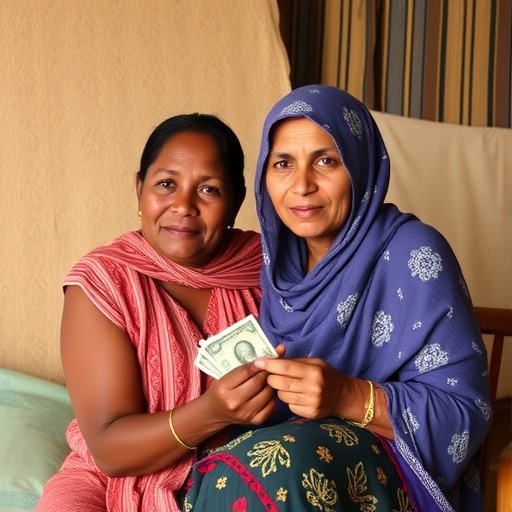
In a groundbreaking study published in Nature Communications, researchers have unveiled compelling evidence that unconditional cash transfers (UCTs) can profoundly impact family dynamics and the wellbeing of low-income mothers. This innovative research sheds new light on the intricate ways financial support influences psychological, emotional, and relational outcomes within vulnerable populations, promising a paradigm shift in social welfare policy and intervention strategies.
The investigation focused on evaluating how families, particularly mothers with constrained resources, respond to financial injections that come with no strings attached. Unlike traditional conditional cash transfer programs, which often require beneficiaries to meet specific criteria such as school attendance or health check-ups, UCTs empower recipients with complete autonomy over how to allocate the funds. This study’s nuanced approach allowed researchers to disentangle the effects of economic support from the pressures and administrative burdens often accompanying targeted social programs.
Employing a multi-method longitudinal design, the research team tracked a diverse cohort of low-income mothers over an extended period. They collected quantitative data on mental health indices, parenting behaviors, and family cohesion, alongside qualitative interviews to capture lived experiences and subjective wellbeing. This comprehensive methodology ensured a holistic understanding of how UCTs ripple through various dimensions of family life.
One of the key technical findings highlighted increased parental responsiveness and nurturance in families receiving unconditional support. The alleviation of financial stress appeared to enhance cognitive and emotional resources, allowing mothers to engage more meaningfully with their children. Neuropsychological theories suggest that chronic stress can impair executive functioning; hence, reducing economic strain may restore cognitive bandwidth crucial for effective parenting.
The study also revealed significant improvements in maternal mental health, marked by reductions in anxiety and depressive symptoms. Through robust psychometric assessments, including standardized scales like the Beck Depression Inventory, the researchers documented statistically significant declines in negative affect. These effects are particularly salient given the well-established link between maternal mental health and child developmental outcomes.
Intriguingly, the data pointed to improved family processes beyond the immediate parent-child relationship. Couples reported fewer conflicts and increased cooperative decision-making, implying that the positive impacts of UCTs extend into broader household dynamics. The economic security afforded by the cash transfers likely mitigated common stressors that contribute to relational discord, underscoring the systemic benefits of financial interventions.
From a social policy perspective, this research challenges prevailing assumptions that only conditional transfers yield measurable benefits. The absence of bureaucratic oversight in UCT programs reduces stigma and administrative costs, making them potentially more scalable and less intrusive. Moreover, the autonomy afforded to recipients promotes dignity and empowerment, aligning with human rights-based approaches to poverty alleviation.
Technically, the study employed advanced statistical modeling techniques to control for confounding variables and isolate the causal effects of UCTs. Hierarchical linear modeling and propensity score matching enhanced the rigor and validity of the findings, addressing common critiques of observational poverty research. These methodological strengths lend credence to the argument for broader adoption of unconditional cash transfer schemes.
The implications for child development policy are profound. By easing maternal stress and enriching parent-child interactions, UCTs may set the stage for positive trajectories in cognitive, emotional, and social growth. The researchers posit that long-term educational and health benefits could stem from these early-life supports, potentially breaking cycles of intergenerational poverty.
In addition to psychological outcomes, the research also explored the economic behaviors of recipient families. Contrary to some political rhetoric about potential misuse of funds, the majority of mothers invested in essential needs such as food, housing, and healthcare. This evidence dispels myths about irresponsibility and instead portrays recipients as rational agents making choices aligned with their family’s wellbeing.
Critically, the study situates its findings within a broader global discourse on poverty reduction. The authors advocate for integrating unconditional cash transfers into social safety nets worldwide, especially in contexts marked by entrenched inequality and limited service access. The universal nature of financial support could serve as a foundation for more inclusive social policies.
The neuroscientific underpinnings of these outcomes also invite further research. By correlating reductions in stress biomarkers such as cortisol with enhanced family functioning, the study opens avenues for interdisciplinary explorations connecting economics, psychology, and biology. Such integrative approaches are necessary to fully elucidate the mechanisms by which economic interventions influence health and behavior.
Importantly, this research also addresses ethical dimensions of social welfare. By removing conditionalities, UCTs respect individual autonomy and reduce paternalistic governance inherent in some welfare systems. This shift aligns with contemporary ethical frameworks advocating for participatory and rights-based policy design, highlighting how fiscal policy can reflect democratic values.
The investigators underscore the necessity of long-term monitoring to assess sustainability and downstream impacts. While immediate benefits are evident, tracking cohorts over decades will clarify how early financial support interacts with other social determinants to shape life course outcomes. These data will be indispensable for policymakers aiming to optimize program design and funding allocations.
Finally, the study’s interdisciplinary collaboration, integrating expertise from economics, developmental psychology, and public health, exemplifies the future of social science research. By leveraging diverse perspectives and methodologies, the team has charted a new course for evidence-based interventions addressing complex societal challenges.
This seminal work on unconditional cash transfers offers a beacon of hope for millions of families navigating the hardships of poverty. By illuminating the profound, multifaceted benefits of direct financial support without barriers, it encourages a reimagining of social safety nets that prioritize human dignity, mental health, and family cohesion. As the debate over welfare reform intensifies globally, these findings provide a robust empirical foundation for policies that empower rather than constrain those in need.
Magnuson, K.A., Duncan, G.J., Yoshikawa, H. et al. Effects of unconditional cash transfers on family processes and wellbeing among mothers with low incomes.
Nat Commun 16, 7517 (2025). https://doi.org/10.1038/s41467-025-62438-x
Cite Scienmag News
Denise Maddox. (August 13, 2025). Unconditional Cash Transfers Boost Low-Income Mothers’ Wellbeing. Scienmag. https://scienmag.com/unconditional-cash-transfers-boost-low-income-mothers-wellbeing/
Denise Maddox. "Unconditional Cash Transfers Boost Low-Income Mothers’ Wellbeing." Scienmag, 13 August 2025, https://scienmag.com/unconditional-cash-transfers-boost-low-income-mothers-wellbeing/. Accessed 6 September 2026.
Denise Maddox. "Unconditional Cash Transfers Boost Low-Income Mothers’ Wellbeing." Scienmag. August 13, 2025. https://scienmag.com/unconditional-cash-transfers-boost-low-income-mothers-wellbeing/


