

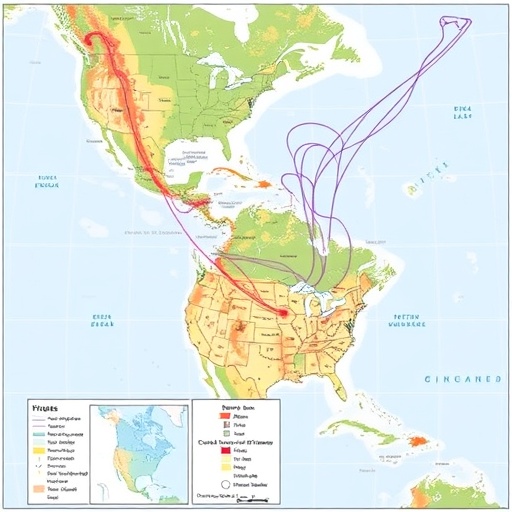
A groundbreaking digital resource designed to revolutionize the conservation of migratory birds across the Americas was unveiled today at the fifteenth meeting of the UN Convention on Migratory Species (CMS COP15) in Campo Grande, Brazil. This innovative platform, the Americas Flyways Atlas, represents an unparalleled achievement in ecological monitoring and international collaboration, offering detailed annual migratory pathways and critical habitat mapping for 89 of the hemisphere’s most vulnerable bird species. Its launch marks a pivotal step forward in integrating vast citizen-science datasets with cutting-edge ecological modeling, guiding conservation efforts at a scale and precision never before possible.
Migratory bird species navigate complex hemispheric flyways that extend from the icy expanses of the Canadian Arctic, traverse the diverse biomes of Central America, and continue down to the remote reaches of Patagonia. The Atlas leverages millions of observations contributed by over a million eBird citizen scientists, synchronized with advanced computational models, to identify “Bird Concentration Areas.” These areas, essential for breeding, stopover, and wintering, support high abundances of species listed under CMS Appendices I and II, which are legally protected due to their vulnerability. Understanding the spatial-temporal dynamics of these crucial sites enables policymakers and conservationists to prioritize interventions that safeguard these pathways against ever-increasing anthropogenic threats.
The scientific rigor embedded in the Americas Flyways Atlas sets it apart from conventional ecological datasets. Where traditional bird monitoring has often been fragmented or regionally constrained, this tool integrates ecological, geographical, and behavioral data across all 56 Western Hemisphere countries within the flyways. By depicting migratory patterns at continental scales, researchers can now visualize the interconnectedness of diverse habitats, highlighting how the degradation of a single site—whether a wetland drained for agriculture or a fragmented forest stopover—can precipitate cascading effects that imperil entire migratory populations. Notably, the Atlas provides actionable insights that align with the international mandates of CMS and supports real-time policy deliberations at COP15, where robust, evidence-based treaty decisions are underway.
Among the broad spectrum of avian fauna included are emblematic species whose conservation status reflects the urgent environmental challenges of the region. The Buff-breasted Sandpiper, a grassland shorebird with a steep population decline due to habitat conversion, and the Semipalmated Sandpiper, a long-distance migrant witnessing enigmatic but ongoing reductions in numbers, exemplify species whose futures depend on the protection of fragile stopover ecosystems. Similarly, the Cerulean Warbler, dependent on increasingly fragmented forest breeding grounds, and the high-altitude Andean Flamingo, reliant on vulnerable Andean wetlands, underscore the diverse ecological niches encompassed within the Atlas. The Hudsonian Godwit exemplifies the necessity of protecting a sequence of sensitive sites through its extensive Arctic breeding and hemispheric migration.
The primary innovation of the Americas Flyways Atlas lies in its capacity to synthesize vast citizen-science contributions with sophisticated spatial analyses. Millions of data points submitted through eBird are rigorously validated and integrated within predictive models that map species distributions dynamically throughout the year. This fusion of participatory science and computational ecology offers a powerful decision-support tool, orienting conservation resources where they yield maximal benefit. As observed by Chris Wood, Director of eBird and Program Director at the Cornell Lab of Ornithology, the transformation of observational data into actionable conservation intelligence is a milestone, empowering both local authorities and international coalitions to enact measures that effectively counteract habitat loss, pollution, and climate disruption.
The Atlas’s strategic function as a policy enabler is especially consequential amidst the backdrop of COP15, which convenes 133 Parties actively negotiating species listings, habitat protections, and frameworks for strengthened ecological connectivity. The platform promotes transboundary cooperation by furnishing a shared evidence base, thereby addressing a critical historical gap in migratory species conservation—fragmented actions that neglect the continent-wide range these birds traverse. Migratory birds inherently negate political boundaries, making synchronized conservation indispensable. The Atlas’s capability to visualize and substantiate these shared ecological corridors reinforces the essential role of international legal instruments and cooperative management.
Beyond its immediate application to species protection, the Americas Flyways Atlas represents a paradigm shift in biodiversity monitoring. By integrating over 2.2 billion global bird observations and transcending traditional ecological barriers, the tool exemplifies the power of open-access, data-driven conservation enabled by citizen engagement and advanced machine learning. This comprehensive repository enhances the capacity to track trends, detect emerging threats, and evaluate the efficacy of conservation interventions in near real-time—a dimension critical for adaptive management in the face of rapidly changing environmental conditions.
Moreover, the Atlas emerges at a moment when migratory bird populations worldwide confront unprecedented pressures. Intensifying urban expansion, agricultural intensification, infrastructure development, and climate-induced alterations in habitat suitability are compounding risks. The ability to pinpoint sites where these anthropogenic pressures intersect with critical avian life stages heightens the strategic efficacy of conservation investments. The identification of Bird Concentration Areas allows targeted protection and restoration initiatives, ensuring that efforts are not diluted but concentrated where ecological stakes are highest.
Stakeholders have lauded the Atlas as a leap forward in hemispheric-scale ecological governance. Amy Fraenkel, Executive Secretary of CMS, highlighted the tool’s role in bridging high-caliber scientific research with vast citizen-contributed data, emphasizing its centrality in bolstering ecological connectivity across borders. Simultaneously, João Paulo Capobianco, COP15 chair and Brazilian Ministry of Environment and Climate Change Executive Secretary, underscored the Atlas’s relevance for multilateral cooperation. The platform’s finely resolved mapping of migratory corridors offers compelling justification for broader participation in the CMS framework, underlining the inseparability of biodiversity conservation from international collaboration.
The languages supported by the Americas Flyways Atlas—English, Spanish, and Portuguese—reflect the cultural and geopolitical diversity of the Americas, enhancing accessibility and engagement across stakeholders. This inclusivity amplifies the platform’s potential impact, facilitating shared understanding and joint action among countries spanning multiple continents and ecosystems. Robust multilingual tools are essential to galvanize participation from governments, researchers, indigenous communities, and NGOs united by their collective responsibility for migratory bird stewardship.
In sum, the Americas Flyways Atlas crystallizes an ambitious vision for migratory bird conservation that integrates comprehensive data, advanced ecological modeling, and international diplomacy. By codifying the complex, continent-spanning life cycles of imperiled avian species into a user-friendly yet scientifically robust interface, the Atlas serves as both a compass and a catalyst. It guides pragmatic conservation actions ensuring habitat preservation and mitigation efforts are targeted and effective, while simultaneously fostering the transnational cooperation imperative to sustain migratory species through an era of unprecedented environmental change.
Subject of Research: Migratory bird conservation and habitat mapping across the Americas using citizen-science data and ecological modeling.
Article Title: Americas Flyways Atlas: Transforming Migratory Bird Conservation Through Data-Driven International Action
News Publication Date: March 26, 2026
Web References:
- Americas Flyways Atlas: https://www.cms.int/atlas-americas-flyways
- CMS COP15 information: https://conta.cc/4aK8t3K
- Americas Flyways Atlas Launch Recording: https://www.youtube.com/watch?v=-SCCvH_e4vA
Image Credits: CMS / Cornell Lab of Ornithology
Keywords: Biodiversity, Migratory birds, Conservation, Citizen science, Ecological modeling, International cooperation, Habitat protection, Flyways, Endangered species, Ecological connectivity, Avian population studies


