


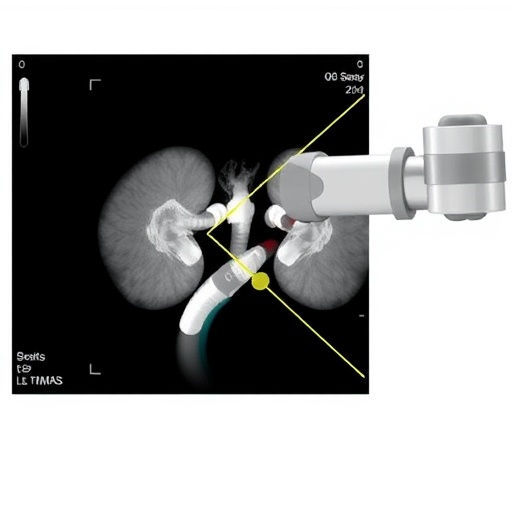
In the continuously evolving realm of minimally invasive surgery, recent advances signify a monumental leap for urologic interventions. A groundbreaking study unveils the integration of ultrasonographic guidance with robotic-assisted technologies in percutaneous nephrolithotomy (PCNL), marking a new era for precision, safety, and efficiency in kidney stone removal. This innovative approach not only harnesses the intuitive real-time imaging capabilities of ultrasound but also capitalizes on the steady, refined dexterity of robotic systems, promising to revolutionize how surgeons approach complex renal calculi.
Traditionally, PCNL procedures have relied on fluoroscopy, a form of X-ray imaging, to guide needle placement into the kidney. While effective, fluoroscopy exposes patients and surgeons to ionizing radiation and provides only a two-dimensional projection, potentially limiting spatial awareness during critical puncture and tract dilation phases. The current study challenges this paradigm by substituting fluoroscopic imaging with ultrasonography, a radiation-free modality, thereby significantly reducing radiation exposure without compromising procedural accuracy.
The heart of this technical innovation lies in the real-time, three-dimensional visualization of kidney anatomy afforded by ultrasonography. This imaging modality allows surgeons to identify the renal collecting system, surrounding vasculature, and stone burden simultaneously, enabling a tailored and safer approach to each puncture site. Coupled with a robotic platform designed specifically for urologic interventions, the system translates ultrasound data into precise mechanical movements, offering sub-millimetric control over needle insertion and instrument navigation.
Ultrasonographic-guided robotic-assisted PCNL introduces several operational advantages compared to conventional methods. The robotic assistance mitigates human hand tremor and fatigue, ensuring consistent trajectory and depth during needle advancement. Moreover, the integration of real-time ultrasound feedback with robotic manipulation facilitates immediate adjustment to anatomical variability, which is paramount given the complex three-dimensional structure of the kidney and its proximity to vital tissues.
This synergy of imaging and robotics is made possible by advanced algorithms that interpret ultrasound signals to reconstruct dynamic anatomical maps. These maps feed into an intelligent navigation system that provides haptic feedback and predictive modelling, guiding the surgeon’s hand and robotic actuators in unison. The result is an unprecedented level of precision, greatly diminishing the risk of hemorrhage or injury to adjacent organs, risks traditionally inherent in percutaneous renal access.
Crucially, the study demonstrates that this technology can be seamlessly incorporated into existing surgical workflows. Surgeons reported an intuitive interface that did not extend procedure time and, in some cases, reduced it, owing to more efficient puncture attempts and tract creation. This highlights the potential for widespread adoption and scalability, particularly in centers equipped with robotic surgical suites but seeking to minimize radiation exposure for patients and operating teams.
The implications of this advancement extend beyond the immediate clinical outcomes. Reduced radiation exposure aligns with global safety mandates and addresses cumulative occupational hazards faced by surgical teams performing frequent PCNL procedures. Furthermore, enhanced procedural accuracy may translate into improved patient recovery profiles, with lower complication rates and shorter hospital stays, ultimately reducing healthcare costs and improving patient satisfaction.
From a technical perspective, the robotic system’s capability to interpret ultrasonographic data involves complex image processing and machine learning techniques. These analytical methods facilitate the differentiation between tissue types, stone densities, and instrument positioning, optimizing decision-making during puncture and tract dilation. The hardware-software integration ensures seamless real-time responsiveness, critical for the dynamic environments encountered during surgery.
Moreover, the study underscores the importance of multidisciplinary collaboration, combining expertise in urology, radiology, robotics, and computer science. This convergence is the backbone of the innovation, ensuring that each component — from high-frequency ultrasound probes to robotic arms and control software — operates harmoniously to achieve clinical objectives safely.
Patient outcomes reported in the analysis are promising: operative success rates paralleled or exceeded those of traditional PCNL while complication rates decreased. Pain scores postoperatively were reduced, likely reflecting the minimally traumatic nature of precision-guided access. Such findings reinforce the notion that newer technologies can deliver not only equivalent efficacy but also enhanced patient experience.
The novel approach also reveals significant educational benefits. The integrated ultrasound-robotic interface offers augmented reality overlays and objective metrics that can expedite the learning curves for trainees. This potential democratizes access to complex procedures, enabling surgeons in training to gain confidence and competence within a controlled, feedback-rich environment.
Looking toward the future, the fusion of ultrasonography and robotic assistance in PCNL may catalyze further innovations across other percutaneous and endoscopic interventions. The principles of radiation avoidance, enhanced precision, and real-time imaging could be adapted to diverse procedures across various organ systems, broadening the impact of this technological advancement.
Despite its promise, the system presently faces challenges including the need for optimized ultrasonographic probes tailored to specific anatomical nuances and the continued refinement of software algorithms to handle a wider variety of anatomical variations and pathological presentations. Ongoing clinical trials aim to validate these early results and expand understanding of long-term outcomes and cost-effectiveness.
In conclusion, the introduction of ultrasonographic-guided robotic-assisted PCNL represents a significant milestone in urologic surgery. By addressing longstanding limitations related to radiation exposure and manual dexterity, it redefines the standards for minimally invasive kidney stone management. This innovation exemplifies how convergence of cutting-edge imaging and robotics can reshape surgical paradigms, underscoring the limitless potential of interdisciplinary technology in advancing patient care.
Bazzani, S., Puliatti, S., Ferretti, S. et al. Ultrasonographic-guided robotic-assisted percutaneous nephrolithotomy.
Commun Eng 4, 120 (2025). https://doi.org/10.1038/s44172-025-00451-0
Cite Scienmag News
Denise Maddox. (August 4, 2025). Ultrasound-Guided Robotic Percutaneous Nephrolithotomy Advances. Scienmag. https://scienmag.com/ultrasound-guided-robotic-percutaneous-nephrolithotomy-advances/
Denise Maddox. "Ultrasound-Guided Robotic Percutaneous Nephrolithotomy Advances." Scienmag, 4 August 2025, https://scienmag.com/ultrasound-guided-robotic-percutaneous-nephrolithotomy-advances/. Accessed 3 September 2026.
Denise Maddox. "Ultrasound-Guided Robotic Percutaneous Nephrolithotomy Advances." Scienmag. August 4, 2025. https://scienmag.com/ultrasound-guided-robotic-percutaneous-nephrolithotomy-advances/


