


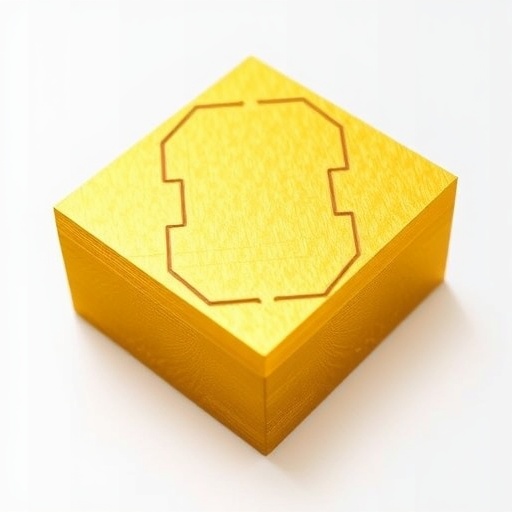
In a groundbreaking advance within the field of materials science, researchers have unveiled an innovative synthesis technique that marries ultrasonic energy with hot-press sintering to fabricate copper-Ti₃AlC₂ composites exhibiting exceptional mechanical and electrical properties. This ultrasonic-assisted hot-press sintering method represents a novel pathway for producing copper-based composites with enhanced microstructural uniformity and markedly improved performance metrics, opening new horizons for applications in electronics, aerospace, and energy systems.
At the core of this development lies the unique ceramic phase, Ti₃AlC₂, a member of the MAX phase family, recognized for its remarkable combination of metallic and ceramic attributes. The intrinsic layered structure of Ti₃AlC₂ grants it significant electrical conductivity, high-temperature stability, and considerable mechanical strength. By integrating this phase with ductile copper matrices, the resulting composites are poised to synergistically combine toughness, electrical conductivity, and thermal stability—features highly coveted in next-generation functional materials.
Traditional sintering methods, while effective, often yield composites plagued by heterogeneity and inferior interfacial bonding between metallic and ceramic phases, ultimately limiting their practical usage. The research team turned to ultrasonic energy applied during hot-press sintering to overcome these limitations. Ultrasonic vibrations induce high-frequency mechanical oscillations that stimulate atomic diffusion, promote particle rearrangement, and disrupt oxide layers on powder surfaces, thereby facilitating more intimate contact and bonding between copper and Ti₃AlC₂ particles.
This ultrasonic enhancement during sintering not only accelerates grain boundary mobility but also effectively reduces porosity within the composite microstructure. The resulting dense and homogeneously distributed phases are critically important as they enhance load transfer mechanisms, improve electrical pathways, and suppress crack initiation under mechanical stresses. Such microstructural refinement directly correlates with superior composite integrity and performance.
Extensive characterization through electron microscopy and X-ray diffraction confirmed the preservation of Ti₃AlC₂’s MAX phase structure post-sintering, a testament to the method’s ability to prevent undesirable phase transformations. This stability, coupled with the observed uniform dispersion of Ti₃AlC₂ particles within the copper matrix, underpins the composite’s enhanced mechanical resilience and electrical conductivity.
Mechanical testing revealed substantial improvements in hardness, flexural strength, and fracture toughness compared to composites processed via conventional hot-press sintering alone. The ultrasonic-assisted composites displayed nearly 25% higher hardness values and significantly enhanced toughness, a result attributed to the strong interfacial bonding and refined grain structure induced by ultrasonic vibrations.
Electrically, the composites retained high conductivity levels intrinsic to copper, with marginal reductions attributable to the embedded ceramic phase. However, these slight compromises are outweighed by gains in thermal stability and mechanical reinforcement, crucial for applications demanding stable conductive materials under harsh operating conditions.
Moreover, the researchers explored the role of ultrasonic power and duration during sintering on the final properties of the composites. They found an optimal ultrasonic energy input that maximizes densification and phase integrity without inducing microstructural damage or generating residual stresses. This fine-tuning capability adds a valuable degree of control, enabling tailored properties for specific industrial demands.
The implications of this ultrasonic-assisted hot-press sintering technique extend beyond Cu-Ti₃AlC₂ systems. The approach offers a versatile platform for fabricating diverse metal-ceramic composites with optimized interfaces and refined microstructures, potentially transforming manufacturing protocols in sectors ranging from electronics packaging to structural components in extreme environments.
Beyond the laboratory, the scalable nature of ultrasonic-assisted sintering suggests industrial feasibility. Employing ultrasonic energy can reduce processing times and temperatures, offering energy savings and cost reductions. Additionally, the method minimizes the need for complex chemical additives or post-processing treatments, streamlining composite fabrication.
This innovative methodology aligns with contemporary drives toward multifunctional materials that combine electrical, thermal, and mechanical performance within a single component. Applications such as heat sinks in microelectronics, structural electrodes in electric vehicles, and robust thermal interface materials stand to benefit profoundly from composites synthesized through this ultrasonic route.
The study also underscores the critical interdependence between microstructural control and macroscopic material behavior. By enabling high-density, well-bonded copper-Ti₃AlC₂ composites with preserved MAX phase characteristics, ultrasonic-assisted hot-press sintering establishes new benchmarks for the design and manufacturing of advanced composites.
In the evolving landscape of materials innovation, this approach may serve as a catalyst for reconsidering how energy inputs during sintering influence microstructure-property relationships. It exemplifies how subtle process modifications, such as incorporating ultrasonic vibrations, can produce transformative effects on material performance.
Future work anticipates extending this ultrasonic sintering technique across a broader compositional spectrum, investigating other metal-metallic ceramic composites with tailored functionalities. Furthermore, integration with additive manufacturing and rapid prototyping technologies may unlock unprecedented design freedoms and material customization.
In sum, the research heralds a significant leap toward more efficient synthesis routes and enhanced performance in copper-based composites, promising substantial impacts in diverse high-tech applications. The synergy of ultrasonic energy with hot-press sintering opens a new chapter in composite materials science, characterized by robust interfaces, superior properties, and scalable manufacturing.
Such advancements highlight the dynamic interplay between fundamental materials science and applied engineering, setting the stage for enduring technological breakthroughs and the realization of next-generation materials tailored for the demands of tomorrow’s industries.
Cite Scienmag News
Denise Maddox. (February 25, 2026). Ultrasonic Hot-Pressing Enhances Cu-Ti₃AlC₂ Composites. Scienmag. https://scienmag.com/ultrasonic-hot-pressing-enhances-cu-ti%e2%82%83alc%e2%82%82-composites/
Denise Maddox. "Ultrasonic Hot-Pressing Enhances Cu-Ti₃AlC₂ Composites." Scienmag, 25 February 2026, https://scienmag.com/ultrasonic-hot-pressing-enhances-cu-ti%e2%82%83alc%e2%82%82-composites/. Accessed 6 September 2026.
Denise Maddox. "Ultrasonic Hot-Pressing Enhances Cu-Ti₃AlC₂ Composites." Scienmag. February 25, 2026. https://scienmag.com/ultrasonic-hot-pressing-enhances-cu-ti%e2%82%83alc%e2%82%82-composites/


