


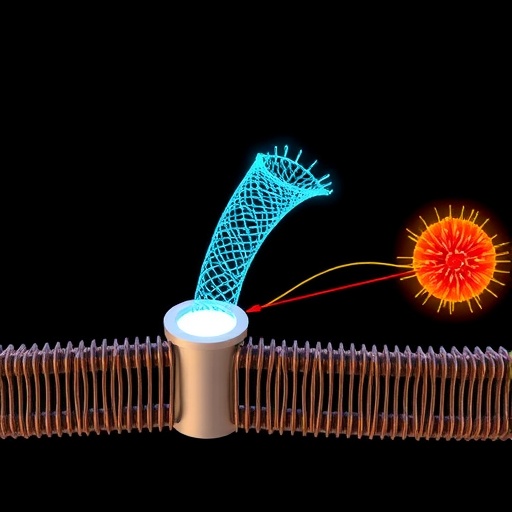
A newly uncovered facet of how cellular calcium pumps regulate intracellular calcium levels has emerged from groundbreaking research investigating the plasma membrane Ca²⁺-ATPases (PMCAs), revealing an unexpected druggable site that echoes mechanisms of plant-derived toxins. At the heart of this discovery lies the identification of a modulatory binding pocket within PMCA2, previously thought exclusive to similar pumps, which now appears to accommodate not only regulatory lipids but also pharmacological inhibitors. This insight not only challenges existing models of calcium pump regulation but opens avenues for precise manipulation of calcium signaling in health and disease.
Calcium homeostasis is fundamental to myriad cellular processes, with PMCA proteins playing a pivotal role by actively extruding Ca²⁺ from cells. Despite advances in structural biology illuminating PMCA architecture, details of how lipid regulators and small molecules influence these pumps remain elusive. The current study bridges this knowledge gap by correlating the binding site for the lipid phosphatidylinositol 4,5-bisphosphate (PtdIns(4,5)P₂) in PMCA2 with the binding locus of thapsigargin, a potent inhibitor known for targeting SERCA-type Ca²⁺-ATPases.
Structurally, thapsigargin binds to the sarcoplasmic/endoplasmic reticulum Ca²⁺-ATPase (SERCA) pump, locking it into an inactive conformation characterized by a Ca²⁺-free E2 state. Intriguingly, high-resolution comparisons revealed that the binding pocket in PMCA2 accommodating PtdIns(4,5)P₂ is topographically and chemically analogous to that occupied by thapsigargin in SERCA1a. Although the hydrophilic nature of PtdIns(4,5)P₂ slightly shifts its position towards the cytoplasmic membrane interface in PMCA2, numerous residues interacting with this lipid correspond to those involved in thapsigargin binding in SERCA.
To further probe this overlap, molecular docking studies positioned thapsigargin into the PMCA2 structure in its E2.Pᵢ state. These simulations compellingly demonstrated that thapsigargin snugly occupies the PtdIns(4,5)P₂-binding site, hinting at a competitive inhibition mechanism whereby the toxin could effectively displace the lipid regulator. This finding was particularly remarkable given that thapsigargin is traditionally not considered a PMCA inhibitor, spotlighting the structural and functional versatility of the identified pocket.
Functional assays conducted with PMCA2 complexed with its accessory subunit neuroplastin (NPTN) substantiated the computational predictions. Using BK_Ca channel activation as a sensitive readout for PMCA-mediated Ca²⁺ transport, bath application of thapsigargin resulted in a concentration-dependent reduction in pump activity. The determined half-maximal inhibitory concentration (IC₅₀) of approximately 2.6 µM revealed potent inhibition, underscoring thapsigargin’s unexpected efficacy against PMCA2 when compared to traditional views.
Comparisons of the inhibitory effects induced by direct phosphoinositide depletion through CiVSP activation versus thapsigargin application revealed a fascinating convergence. Both strategies diminished PMCA2 activity to similar extents, suggesting that thapsigargin’s mode of action involves competing with PtdIns(4,5)P₂ at their shared binding site. This hypothesis was rigorously tested by employing a dual-perturbation protocol: following CiVSP-mediated PtdIns(4,5)P₂ depletion, subsequent thapsigargin treatment failed to cause any additional inhibitory effect. Thus, the data strongly implicate competitive binding as the molecular mechanism preventing additive pump suppression.
These discoveries elevate the PtdIns(4,5)P₂-binding site on PMCA2 from a mere lipid interaction domain to a promising target for pharmacological intervention. This site’s ability to accommodate structurally diverse ligands—from natural phospholipids to complex polycyclic toxins—suggests an inherent plasticity that could be exploited to design novel modulators of Ca²⁺ transport. Such modulators have profound potential in treating disorders linked to aberrant intracellular calcium signaling, including neurodegeneration, cardiac dysfunction, and certain cancers.
Moreover, the structural and functional parallels drawn between PMCA2 and SERCA hint at evolutionary conservation in the mechanisms regulating Ca²⁺-ATPase family members. The recognition that a well-studied plant toxin targets this conserved pocket in SERCA and can similarly inhibit PMCA2 broadens our understanding of cross-family interactions and encourages reevaluation of existing pharmacophores in the context of diverse calcium pumps.
The methodology in this study combined state-of-the-art cryo-electron microscopy with precise electrophysiological readouts and sophisticated computational docking, sharply elucidating the molecular underpinnings of pump regulation. This integrative approach allowed for the unprecedented visualization of ligand-binding dynamics at atomic resolution, propelling forward the field of transporter biology.
Future directions will likely explore the development of selective small molecules tailored to exploit this modulatory pocket in PMCA isoforms. Such work will be indispensable for therapeutic strategies aimed at fine-tuning calcium signaling pathways, minimizing off-target effects, and overcoming the challenges posed by the high sequence and structural similarity among Ca²⁺-ATPase pumps.
Intriguingly, this research also raises fundamental questions about the physiological relevance of endogenous lipid modulation in PMCA function. Given the central role of PtdIns(4,5)P₂ in cellular signaling, its interaction with PMCA2 represents a sophisticated regulatory axis that coordinates membrane phosphoinositide dynamics with calcium homeostasis, potentially influencing processes ranging from synaptic transmission to muscle contraction.
The interface where PtdIns(4,5)P₂ binding occurs appears to serve as a nexus between the plasma membrane environment and the cytoplasmic machinery, suggesting that local lipid composition can rapidly and reversibly modulate pump activity in response to cellular cues. By decoding this relationship, the study lays crucial groundwork for understanding how spatial and temporal lipid fluctuations impact calcium signaling fidelity.
Lastly, the revelation that pharmacological agents such as thapsigargin can hijack lipid-binding pockets to exert inhibition underscores the therapeutic relevance of targeting lipid-protein interfaces in membrane proteins. This insight extends beyond PMCAs, potentially inspiring strategies targeting other lipid-regulated transporters and channels implicated in various diseases.
In sum, the identification of a common modulatory pocket in PMCA2 for both physiological lipid regulation and pharmacological inhibition constitutes a paradigm-shifting advance in membrane transport biology. By linking structural homology with functional convergence, this research charts a compelling course toward novel treatments that harness the intricate interplay between lipids and pumps to restore cellular calcium balance.
Cite Scienmag News
Denise Maddox. (August 21, 2025). Ultrafast Plasma Membrane Ca2+ Transport Mechanism. Scienmag. https://scienmag.com/ultrafast-plasma-membrane-ca2-transport-mechanism/
Denise Maddox. "Ultrafast Plasma Membrane Ca2+ Transport Mechanism." Scienmag, 21 August 2025, https://scienmag.com/ultrafast-plasma-membrane-ca2-transport-mechanism/. Accessed 8 September 2026.
Denise Maddox. "Ultrafast Plasma Membrane Ca2+ Transport Mechanism." Scienmag. August 21, 2025. https://scienmag.com/ultrafast-plasma-membrane-ca2-transport-mechanism/


