


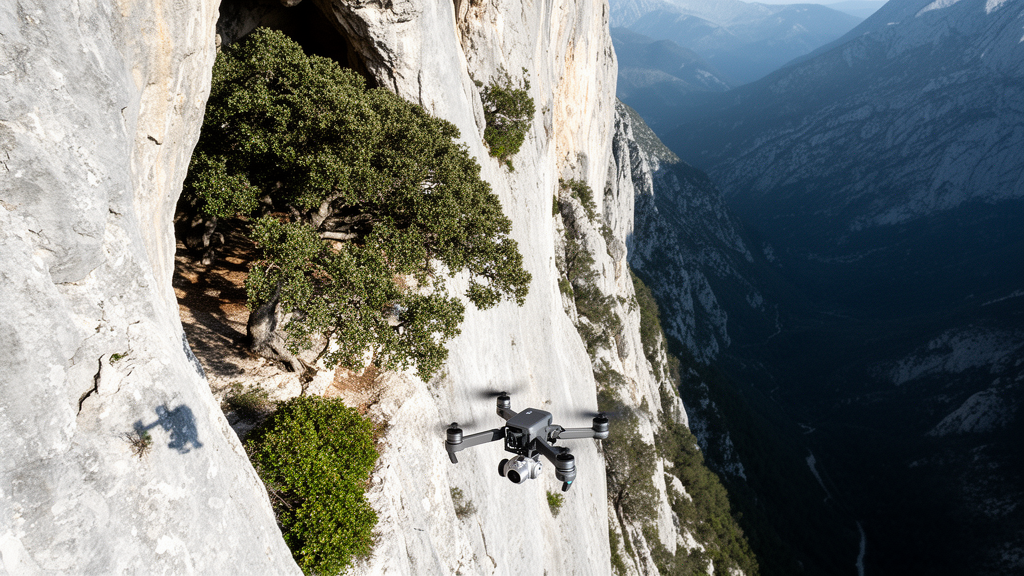
A 2024 field survey using drone imagery and ground photography identified 44 plant species and subspecies around the exterior walls of Tecchia di Tenerano, a limestone geotope near Tenerano in the Apuan Alps of northwestern Tuscany, Italy. The investigation focused on portions of the rocky complex that could not be reached from the ground and that appeared to retain vegetation unaffected by human management.
The study examined a high wall of cavernous limestone above a cave approximately 150 m deep. The site is located at 44.1406°N, 10.1060°E and 481 m above sea level. The rock face reaches about 75 m in height, has a 90-degree slope and a southern exposure. It forms part of a larger karst system developed in the basal carbonic breccia of the Falda Toscana in the northern sector of the Apuan Alps.
Weather records from the nearby Equi Terme station for 2014–2023 indicate average annual temperatures between 4 and 22 °C and approximately 1,600 mm of annual rainfall, with the maximum in autumn and winter and the minimum in summer. The surrounding forest landscape includes old, nearly monophytic coppices of Ostrya carpinifolia and sparse chestnut groves of Castanea sativa, while Quercus ilex characterizes the walls and top of the rocky buttress.
Researchers conducted a field exploration in June 2024, photographing the site with a reflex camera equipped with a 200× telephoto lens. Dense deciduous foliage prevented the drone from taking off, so the aerial survey was conducted in autumn 2024. A DJI Mini 3 Pro quadcopter with a visible-spectrum RGB camera collected 15 nadir images and 10 front images from 10 m above the top and 10 m from the external wall face.
The manual flight proceeded at 1.5 m per second with 60% overlap and a ground sampling distance of 0.7 cm per pixel. The images were processed with Agisoft Metashape into a three-dimensional reconstruction and orthophoto. Researchers then established five 60 m² survey plots on the reconstructed model, each divided into 1 m by 1 m quadrats for percentage-cover measurements. Coverage data were compared using principal component analysis in PAST 4.03.
The plots extended from 510 to 556 m in altitude. Total plant cover ranged from 11.5% in the plot at 510 m to 54.7% in the highest plot at 556 m, with differences associated with rock morphology and slope. Sixteen of the 44 detected taxa occurred within the five drone-imaged plots; the remaining taxa were photographed or found outside the plots.
The detected flora was dominated numerically by arboreal, shrubby and chamaephytic life forms, while Mediterranean chorotypes were prevalent. No therophytes were identified in the drone footage of the limestone wall. The researchers attributed their apparent absence partly to the technical difficulty of recognizing very small plants and partly to difficulties in dispersal and establishment on rocky substrates. Five Italian endemics were recorded: Atadinus glaucophyllus, Globularia incanescens, Moltkia suffruticosa subsp. bigazziana, Salix crataegifolia and Siler montanum subsp. apuanum.
Holm oak, Quercus ilex, colonized the summit, ridge and ledges alongside hop-hornbeam, Arbutus unedo and Fraxinus ornus. On more strongly sloping parts of the wall, Atadinus glaucophyllus, Juniperus phoenicea and Moltkia suffruticosa subsp. bigazziana became prevalent. Common herbaceous taxa included Brachypodium genuense, Parietaria officinalis and Centranthus ruber. Inside the cave, investigators observed no vegetation other than a widespread algal covering on the walls.
The principal component analysis separated two vegetation types: ledge communities, mainly arboreal or shrubby and characterized by Quercus ilex, and rocky slope-wall communities, where smaller species occurred and Atadinus glaucophyllus was consistently present. The first two components accounted for 53.337% and 23.639% of the variance, respectively. Based on prevalent and typical species, the researchers associated parts of the site with habitat 9340, “Quercus ilex and Quercus rotundifolia forests,” under the 92/43/EEC Directive, and considered some relevés potentially associated with habitat 8210, “Calcareous rocky slopes with chasmophytic vegetation.”
The observations were bounded by the small number of surveys and the inability of the imaging method to identify all very small species reliably. Because samples could not be collected for definitive identification and some taxa fell below the method’s detection limit, the researchers said the communities could not be assigned to formal phytosociological syntaxa. They nevertheless interpreted the Mediterranean-dominated rock vegetation as extrazonal within the Apuan landscape and described the ledges as relict stations associated with post-glacial movements of holm oak into the mountain interior. The communities may preserve traces of the formerly natural vegetation around the caves, while advances in sensor technology were predicted to improve resolution and species-identification capabilities.
Subject of Research: UAV-based botanical survey of plant communities on the exterior walls of an Apuan limestone cave
Article Title: The ledge plant communities in a limestone cave of the Apuan area: identification and survey by UAV technology
Article References: Bertacchi, A., Orazi, D., & Ercolini, L. (2025). The ledge plant communities in a limestone cave of the Apuan area: identification and survey by UAV technology. Italian Botanist, 20, 9-22. https://doi.org/10.3897/italianbotanist.20.145009
Image Credits: AI Generated
DOI: 10.3897/italianbotanist.20.145009
Keywords: UAV botanical survey, Tecchia di Tenerano, Apuan Alps, limestone cave, cliff vegetation, plant species identification, Italian endemic plants, phytosociology, Mediterranean flora, ledge, plant, communities
Cite Scienmag News
Margaret Porter. (October 20, 2026). UAV survey identifies 44 plant taxa on inaccessible walls of an Apuan limestone cave. Scienmag. https://scienmag.com/uav-survey-identifies-44-plant-taxa-on-inaccessible-walls-of-an-apuan-limestone-cave/
Margaret Porter. "UAV survey identifies 44 plant taxa on inaccessible walls of an Apuan limestone cave." Scienmag, 20 October 2026, https://scienmag.com/uav-survey-identifies-44-plant-taxa-on-inaccessible-walls-of-an-apuan-limestone-cave/. Accessed 20 October 2026.
Margaret Porter. "UAV survey identifies 44 plant taxa on inaccessible walls of an Apuan limestone cave." Scienmag. October 20, 2026. https://scienmag.com/uav-survey-identifies-44-plant-taxa-on-inaccessible-walls-of-an-apuan-limestone-cave/


