

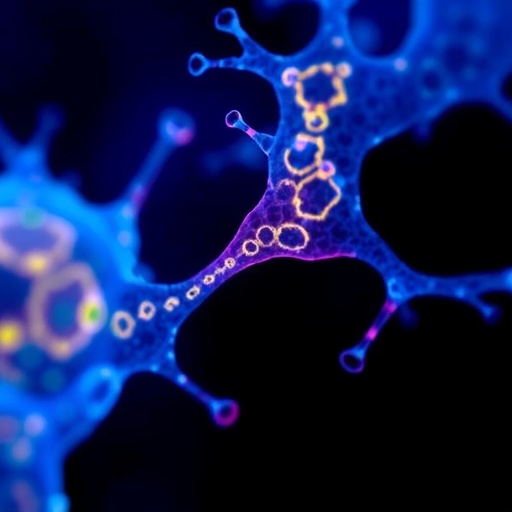
In a groundbreaking advancement that pushes the boundaries of spatial transcriptomics, researchers at the University of Michigan have pioneered an innovative technology called Seq-Scope-eXpanded, or Seq-Scope-X. This next-generation methodology enhances the resolution of spatial gene expression mapping within tissue samples beyond existing physical limits imposed by molecular diffusion barriers. By marrying tissue expansion techniques with the high-throughput capabilities of Illumina sequencing platforms, the team has unveiled previously inaccessible layers of cellular and subcellular transcriptomic architecture, promising transformative insights in molecular physiology and pathology.
The original Seq-Scope technology, developed in 2021 by Jun Hee Lee and colleagues, heralded a new era in spatial omics by enabling comprehensive mapping of all expressed messenger RNA (mRNA) molecules across intact tissues at a microscopic scale. Leveraging Illumina sequencing’s spatial barcoding approach, Seq-Scope cleverly delineated gene activity in situ without the need for single-cell dissociation. However, despite its revolutionary capacity, the system faced intrinsic spatial resolution constraints dictated by the physics of molecule diffusion from tissue to capture arrays during sample preparation.
“It became clear that simply improving resolution on the sequencer side was insufficient due to a hard limit imposed by molecular diffusion, which restricts spatial accuracy to roughly one micron,” explained Lee, a Professor of Molecular & Integrative Physiology. This diffusion barrier essentially blurs the transcriptomic signals as molecules spread from their origin points before being immobilized on sequencing substrates, capping the achievable spatial precision of any sequencing-based spatial method operating under conventional protocols.
To overcome this fundamental limitation, the research team conceived a clever solution: physically enlarging the tissue samples through hydrogel embedding followed by isotropic expansion using water infusion — a strategy adapted from tissue clearing and expansion microscopy techniques. This approach effectively magnifies the spatial dimensions of the tissue, thereby increasing the physical distances between biomolecules relative to the capture surface and circumventing the diffusion-imposed resolution ceiling.
The development of this expansion approach was spearheaded by Lee’s graduate student Angelo Anacleto in collaboration with Hee-Sun Han, a Professor of Chemistry at the University of Illinois Urbana-Champaign. Their interdisciplinary collaboration integrated precise chemical protocols for controlled hydrogel embedding and swellable polymer formulation with the sophisticated gene-capturing Seq-Scope workflow developed at Michigan.
By applying the expansion process, called Seq-Scope-eXpanded, the researchers not only retained the comprehensive transcriptome profiling capacity of the original technique but also achieved an unprecedented enhancement in spatial granularity. The expanded tissues, now magnified in size, allowed the team to differentiate individual cells with far greater accuracy and to trace gene expression patterns within subcellular microenvironments such as distinct nuclear and cytoplasmic regions.
Critical to the interpretation of this flood of high-resolution spatial transcriptomic data were novel computational methods developed by Hyun Min Kang, a Professor of Biostatistics. These algorithms enabled the team to dissect mRNA localization patterns within liver cells, distinguishing transcripts synthesized in the nucleus from those populating the cytoplasm. Such insights into spatially resolved gene regulation dynamics deepen understanding of cellular function and pathology at a molecular level previously impossible to achieve.
Lee emphasized that Seq-Scope-X pushes spatial transcriptomics into an entirely new regime, surpassing prior limitations by nearly an order of magnitude. This leap forward aligns with a broader trend of rapid improvements in spatial omics technologies, which have been advancing roughly fourfold in resolution each year over the past decade. “Our work places the University of Michigan at a critical inflection point where biological discovery potential accelerates sharply thanks to unprecedented spatial detail,” Lee remarked.
Beyond liver tissue, the technology’s versatility suggests broad applicability across diverse tissues and research domains, including cancer biology, developmental biology, and neuroscience. Its capacity to resolve molecular conversations at cellular and subcellular scales could identify novel disease biomarkers, map complex tissue microenvironments, and elucidate intricate cellular interactions underlying health and disease.
While the techniques rely on sophisticated chemistry and advanced sequencing platforms, the underlying concept of physically expanding tissues before molecular profiling introduces a powerful avenue to break through inherent biophysical constraints that have long hampered spatial omics methods. This hybridization of chemical manipulation and sequencing biology represents a paradigm shift in spatial molecular profiling.
The research team also acknowledges the importance of technological transfer and further development to bring Seq-Scope-X from the laboratory to widespread usage. Jun Hee Lee holds key intellectual property rights covering this innovation, emphasizing a strategic approach to manage patenting and collaboration to maximize impact while safeguarding scientific integrity.
In sum, Seq-Scope-eXpanded stands as a milestone in the quest to map biological information in its true spatial context with extraordinary precision. It invites a reimagining of how we explore gene expression dynamics, not as isolated snapshots but as living landscapes within tissues. This technology promises not only to enrich basic science but also to catalyze breakthroughs in diagnostics and therapy, marking an exciting horizon in biomedical research.
Subject of Research: Spatial transcriptomics, molecular resolution enhancement, tissue expansion techniques
Article Title: Seq-Scope-eXpanded: spatial omics beyond optical resolution
Web References:
https://www.nature.com/articles/s41467-026-69346-8
References:
Lee JH et al., “Seq-Scope-eXpanded: spatial omics beyond optical resolution,” Nature Communications, DOI: 10.1038/s41467-026-69346-8
Image Credits: Jun Hee Lee Laboratory
Keywords
Spatial transcriptomics, Seq-Scope, tissue expansion, hydrogel embedding, Illumina sequencing, molecular diffusion barrier, subcellular resolution, gene expression mapping, computational spatial omics, liver transcriptome, hydrogel diffusion, advanced sequencing technology


